
Reviewed · GHOREPANI POON HILL TREKS
Private 4 Day Poon Hill Trek from Pokhara
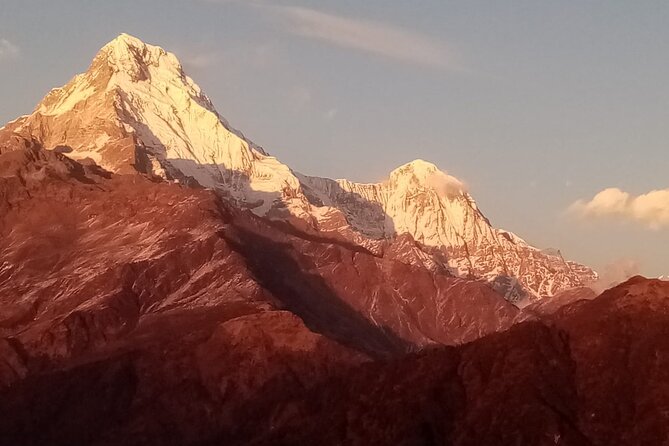
Sunrise comes early in the Himalayas. This private four-day trek from Pokhara combines the famous Poon Hill viewpoint with rhododendron forests, stone villages, teahouse stays, and close views of the Annapurna and Dhaulagiri ranges. I especially like the small private format, which lets your guide adjust the pace and explain local culture along the way. I also like the route through Ghandruk, a Gurung village known for its hospitality.
The main consideration is physical effort. This is a moderate trek with long walking days, steep stone steps, and an early morning climb to Poon Hill. The price of $240 per person includes permits, guide services, lodging, and transport listed in the program, but meals are extra and can add about $112 per person for four days.
In This Review
- Key points at a glance
- Why Poon Hill works well in four days
- Day 1: Pokhara to Tikhedhunga via Nayapul
- Day 2: Ulleri’s stone steps and the forest route to Ghorepani
- Day 3: Poon Hill sunrise, then the long descent to Ghandruk
- Day 4: Ghandruk to Nayapul and back to Pokhara
- The guides are a major part of the value
- What the $240 price really covers
- Who should book this trek?
- Booking, cancellation, and practical checks
- Should you book the Poon Hill trek?
- FAQ
- How long is the Poon Hill trek from Pokhara?
- Is the trek private?
- What fitness level is needed?
- Is the Poon Hill sunrise included?
- Where does the trek stay overnight?
- Are meals included in the $240 price?
- Is hotel pickup and drop-off included?
- Can I cancel for a full refund?
Key points at a glance
- Poon Hill sunrise: Reach the viewpoint before dawn for wide views of Annapurna and Dhaulagiri in changing morning light.
- Four days, three nights: The route runs from Nayapul through Tikhedhunga and Ghorepani, then to Ghandruk and back to Pokhara.
- Private guiding: Only your group takes part, with an English-speaking guide assigned by CAN Travels.
- Strong guide feedback: Guides including Milan Rai, Biru, Vikram, Amrit, and Bikram are praised for care, clear English, safety, and local explanations.
- Village-based trekking: Sleep in guesthouses and teahouses while passing through Gurung and Magar communities.
- Moderate fitness needed: Expect around six hours of walking on most trekking days, plus a two-hour sunrise outing on Day 3.
Why Poon Hill works well in four days
Poon Hill is one of Nepal’s most practical short treks. You get a genuine mountain route without committing to the longer schedules needed for high passes or remote base camps. The trail brings together many of the things people hope to see in the Annapurna region: snowy peaks, forest paths, terraced farmland, waterfalls, stone stairways, and small settlements.
The private arrangement matters here. A fixed group can be hard for a trek with early starts and changing energy levels. With only your own party, you can discuss the pace with your guide and ask for more explanation about the mountains, local customs, and wildlife. The guide is not just there to point out the route. The strongest feedback focuses on the guides’ kindness, patience, safety checks, and spoken English.
You should still read the word moderate carefully. This is not a casual walking holiday. Day 1 and Day 2 each involve about six hours on foot, Day 3 combines an early Poon Hill climb with another six-hour trek to Ghandruk, and Day 4 adds another downhill walking stretch before the return bus. The stone steps near Ulleri are particularly demanding.
More Ghorepani and Poon Hill Treks:
- Poon hill Trek 3 days
★ 5.0 · 176 reviews - Pokhara: 4-Day Ghorepani, Poonhill & Ghandruk Mountain Trek
★ 5.0 · 132 reviews - Ghorepani – Poon Hill Trek 3N-4D
★ 5.0 · 125 reviews
Day 1: Pokhara to Tikhedhunga via Nayapul
The first day begins with a shared public bus from Pokhara to Nayapul, a drive of roughly one to two hours. The route then starts on foot, passing through Birethanti and Hille before climbing toward Tikhedhunga.
This opening day gives you a gradual introduction to village life and the trail. Birethanti and Hille are part of the settled lower route, so you will see farmland, homes, and everyday movement rather than an isolated wilderness path. The walk takes about six hours, which makes the first day a real trek rather than a simple transfer followed by a short stroll.
Tikhedhunga is your first overnight stop. The accommodation is described as a guesthouse, with teahouse-style lodging used along the route. You should expect a simple base for the night, not a resort. The value is being close to the trail and sharing the same basic rhythm as other people walking through the villages.
There is one practical point to clarify before booking. The inclusions mention round-trip transfer by private car, while the day-by-day plan describes a shared public bus to Nayapul and a local bus back from Nayapul. Ask CAN Travels which transport applies to your departure. That small detail can affect comfort, timing, and the meaning of the advertised private transfer.
Day 2: Ulleri’s stone steps and the forest route to Ghorepani
Day 2 is likely to be the toughest sustained climb. From Tikhedhunga, you ascend the steep stone staircase toward Ulleri, then continue through rhododendron and oak forests to Ghorepani. The walking time is listed at about six hours.
The Ulleri section is famous for its steps, and the best approach is steady rather than fast. You do not need to race your guide or fellow walkers. Set a pace you can hold, take short pauses when needed, and keep some energy for the second half of the day.
After Ulleri, the forest changes the feel of the route. Rhododendron and oak provide shade, and the trees break up the climb with a more peaceful setting. In season, rhododendron flowers can add color to the path, though the exact display depends on the time of year. Waterfalls and mountain glimpses appear along the route, giving you good reasons to pause without treating every stop as a formal attraction.
Ghorepani is an important overnight stop because it positions you for the pre-dawn walk to Poon Hill. The village has broad mountain views, and the setting gives you a first strong sense of the surrounding ranges. It is also the point where the trek’s most famous moment becomes possible: getting to the viewpoint before sunrise.
Day 3: Poon Hill sunrise, then the long descent to Ghandruk
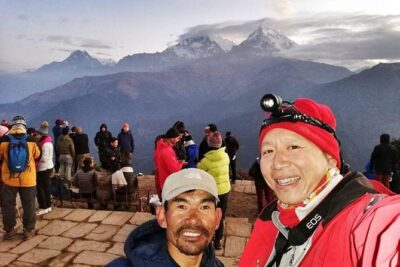
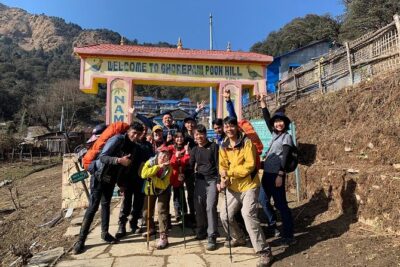
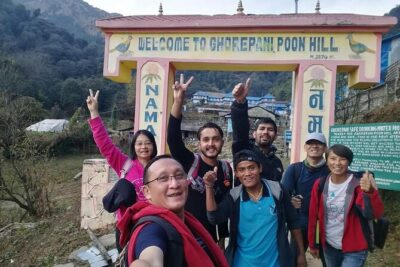
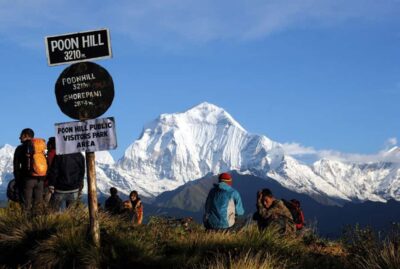
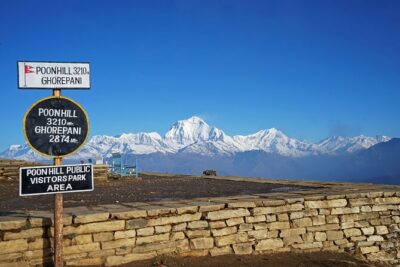
The third day starts very early. You hike from Ghorepani to Poon Hill View Point for sunrise, with the outing listed at about two hours. The timing is the whole point. You are walking in darkness or low light at first, then waiting as the sky changes over the Himalayas.
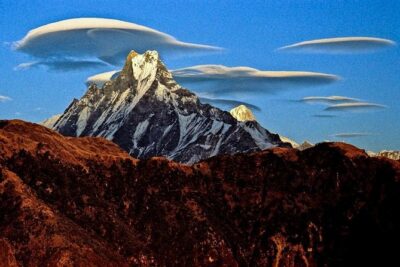
From Poon Hill, you can see the Annapurna and Dhaulagiri ranges. The description highlights Annapurna and Dhaulagiri in particular, while the Day 4 route also names Annapurna I, Annapurna South, Dhaulagiri, Machhapuchhre, and Himchuli among the mountains seen along the way. Clear conditions matter, so the view cannot be guaranteed, but this is the trek’s central reward.
The sunrise is not a quick photo stop. Give yourself time to watch the colors shift across the snow peaks. Dhaulagiri is singled out in the strongest praise for its sunrise appearance, so keep your attention beyond the nearest ridge. Your guide can help identify the mountains, which is useful when several white summits appear similar in the early light.
After returning to Ghorepani, you continue toward Ghandruk. This section takes about six hours and changes the character of the trek from uphill approach to a long descent through forest and village country. Downhill walking may sound easier, but stone steps can be hard on knees and thighs. Good footwear and controlled steps matter more here than speed.
Ghandruk is a Gurung village in Kaski District, known for its hospitality. You spend the night in a teahouse, making this a particularly good evening for local contact. The cultural side of the experience is not a staged performance. It comes through the village setting, the traditional guesthouse arrangement, and conversations your guide helps make easier.
This is also the longest and most demanding day in practical terms because it combines the early viewpoint hike with the main trek to Ghandruk. If you are concerned about stamina, ask the operator how the walking pace and rest stops are handled before you leave.
More Treks and Hikes:
- Trekking in Annapurna/Langtang/Everest/Upper Mustang regions
★ 5.0 · 161 reviews - Pokhara: Annapurna Foothills Day Hike with Transfers
★ 5.0 · 100 reviews - Kathmandu/Pokhara: 5-Day Annapurna Base Camp (ABC) Trek
★ 4.9 · 72 reviews - From Pokhara: 3-Day Ghorepani Poon Hill Trek with Guide
★ 4.9 · 68 reviews
Day 4: Ghandruk to Nayapul and back to Pokhara
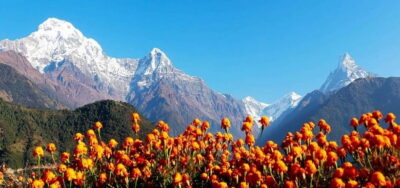
The final walking day descends from Ghandruk toward Nayapul. The route passes through rhododendron forest and offers farewell views of Annapurna I, Annapurna South, Dhaulagiri, Machhapuchhre, and Himchuli. The walking portion is listed at roughly six hours.
A downhill finish is welcome after the previous day, but it still requires care. The route is not described as a short village walk, so keep water and snacks accessible and avoid assuming the final day will feel effortless. Your guide can help set a comfortable pace, especially if your group includes people with different fitness levels.
At Nayapul, the program says you take a local bus back to Pokhara Lakeside. That ride takes about one and a half hours, after which you are dropped at your hotel. The contrast is part of the experience: forest trail and mountain villages give way to the traffic and activity of Pokhara.
The return transport is another detail worth confirming. The itinerary refers to a local bus, while the inclusions refer to private car transfers. The operator should explain whether private transport is used for some groups or under certain conditions.
The guides are a major part of the value
The strongest praise is directed at the guides rather than only at the scenery. Milan Rai is described as making the Poon Hill and Ghandruk circuit feel well arranged. Biru receives repeated praise for patience, care, safety, and explanations of the mountains and culture.
Vikram is noted for listening to what the participant wanted from the trek and for using older routes away from the most direct path. That suggests useful flexibility, but you should ask what route changes are possible and how they affect walking time. A quieter path can be appealing, yet a different route may also mean extra effort.
Amrit is praised for explaining the mountains, culture, and Nepal along the way. Bikram receives especially warm feedback for helping a solo participant feel comfortable and making the trek easier through a caring approach. These details matter because a guide can shape the whole mood of a four-day walk.
Guide quality is difficult to judge from a short description, but the repeated pattern is clear: English communication, kindness, local knowledge, and attention to safety are the most highly praised parts of the service. When you book, ask who is assigned to your group and tell the company what you want from the trek, such as photography, a slower pace, cultural explanation, or more direct walking.
What the $240 price really covers
At $240 per person, this is a useful package if you want the main practical pieces arranged for you. It includes an English-speaking trekking guide, trekking permit and TIMS card, accommodation, hotel pickup and drop-off, and the transport listed as part of the route. It is also a private trip, so your group does not share the guide’s attention with a large mixed party.
The price does not include meals. The stated estimate is about $28 per person per day, which brings the possible four-day meal cost to around $112 per person. That puts the likely total near $352 per person before any optional gratuity, assuming the daily meal estimate applies across all four days.
That total is easier to judge when you consider what you are buying. You are not only paying for a bed and a trail permit. You are paying to have the route organized from Pokhara, to have a guide with you through the mountain villages, and to avoid arranging each lodge and transfer separately. The package is less attractive if you already have a trusted guide, permits, and transport arranged.
Gratuity is optional. Carry some money for meals and any personal purchases, but the supplied information does not specify meal menus, lodge standards, or payment methods. Ask those questions before departure rather than assuming every cost is covered.
Who should book this trek?
I would recommend it to you if you want a short introduction to the Annapurna region and prefer a guide-led trip. It suits people who value mountain views, village stays, and cultural contact but do not have time for a longer Nepal trek.
It is also a good fit for solo participants who want the privacy of their own booking without walking entirely alone. The positive feedback about Bikram’s care during a solo trek is especially relevant here. Families or mixed-ability groups may also benefit from discussing pace and rest needs with a private guide.
You should think twice if you dislike early starts, long downhill walks, basic guesthouse accommodation, or uncertain mountain weather. The two-hour Poon Hill outing begins before sunrise, and the main walking days run around six hours. This is accessible compared with more demanding Himalayan routes, but it still asks for regular effort.
A moderate fitness level is required. Training with hills, stairs, or long walks before arrival will make Ulleri and the Ghandruk descent more enjoyable. Comfortable trekking shoes are a sensible choice, though the supplied information does not specify a required equipment list.
Booking, cancellation, and practical checks
Confirmation is provided at booking, and free cancellation is available if you cancel at least 24 hours before the experience start time. Cancellations made less than 24 hours in advance are not refunded, and changes inside that period are not accepted. The cut-off follows local time.
Before paying, I would ask CAN Travels three direct questions: Is the vehicle private or public on each transfer? Which guide is likely to lead the group? Are meals paid directly at the teahouses, and is the $28 daily estimate still current?
Those answers will remove the only real uncertainty in the package. The route itself is straightforward to understand, but the transport wording and meal arrangements deserve clarification.
Should you book the Poon Hill trek?
Book this trek if you want a well-supported four-day route with a famous sunrise, mountain villages, and a private English-speaking guide. The strongest value lies in the combination of permits, lodging, transport support, and guide care, not simply in the $240 headline price.
I would choose it for a first Himalayan trek, a solo visitor wanting support, or a small group that prefers a flexible pace. I would not choose it if you want a luxury lodge holiday or a completely low-effort mountain outing. Prepare for steep steps, an early morning climb, and two long trekking days, then add the meal budget to the advertised price.
FAQ
How long is the Poon Hill trek from Pokhara?
The experience lasts approximately four days. The itinerary includes three nights of trekking accommodation before returning to Pokhara on Day 4.
Is the trek private?
Yes. It is described as a private activity, and only your group participates.
What fitness level is needed?
A moderate physical fitness level is required. The itinerary lists about six hours of walking on Days 1, 2, 3, and 4, with an additional two-hour hike to Poon Hill on Day 3.
Is the Poon Hill sunrise included?
Yes. The early morning hike to Poon Hill View Point and the admission ticket are included in the program.
Where does the trek stay overnight?
The route includes guesthouse and teahouse accommodation. Overnight stops are listed at Tikhedhunga, Ghorepani, and Ghandruk.
Are meals included in the $240 price?
No. Meals are not included. They are available for purchase at an estimated cost of about $28 per person per day.
Is hotel pickup and drop-off included?
Yes. Hotel pickup and drop-off are included. The trip begins from Pokhara and ends with a return to your hotel in Pokhara.
Can I cancel for a full refund?
Yes, if you cancel at least 24 hours before the experience start time. Cancellations made less than 24 hours before the start time are not refunded.
More 4-Day Experiences
- Pokhara: 4-Day Mardi Himal Trek
★ 4.9 · 59 reviews - 4-Day Private Poon Hill Trekking Tour
★ 5.0 · 58 reviews - Pokhara: 4-Day Private Trek Tour
★ 4.9 · 43 reviews - From Pokhara: 4-Day Mardi Himal Base Camp Trek
★ 4.9 · 31 reviews
Just added around Pokhara
- Double Dare: Tandem Bungee Adventure★ 4.3 · 3 reviews
- Exhilarating Pokhara-Kathmandu Bus Journey Experience★ 3.5 · 3 reviews
- 3 Day Australian Camp Dhampus Ghandruk Easy Trek in Pokhara★ 3.5 · 3 reviews
- Paragliding in Pokhara★ 5.0 · 3 reviews
- Seti George and Thrilling Suspension Bridge Tour at Pokhara★ 4.5 · 3 reviews
- Overnight Dhampus Australian Camp Easy Hiking from Pokhara★ 5.0 · 3 reviews
- Full Day Entire Pokhara Tour by Car with Guide★ 4.5 · 3 reviews
- 5 Days Mardi Himal Trek.★ 5.0 · 3 reviews
Ghorepani Poon Hill Treks, compared.
4-Day Ghorepani, Poonhill & Ghandruk Mountain Trek
Read our review →
Browse the lists this tour appears in