
Reviewed · ANNAPURNA BASE CAMP TREKS
Private 7 – Day Annapurna Base Camp Trekking
Annapurna rewards steady feet. This private seven-day trek from Pokhara takes you through mountain villages, stone stairways, forests, and high Himalayan country before reaching Annapurna Base Camp. I like the private format, which lets your group set a sensible pace, and I like that guide, porter, meals, lodging, permits, transport, and safety support are bundled into the $625 price. The main consideration is the physical demand: one day lasts about eight hours, and the route includes long uphill sections and 2,500 stone steps.
You begin at 8:15 a.m. in Pokhara Lakeside and return there at the end. The trek uses tea houses rather than luxury hotels, so you should expect simple lodging and a close look at village life. Guides such as Sanjay, Amar, Laxman, Andrea, and Kumar have been praised for care and flexibility, but you still need travel insurance and a moderate level of fitness.
In This Review
- Key points to know before you book
- Why this private ABC trek works well
- Starting from Pokhara Lakeside
- Day two: 2,500 steps and the trail to Bamboo
- Day three: Bamboo, Dovan, and the Weeping Wall
- Day four: the final push to Annapurna Base Camp
- Day five: time at base camp and a long return
- Day six: Chhomrong and the Jhinu Danda hot spring
- Day seven: back to Pokhara by jeep
- What the $625 price really covers
- How the private service affects your days
- Food, lodging, and what to pack
- Fitness, weather, and insurance
- Who should book this trek?
- Should you book the Annapurna Base Camp trek?
- FAQ
- Where does the trek start and finish?
- Is this a private trek?
- Are a guide and porter included?
- Are meals included?
- Is accommodation included?
- Are permits and transport included?
- Do I need travel insurance?
Key points to know before you book
- Private group of your own: You trek with your party rather than joining a large shared group, with room to discuss pace and itinerary changes.
- Seven days from Pokhara and back: The trip starts and ends at Lakeside, with overland transport included where stated in the plan.
- Tea house stays and trail meals: Seven breakfasts, six lunches, six dinners, and lodge accommodation are included during the trek.
- Annapurna Base Camp is the main prize: Day four reaches the base camp area, while day five allows time for mountain views before the return.
- A demanding stairway route: Expect a 2,500-step descent on day two, followed by a climb to Sinuwa and Bamboo.
- Useful support is included: A registered guide, porters, permits, trekking map, oxygen saturation checks, water purification, duffle bag, and emergency rescue assistance are part of the package.
Why this private ABC trek works well
This trip is a good fit if you want the Annapurna Base Camp route without arranging each piece yourself. The organizer handles a government-registered guide, porters, permits, lodging, meals, and transport. That matters in Nepal, where a well-timed meal, a suitable tea house, and a guide who knows the trail can make a long walking day much easier.
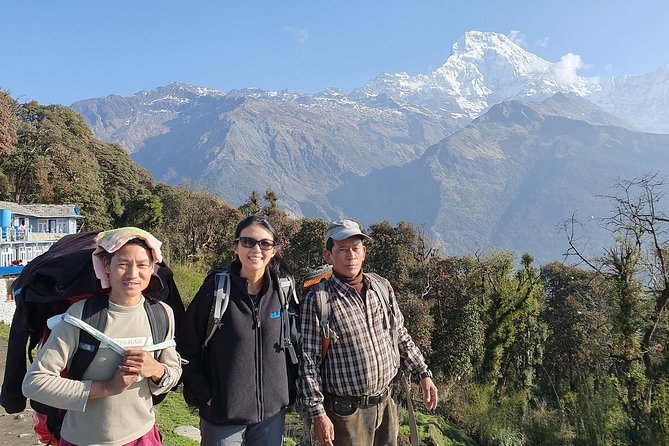
I especially like the private setup. You are not tied to the speed or habits of a large group. If you need a slower morning, a shorter walking break, or a small adjustment, the guide can discuss it with you. Several people who used the service describe the team as willing to change plans and adapt to personal needs. Amar, Laxman, Ram, Andrea, Sanjay, and others are named for their support, while Tej is repeatedly connected with trip planning and management.
The trade-off is that a private trek does not turn a Himalayan route into an easy walk. The itinerary includes steep steps, repeated climbs, and long days. The eight-hour return section on day five is especially important to understand. You should be comfortable walking for several hours on uneven ground and managing a moderate physical workload.
More Annapurna Base Camp Treks:
- Kathmandu/Pokhara: 5-Day Annapurna Base Camp (ABC) Trek
★ 4.9 · 72 reviews - Annapurna Base Camp Trek (8 days)
★ 5.0 · 45 reviews - From Pokhara: 5-Day Annapurna Basecamp Trek with Hot Springs
★ 4.9 · 26 reviews
Starting from Pokhara Lakeside
The meeting point is on Lakeside Road in Pokhara, and the stated start time is 8:15 a.m. Pickup is offered, but you should confirm the exact pickup arrangement when booking. The activity ends back at the same general meeting point in Pokhara.
The first day is described as a three-hour journey toward Chhomrong. The plan begins with breakfast overlooking Annapurna I at 8,091 meters and Machhapuchhre at 6,997 meters, followed by a private jeep ride of about two and a half hours. That opening view gives you an immediate sense of the scale ahead: these are not distant decorative peaks, but huge mountain walls rising above the route.
The day is short by trekking standards, at about three hours in total. That is useful because it gives you time to settle into the group, meet the guide and porter, organize your duffle bag, and adjust to the rhythm of the trail. The exact opening transport details are worth confirming, since the itinerary begins at Chhomrong while the meeting point is in Pokhara.
Day two: 2,500 steps and the trail to Bamboo
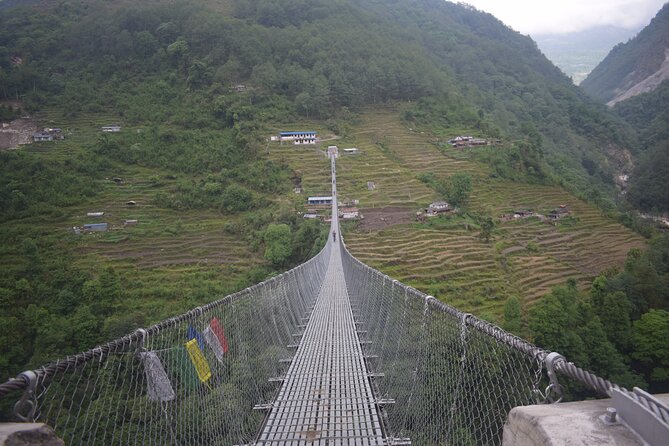
Day two brings the first clear reminder that this is a real trek. You descend 2,500 stone steps and cross a bridge above the Chhomrong Khola before climbing toward Sinuwa. After lunch at Sinuwa, you continue to Bamboo for the overnight stay.
This is a six-hour day, but the step count tells you more than the clock. Descending can be hard on knees, and the following climb asks for fresh energy when your legs have already worked. Use trekking poles if you normally find them helpful, and keep your pace controlled rather than trying to race the group.
Sinuwa provides a practical break in the day. Bamboo then brings you into the forested portion of the route, with a simple tea house stay and a chance to rest. Meals are included, but lodge accommodation on this route is basic. Think of it as a clean place to sleep and eat, not a hotel with broad services.
Day three: Bamboo, Dovan, and the Weeping Wall
After breakfast at Bamboo, the path climbs toward the Himalaya Hotel area. The route passes Dovan, then continues beside the feature known as the Weeping Wall before reaching a local shrine and Himalaya.
The walk takes about five hours. This is a more focused mountain day, with fewer road connections and more continuous trail walking. Forest, river sounds, stone paths, and changing views replace the comfort of the road. The shrine adds a small human detail to a route that can otherwise feel physically intense.
The Weeping Wall is one of the day’s memorable trail features. The name points to water running down the rock face, though the exact appearance can change with conditions. You should pay attention to footing here and keep clothing or rain protection accessible. Mountain weather can shift, and the itinerary itself warns that good weather is required for the experience to operate.
More Treks and Hikes:
- Poon hill Trek 3 days
★ 5.0 · 176 reviews - Trekking in Annapurna/Langtang/Everest/Upper Mustang regions
★ 5.0 · 161 reviews - Pokhara: 4-Day Ghorepani, Poonhill & Ghandruk Mountain Trek
★ 5.0 · 132 reviews - Ghorepani – Poon Hill Trek 3N-4D
★ 5.0 · 125 reviews
Day four: the final push to Annapurna Base Camp
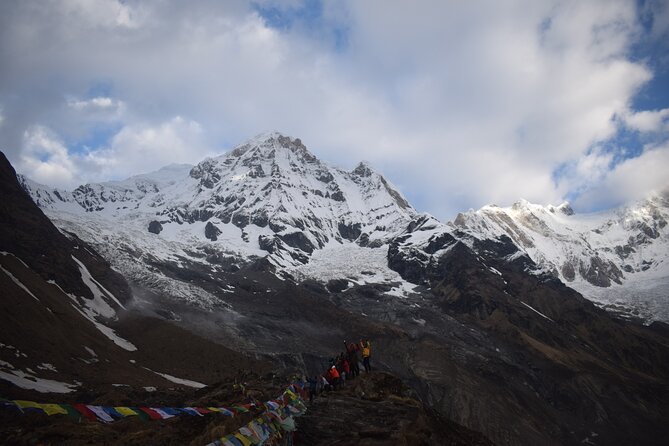
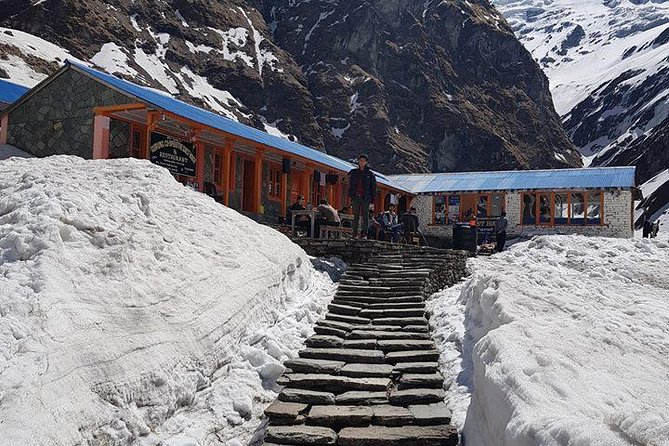
Day four is the approach to Annapurna Base Camp. From Deurali, the trail climbs beside the Modi River and passes through alpine forest. You also see decorated stacks of rocks, an icy cave, and the route into the mountain basin before reaching the base camp area.
This section takes around five hours, but it may feel harder than the time suggests. The trail is climbing steadily, and the surroundings become more exposed and dramatic as you move away from the lower forest. The organized support becomes valuable here: your guide can watch the group’s condition, while porters carry the main load.
The inclusion of oxygen saturation checks is a useful practical feature. It does not replace medical care, and it does not guarantee that altitude problems will not occur, but it gives the guide another way to monitor how you are doing. Emergency rescue assistance is also included, though your own travel insurance remains essential.
The base camp arrival is the emotional high point of the trip. You have moved from villages and dense forest into a high Himalayan setting, with snow-covered summits and the Annapurna massif around you. The mountain names and elevations used in the plan, Annapurna I at 8,091 meters and Machhapuchhre at 6,997 meters, help explain why the views feel so immense.
Day five: time at base camp and a long return
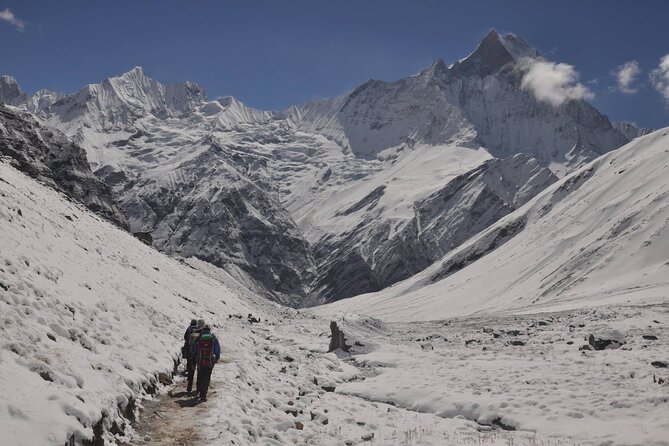
The fifth day begins with time to explore Annapurna Base Camp. The plan allows for panoramic views around the mountain basin, including a 360-degree sweep of the surrounding peaks. This is the day to take photographs, look closely at the rock and snow formations, and enjoy the reward before turning back.
At about eight hours, it is also the longest walking day. The return is not an afterthought. Once you have seen the base camp, you still need to retrace a substantial portion of the route toward the lower tea houses, with the itinerary indicating that you leave from the Bamboo area on the following morning.
I recommend treating this as two different days in your head: a sightseeing morning and a serious descent afterward. Keep water purification supplies handy, pack snacks if you prefer to eat between meals, and do not spend all your energy rushing around the base camp. The scenery is best enjoyed when you are not counting every remaining step.
Day six: Chhomrong and the Jhinu Danda hot spring
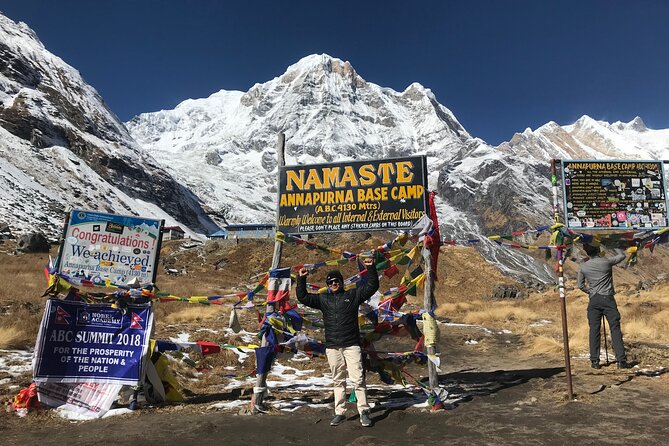
Day six follows the return route from Bamboo through thick bamboo forest. You walk along a narrow ridge toward Sinuwa, then descend toward the Chhomrong River before continuing toward Jhinu Danda.
The walk is listed at about six hours. After the high country, the return to forest and village paths can feel like a change of world. The plan identifies Jhinu Danda hot spring as the day’s stop, giving you a chance to connect the trek with one of the region’s better-known rest points.
The wording of the day’s route is worth checking with your guide before departure, especially regarding the exact overnight location and hot spring timing. The itinerary summary is brief, but the basic pattern is clear: leave Bamboo, pass Sinuwa and Chhomrong River, and return toward the lower villages.
Day seven: back to Pokhara by jeep
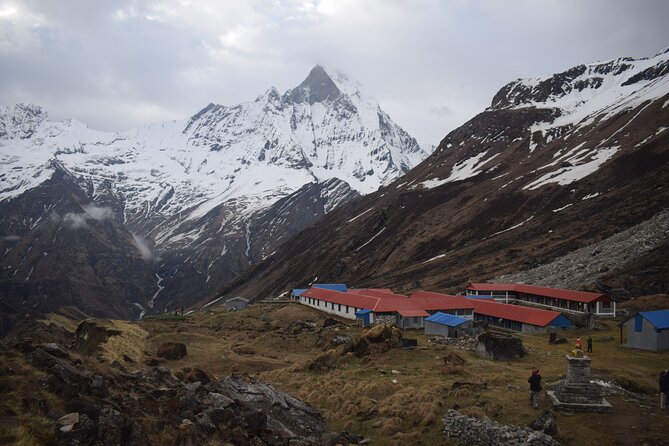
Your final morning begins with breakfast and another mountain view, including Annapurna I and Machhapuchhre. After a short walk to Samrung, you board a private jeep for the drive back toward Pokhara along the Baglung route.
The return section is listed at about three hours. Private road transport is a welcome finish after several days on foot. It means you do not have to arrange your own ride from the trail end, and you can reach Pokhara with the group still together.
Road conditions and travel times in the mountains can vary, so keep your schedule flexible after arrival. The activity officially ends back at the Pokhara meeting point, but you should avoid booking a tight onward connection immediately afterward.
What the $625 price really covers
At $625 per person, this is not simply a walking tour. The price includes the registered guide and porters, their expenses, tea house accommodation, required conservation and trekking permits, stated overland transport, and meals during the trek.
You also receive a trekking map, oxygen saturation monitoring, water purification, a duffle bag, emergency rescue assistance, government tax, service charges, and public liability insurance. The meal allowance is seven breakfasts, six lunches, and six dinners. That covers the seven-day trekking schedule as presented.
The value is strongest if you would otherwise need to arrange permits, a guide, porters, lodging, meals, and transport separately. It also gives you one point of contact if plans change. Several people using this service had custom timing or route requests, including a six-day plan adjusted into a private package.
There are clear exclusions. Hotel stays in Kathmandu and Pokhara are not included. Travel insurance is not included, and tips for the guide and porter are separate. You should budget for those items rather than treating the advertised price as the full cost of a Nepal holiday.
How the private service affects your days
A private group is most useful when the people in your party have similar fitness levels and expectations. You can talk with the guide about walking speed, rest stops, and minor changes without waiting for a larger group to agree.
The personal care described by past customers is one of the strongest reasons to consider this operator. Guides including Sanjay, Amar, Laxman, Ram, Andrea, Kumar, and Min are associated with patient support, route knowledge, and help during difficult sections. One person particularly praised the comfort of feeling supported like a friend, while another appreciated the team’s assistance even after the trek had finished.
Still, the exact guide and porter assigned to you may differ. Treat the named guides as examples of the team’s service, not a promise that one particular person will lead your trek. Ask who is assigned before departure if that matters to you.
Food, lodging, and what to pack
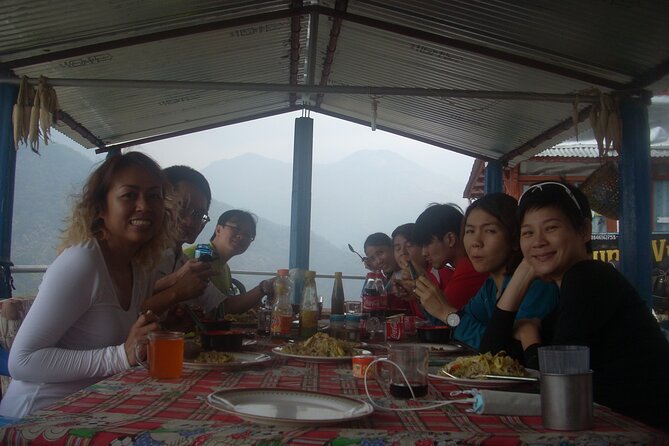
Tea houses keep the route possible without carrying camping equipment, but they also set a simple standard. You will sleep in lodges along the trail and eat the included breakfasts, lunches, and dinners. The plan does not specify menus, room arrangements, or bathroom facilities, so ask the operator if you have firm requirements.
The provided duffle bag can make packing easier. Water purification is also included, which reduces the need to rely on single-use bottles. A trekking map and basic safety monitoring add practical value without changing the simple nature of the trip.
Bring clothing that can handle changing conditions, sturdy walking shoes, rain protection, personal medication, and a headlamp. Those packing suggestions are common sense for a seven-day mountain trek, but the supplied details do not specify a formal equipment list, so confirm what the duffle bag and operator-provided items contain.
Fitness, weather, and insurance
The official fitness requirement is moderate, but the route deserves an honest reading. The 2,500-step section, repeated uphill stretches, a five-hour climb to base camp, and an eight-hour day on the return make this unsuitable for anyone expecting gentle sightseeing.
You do not need to be an elite athlete based on the information provided, but you should be able to walk for several hours and cope with uneven trails. Training with stairs and sustained uphill walking will help. Build your confidence gradually rather than relying on one long walk before departure.
Travel insurance is required advice for good reason. The package includes assistance for emergency rescue evacuation and public liability insurance, but it does not replace your own travel policy. Check that your insurance covers trekking and emergency evacuation before you leave home.
The experience also depends on good weather. If poor weather causes cancellation, you are offered another date or a full refund. If you cancel yourself, free cancellation applies when you cancel at least 24 hours before the 8:15 a.m. start time. Changes made inside that period are not accepted.
Who should book this trek?
I would choose this trek if you want a focused Annapurna Base Camp experience, have seven days available, and prefer a private guide-and-porter arrangement. It suits couples, friends, and small family groups that value flexibility over a fixed large-group schedule.
It is also a good choice if you want the practical pieces handled for you. The price includes enough of the core trekking costs to make budgeting straightforward, while the private format lets you communicate your needs directly.
I would look elsewhere if you want luxury lodging, a relaxed walking schedule, or a detailed hotel package in Pokhara and Kathmandu. I would also ask more questions before booking if anyone in your group has limited mobility, since the route includes steep stairs and long trail days.
Should you book the Annapurna Base Camp trek?
Book it if the idea of reaching Annapurna Base Camp matters more to you than comfort, and if you want a private team to handle the hard logistics. The strongest advantages are the included guide and porters, meals and tea houses, permits, transport, safety support, and repeated praise for flexible, caring service.
Before paying, confirm the assigned guide, porter arrangements, exact first-day transport from Pokhara, day-five overnight location, and what is supplied in the duffle bag. If those details match your needs, $625 offers solid value for a private seven-day Himalayan trek. Go prepared for stairs, long descents, simple lodges, and weather changes, and you will be giving yourself the best chance of enjoying the mountains rather than merely enduring them.
FAQ
Where does the trek start and finish?
It starts at 8:15 a.m. from Pokhara Lakeside, at Lakeside Road in Pokhara. The activity ends back at the meeting point in Pokhara.
Is this a private trek?
Yes. Only your group participates, so you do not join a large shared tour.
Are a guide and porter included?
Yes. The package includes one government-registered trekking guide and porters, along with their expenses.
Are meals included?
Yes. The package includes seven breakfasts, six lunches, and six dinners during the trek.
Is accommodation included?
Yes. Lodge accommodation along the trekking route is included. Hotels in Kathmandu and Pokhara are not included.
Are permits and transport included?
The package includes ACAP and necessary permits, plus overland transportation as described in the itinerary.
Do I need travel insurance?
Yes. Travel insurance is not included, and you are advised to obtain it before departure. Emergency rescue assistance is included, but it does not replace your own insurance policy.
Just added around Pokhara
- Double Dare: Tandem Bungee Adventure★ 4.3 · 3 reviews
- Exhilarating Pokhara-Kathmandu Bus Journey Experience★ 3.5 · 3 reviews
- 3 Day Australian Camp Dhampus Ghandruk Easy Trek in Pokhara★ 3.5 · 3 reviews
- Paragliding in Pokhara★ 5.0 · 3 reviews
- Seti George and Thrilling Suspension Bridge Tour at Pokhara★ 4.5 · 3 reviews
- Overnight Dhampus Australian Camp Easy Hiking from Pokhara★ 5.0 · 3 reviews
- Full Day Entire Pokhara Tour by Car with Guide★ 4.5 · 3 reviews
- 5 Days Mardi Himal Trek.★ 5.0 · 3 reviews
Annapurna Base Camp Treks, compared.



Kathmandu to Annapurna Base Camp (ABC) 5-Day Trek
Read our review →

Browse the lists this tour appears in