
Reviewed · ANNAPURNA BASE CAMP TREKS
Annapurna Base Camp Trek
The mountains begin long before base camp. This 11-day Annapurna trek pairs Poon Hill sunrise views with a full walk to Annapurna Base Camp, while airport transfers, lodging, permits, and guide support are arranged for you. I like the small maximum group of 10 and the inclusion of Kathmandu and Pokhara transport. I also like that a sleeping bag, down jacket, and trekking map can be provided when needed. The main drawback is the physical demand: steep stone steps, long walking days, and one lengthy bus journey require real stamina.
You will pass through Gurung villages, rhododendron forests, river valleys, and high mountain country before reaching the sanctuary. Guide Indra has earned praise for careful attention to routes, weather, and changing trail conditions, a useful quality when the path gets steep or the altitude begins to bite. Drinks, desserts, porter service, insurance, tips, and personal expenses are extra, so the advertised price is not the final cost for everyone.
In This Review
- Key points at a glance
- What the $785.72 price really covers
- Kathmandu airport to Pokhara by river country
- Nayapul and the first village trail
- Ulleri, Banthanti, and the stone steps
- Poon Hill sunrise at 3,232 meters
- Ghorepani to the rhododendron forests
- Chhomrong and the climb into the sanctuary
- Bamboo, Dovan, and Annapurna Base Camp
- The return through Bamboo and Birethanti
- The hot spring and the human side of the trek
- Accommodation, equipment, and group size
- Who should book this Annapurna trek?
- Should you book it?
- FAQ
- How long is the Annapurna Base Camp trek?
- What is the tour price?
- How many people can join the group?
- Where does the experience begin?
- Is airport pickup included?
- Is transport between Kathmandu and Pokhara included?
- What equipment is provided?
- Is a porter included?
Key points at a glance
- Poon Hill at 3,232 meters: An early climb rewards you with sunrise views of Dhaulagiri, Tukuche Peak, Nilgiri, Annapurna I, and Annapurna South.
- Annapurna Base Camp included: The trek reaches the base camp and returns through the Annapurna Sanctuary, not just the lower foothills.
- Small-group format: The maximum group size is 10, giving you a more personal walking experience than a large trekking convoy.
- Useful equipment supplied: A sleeping bag, down jacket, and trekking map are available when necessary and returned after the trek.
- Kathmandu and Pokhara transfers covered: Tourist bus transport connects the two cities, with airport pickup and drop-off included.
- Natural hot spring stop: The route includes time for a soak in a natural hot spring, a welcome treat after several demanding days.
What the $785.72 price really covers
At $785.72 per person, this trek offers good value if you use the included services. The price covers 10 nights of accommodation, a guide, transport between Kathmandu and Pokhara by tourist bus, conservation permits, TIMS registration, taxes, and the guide’s salary, food, drinks, accommodation, insurance, and transport.
Meals are also built into the package. The published inclusions list breakfast, lunch, and dinner across the trek, with 10 breakfasts, 9 lunches, and 8 dinners specified. You should still budget for alcoholic drinks, soft drinks, desserts, and other food or drink not covered by the package.
The largest possible extra is a porter, listed at $20 per day. Travel insurance is compulsory and is not included. You will also need to pay for your Nepal entry visa, tips for the guide and driver, international flights, and personal costs.
I see the value here in the organization. You are not separately arranging permits, city transfers, mountain lodging, or basic trekking equipment. The price makes more sense for someone who wants a guided package rather than the lowest possible independent trekking cost.
More Annapurna Base Camp Treks:
- Annapurna base camp trek 5 Days
★ 5.0 · 252 reviews - Annapurna Base Camp Trek
★ 5.0 · 111 reviews - Kathmandu to Annapurna Base Camp (ABC) 5-Day Trek
★ 5.0 · 102 reviews
Kathmandu airport to Pokhara by river country
The trip begins at Tribhuvan International Airport in Kathmandu, with a stated meeting time of 7:15 am. Airport pickup and drop-off are included, which removes one of the more awkward tasks after a long international flight.
The first major transfer takes about seven hours by tourist bus. The road follows the Trisuli and Marsyangdi rivers, with views of rural settlements, river scenery, and mountain peaks including Ganesh Himal and Manaslu. The rivers are also used for rafting, so this is more than a dull transfer between two cities.
Still, you should set your expectations correctly. A seven-hour mountain road journey is part of the adventure, but it can be tiring. This day is mainly about reaching Pokhara and positioning you for the trek, not about walking. The payoff is a night in Pokhara before the trail begins.
The return to Kathmandu on Day 11 follows the same general pattern. The bus leaves at 7 am after breakfast and passes satellite towns, rural communities, and fast-moving rivers. Keep that early start in mind when planning your onward flight or extra time in Kathmandu.
Nayapul and the first village trail
After breakfast in Pokhara, you drive roughly 90 minutes to Nayapul. From there, the walking begins, passing through Birethanti at about 1,065 meters before continuing to Tikhedunga at 1,577 meters.
This opening section gives you a gentle introduction to village life and the lower Annapurna foothills. The trail is scenic without immediately pushing you into high altitude. You will have time to settle into your boots, learn your walking pace, and see how the group moves together.
The first day of walking takes about four hours. That sounds manageable, but you should not use it as proof that every day will be easy. The trail becomes much steeper soon after, and the following stages demand more effort.
Ulleri, Banthanti, and the stone steps
Day 3 is one of the more demanding early sections. The route climbs steeply for roughly two hours, then continues upward at a gentler angle through Ulleri at about 2,070 meters and on toward Banthanti. The full walking day is listed at around six hours.
This is where the trek begins to feel serious. Stone steps and sustained climbing test your legs, especially if you are carrying your own pack. If you hire a porter, the $20 daily fee may be well spent for this reason.
The reward is changing scenery and broad mountain views. The forest and village setting begin to give way to more open mountain country, and you gain height quickly. Take this day slowly. The goal is not to race the guide or the strongest member of the group.
More Treks and Hikes:
- Everest Base Camp Trek – 14 Days
★ 5.0 · 1,499 reviews - Everest Base Camp Trekking
★ 5.0 · 485 reviews - Nagarkot Sunrise View and Day Hiking from Kathmandu
★ 5.0 · 471 reviews - Annapurna Circuit Trek with Tilicho Lake
★ 5.0 · 368 reviews
Poon Hill sunrise at 3,232 meters
The early climb to Poon Hill is the trip’s great visual prize. At 3,232 meters, the viewpoint looks toward Dhaulagiri at 8,167 meters, Tukuche Peak at 6,920 meters, Nilgiri at 6,940 meters, Varaha Shikhar at 7,847 meters, Annapurna I at 8,091 meters, and Annapurna South at 7,219 meters.
The sunrise timing means an early start, but the view justifies the lost sleep. This is one of those moments when the effort of the previous day becomes clear. You are not simply walking through forest trails. You are watching light move across some of the world’s highest peaks.
Poon Hill is also a useful checkpoint. You reach a high viewpoint before entering the more remote section of the trek, giving you an impressive reward early in the journey. The day is about six hours of walking, though the pre-sunrise start may make it feel longer.
Bring warm layers. The supplied down jacket can help if you need it, and the sleeping bag is practical for mountain nights. The equipment is loaned for the trek and returned afterward.
Ghorepani to the rhododendron forests
After Poon Hill, the route descends through dense rhododendron and oak forest. The walk takes about five hours and includes the sounds of birds, changing vegetation, and a quieter trail feel than the open viewpoint above.
Ghorepani is an important transition point. You have completed the Poon Hill section, but the main push toward Annapurna Base Camp is still ahead. The descent may feel easier than climbing, though long downhill sections can be hard on knees and ankles.
Good footwear matters here. The route description includes forest trails, stairs, bridges, and steep sections, so sandals or smooth-soled shoes would be a poor choice. You should also keep rain protection accessible, since forest conditions can change quickly even when the morning begins clear.
Chhomrong and the climb into the sanctuary
The next stage descends on stone steps for about an hour and a half, crosses the Chhomrong Khola on a suspension bridge, and then climbs out of the side valley. The walking day is listed at around seven hours, making it one of the longer sections.
Chhomrong is a key point in the route. From here, the valley widens, the trail becomes more focused on the high sanctuary, and the surrounding peaks feel closer. The route is not a straight uphill march. You will often lose height before gaining it again, which can be frustrating if you are watching your elevation.
This is a good place to pay attention to your body. The tour requires moderate physical fitness, but that phrase should not be treated lightly. Seven hours of walking, repeated climbs, and altitude make this much more than a casual scenic walk.
Bamboo, Dovan, and Annapurna Base Camp
As you continue upward, the trail enters the Annapurna Sanctuary. It crosses avalanche-prone sections and moves through changing forest toward the higher valley. Bamboo, Dovan, and the surrounding mountain settlements mark the route into more exposed country.
The day from Chhomrong toward the sanctuary takes about six hours. You will see the valley widen and the trail pass through forest before the views open more fully. The route has a strong sense of progression: villages give way to woodland, woodland gives way to high valley, and the peaks begin to dominate your view.
The following day is the high point of the trek. After breakfast, you visit Annapurna Base Camp and take time for the mountain views before walking back toward Dovan. The base camp section is listed at about six hours, but the return means you should prepare for a full day on your feet.
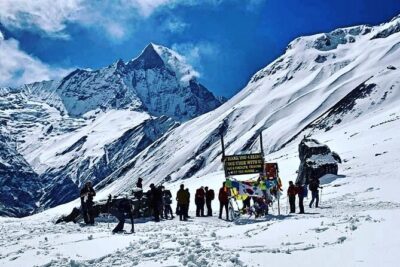
Reaching base camp is not only about the destination. It is the result of several days of repeated ascent, descent, bridges, stairs, and changing weather. The views from the base camp are the central reward, but the route through the sanctuary is what gives the achievement its weight.
The return through Bamboo and Birethanti
After the base camp visit, the trail descends through forests containing rhododendron, oak, and bamboo. The route reaches Bamboo, then includes a steep uphill section of about an hour before continuing through the lower valley.
That uphill section can catch you off guard. You may expect every part of the return to be downhill, but Himalayan trails rarely follow such a tidy plan. Allow extra time, drink regularly, and keep your pace controlled.
The final walking day descends toward Birethanti. The route eventually becomes flatter, and you stop at Birethanti for lunch before walking roughly 30 minutes to Nayapul. From there, transport returns you to Pokhara.
The return is satisfying but not effortless. Descending stairs and uneven paths after the base camp day can leave your legs tired. This is another reason the 11-day schedule has value. It gives the trek enough time to include Poon Hill, base camp, and the return without forcing the entire route into a shorter, harsher schedule.
The hot spring and the human side of the trek
A natural hot spring is included among the experience highlights. After several days of walking, a warm soak can be one of the trip’s simplest pleasures. It also adds variety to a route that might otherwise be measured only by altitude and walking hours.
The cultural side is just as important. The trail passes through Gurung villages, where the setting is shaped by mountain farming, guesthouses, bridges, and local paths rather than big sightseeing facilities. You get a closer look at daily life in the foothills while still having the security of a guide and organized lodging.
The guide makes a practical difference here. Indra has been praised for paying close attention to routes, terrain, and weather conditions. Those qualities matter more than a polished speech when you are choosing between a safer pace and a rushed one, or when trail conditions change.
Accommodation, equipment, and group size
Ten nights of accommodation are included, along with meals listed throughout the walking portion. The package also covers a sleeping bag, down jacket, and trekking map when needed. These inclusions reduce the amount of specialized equipment you need to buy for one trek.
The group maximum is 10 people. That is small enough for the guide to monitor the group more closely, while still offering the social side of a shared trek. You should remember that a small group does not mean a private trek. Walking speeds and fitness levels can still vary.
Porters are not included. If you want porter support, budget $20 per day. You should also confirm how much of your personal luggage you plan to carry, since the physical load can change the feel of every climb.
Who should book this Annapurna trek?
I would recommend this experience to you if you want a guided, organized route to Annapurna Base Camp and prefer having permits, lodging, transport, and basic equipment handled in one package. It suits people with moderate fitness who are comfortable walking for four to seven hours a day over steep and uneven ground.
It is also a strong choice if Poon Hill matters to you. Some base camp treks focus only on reaching the sanctuary, while this route adds an early sunrise viewpoint and the villages and forests around Ghorepani.
I would think twice if you dislike long bus rides, early starts, shared accommodation, or repeated stair climbs. You should also arrange suitable travel insurance before departure, since it is compulsory and excluded from the price.
Booking is confirmed within 48 hours, subject to availability. The cancellation terms are simple: cancel at least three full days before the local start time for a full refund. Cancellations or changes made later are not accepted.
Should you book it?
Book this trek if you want a solid all-in-one introduction to the Annapurna region, with both Poon Hill and Annapurna Base Camp on the same 11-day plan. The $785.72 price is fair for the permits, guide, city transfers, 10 nights of accommodation, meals, and loaned equipment, though you must add insurance, tips, drinks, personal costs, and possibly a porter.
The strongest reason to choose it is the balance of scenery and support. You get major mountain views, Gurung villages, forest trails, a hot spring, Pokhara, and Kathmandu without managing every detail yourself. Just arrive ready for steep steps, long walking days, and a bus ride that is scenic but not short.
FAQ
How long is the Annapurna Base Camp trek?
The experience lasts approximately 11 days, including the journeys between Kathmandu and Pokhara and the walking route to Annapurna Base Camp.
What is the tour price?
The listed price is $785.72 per person.
How many people can join the group?
The maximum group size is 10 people.
Where does the experience begin?
The stated starting point is Tribhuvan International Airport in Kathmandu, Nepal, at 7:15 am.
Is airport pickup included?
Yes. Airport pickup and drop-off are included.
Is transport between Kathmandu and Pokhara included?
Yes. Tourist bus transport from Kathmandu to Pokhara and back to Kathmandu is included.
What equipment is provided?
A sleeping bag, down jacket, and trekking map are provided when necessary. These items are returned after the trek.
Is a porter included?
No. A porter is optional and listed at $20 per day.
Just added around Kathmandu
- Nagarkot Sunrise With 7 UNESCO World Heritage Private Tour★ 5.0 · 3 reviews
- Private Shopping Tour in Kathmandu★ 5.0 · 3 reviews
- Kathmandu: Nightlife and Pub Crawl Tour★ 5.0 · 3 reviews
- Mount Everest Scenic Flight 50 Minutes★ 5.0 · 3 reviews
- Kathmandu: Nagarkot, Bhaktapur, Doleswor & Sanga Statue Tour★ 5.0 · 3 reviews
- Momo Cooking Class -The Art Of Making MoMo with Home Chef★ 5.0 · 3 reviews
- Kathmandu: Momo Making Class with a Local Chef★ 5.0 · 3 reviews
- Makalu Base Camp Trek★ 5.0 · 3 reviews
Annapurna Base Camp Treks, compared.



Kathmandu to Annapurna Base Camp (ABC) 5-Day Trek
Read our review →

11-Day Hike Tour to Annapurna Base Camp Bliss in Kathmandu
Read our review →Browse the lists this tour appears in