
Reviewed · KATHMANDU UNESCO HERITAGE TOURS
Private Kathmandu UNESCO Heritage Sites with Narayanhiti Museum
Six major sights, one full day. This private Kathmandu tour makes the valley easier to handle by pairing a dedicated taxi with an English-speaking guide, covering five major heritage sites and Narayanhiti Palace Museum in about seven to eight hours. I like the private transport and the chance to visit both Buddhist and Hindu landmarks in one day. I also like that the route includes the palace museum, which gives the city’s religious monuments a more recent political chapter.
The main catch is that entrance fees and lunch are extra, so the $75 price is not the final cost. The schedule is also full. You will get a strong first look at Kathmandu, but each stop receives roughly one hour, with only Patan Durbar Square getting 90 minutes.
In This Review
- Key points to know before booking
- Why this private Kathmandu day works
- Swayambhunath, the hilltop Buddhist stupa
- Pashupatinath and the heart of Hindu devotion
- Bouddhanath, the great Tibetan Buddhist center
- Patan Durbar Square and 90 minutes of old Lalitpur
- Kathmandu Durbar Square in the old city
- Narayanhiti Palace Museum, a change of pace
- What the guide and driver add
- Is $75 a fair price?
- Timing, pace, and practical planning
- Who should book this tour?
- Should you book it?
- FAQ
- How long does the Kathmandu heritage tour last?
- How much does the tour cost?
- Is hotel pickup available?
- Is this a private tour?
- Which sites are included in the route?
- Are entrance fees included?
- Is lunch included?
- Is a guide included?
- What is the cancellation policy?
Key points to know before booking
- Five major heritage sites plus a royal palace museum: You visit Swayambhunath, Pashupatinath, Bouddhanath, Patan Durbar Square, Kathmandu Durbar Square, and Narayanhiti Palace Museum.
- A private taxi keeps the day flexible: Only your group takes part, with pickup offered and a driver assigned to your party.
- The guide matters here: An English-speaking licensed guide is included, and Dipendra received especially warm praise for clear explanations and patience.
- Expect extra costs at every main sight: Admission tickets, lunch, alcoholic drinks, and cold drinks are not included.
- Seven to eight hours is a useful but busy window: The plan works well for a free day in Kathmandu, though it leaves little room for slow wandering.
- The best value is cultural range: You move from Buddhist stupas to Hindu temples, royal squares, and a modern palace museum without arranging separate rides.
Why this private Kathmandu day works
Kathmandu sightseeing can be awkward to organize by taxi. The sights sit in different parts of the valley, traffic can be slow, and some old-city streets are narrow. This experience solves the basic transport problem while giving you a guide to explain what you are seeing.
I especially like the balance of sacred and civic places. Swayambhunath and Bouddhanath show the importance of Buddhism in the valley. Pashupatinath gives you one of South Asia’s major Hindu pilgrimage sites. Patan and Kathmandu Durbar Squares add architecture, courtyards, temples, and royal history. Narayanhiti then shifts the story toward Nepal’s more recent monarchy.
The tour is private, not a large shared coach outing. That matters in Kathmandu. You can ask questions, adjust the pace within reason, and avoid waiting for a long line of people to get back into the vehicle. The practical setup is simple: private transportation, an English-speaking driver, and an English-speaking licensed guide.
A full day in a taxi is rarely glamorous, but it is useful. One detailed account praised the driver’s skill in narrow lanes and described the vehicle as modern, clean, and air-conditioned. That is important in a city where road conditions and traffic can make short distances take time.
The day is still a lot to absorb. You will spend about one hour at most stops, and the schedule allows 90 minutes at Patan. If you want long café breaks, careful photography, or extended shopping, this is not the right format. If you want to see the main cultural sights in one organized day, it is a sensible choice.
More UNESCO Heritage Days:
- Private Kathmandu Sightseeing Tour | UNESCO World Heritage sites
★ 5.0 · 756 reviews - Kathmandu: Full Day 7 UNESCO Tour with Lunch – Private/Group
★ 5.0 · 415 reviews - Kathmandu: Full Day Top 4 UNESCO Tour with Lunch – Private/Group
★ 5.0 · 269 reviews
Swayambhunath, the hilltop Buddhist stupa
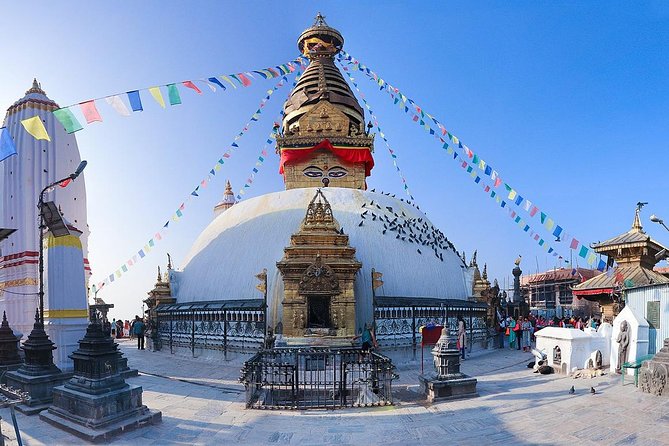
Your first stop is Swayambhunath, an approximately 2,600-year-old Buddhist stupa overlooking the Kathmandu Valley. Its name is linked to the idea of a self-existent deity, and it is often called the Monkey Temple.
The setting gives this visit extra appeal. The stupa is not simply an isolated monument. It is placed above the city, so you get a broad view of Kathmandu while also seeing a major religious site. The combination makes it a strong opening stop, especially if you want an immediate sense of the valley’s spiritual character.
Plan on about one hour here. That is enough for a guided introduction and time to look around, but it may feel short if you want to linger over every shrine or take a long series of photographs. Admission is not included, so keep money available for the entrance ticket.
Your guide can add value here by explaining the Buddhist symbols and the role of the stupa. Without that context, you might simply see a large white dome and a busy religious compound. With clear explanation, the site becomes easier to read.
The name Monkey Temple gives you a clue about the atmosphere, but do not treat the stop as a novelty animal visit. Its main importance is religious and historical. The elevated position and long age of the site make it one of the most memorable stops on the route.
Pashupatinath and the heart of Hindu devotion
Pashupatinath Temple is dedicated to Pashupati, a name meaning the god of animal lives. It is described as one of the major Hindu temples on the subcontinent and receives millions of visitors each year.
This stop gives the day a different tone from Swayambhunath. You move from a Buddhist stupa to a major Hindu temple complex, which helps explain the shared but distinct religious traditions of Kathmandu. I like that the tour does not treat the valley as only a Buddhist destination. It gives Hindu heritage equal weight.
The planned visit lasts about one hour. That keeps the day moving, but it also means you should listen closely to the guide rather than expect a long, unstructured walk. Entrance is extra.
Because Pashupatinath is an active religious place, respectful behavior matters. The provided information does not spell out access rules or photography restrictions, so ask your guide before entering particular areas or taking pictures. A good guide is especially useful here because the difference between a tourist attraction and a living place of worship is significant.
The temple’s location beside a river adds to its importance, though the experience is not presented as a nature stop. You are coming here for the religious setting, the temple traditions, and the chance to understand one of Nepal’s most important Hindu sites.
Bouddhanath, the great Tibetan Buddhist center
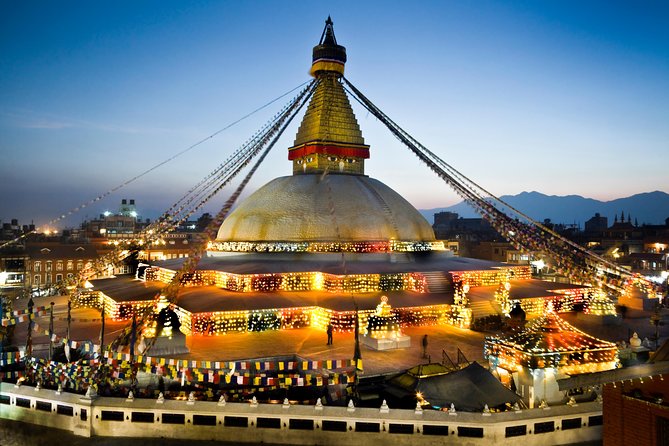
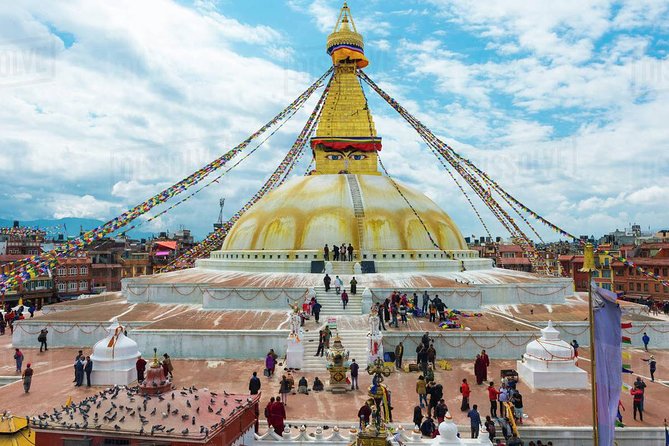
The third stop is Bouddhanath, also called Buddha Stupa in the tour details. It is described as one of the world’s largest stupas and dates to the fourth century. The site is particularly important to Tibetan people and resembles a Tibetan Buddhist shrine.
This is one of the day’s clearest visual highlights. The large stupa has a very different character from Swayambhunath. Swayambhunath gives you a hilltop setting and valley views, while Bouddhanath offers a major Buddhist center with a strong Tibetan connection.
You have about an hour here. That is enough to understand the layout and hear the main explanation, but you may want more time if you enjoy watching religious activity or examining the surrounding buildings. Since admission is not included, budget for another ticket.
The guide’s role is valuable at Bouddhanath. A stupa can look simple at first glance, especially when you are seeing several monuments in one day. An explanation of its religious meaning and Tibetan links helps you understand why this is not merely an impressive structure for photographs.
The schedule places two Buddhist sites on the same day, but they are not duplicates. Their different settings and traditions make the comparison worthwhile. If Buddhist art and architecture are your main interests, you may wish the tour allowed longer here. Still, the one-hour stop gives you a useful introduction without taking the entire day.
More History Tours:
- UNESCO Seven World Heritage Tour in Kathmandu
★ 5.0 · 253 reviews - Kathmandu Private Sightseeing Tour | UNESCO World Heritage Sites
★ 5.0 · 109 reviews - Kathmandu: Full Day Private Top 4 UNESCO Heritage Tour W/Lunch.
★ 5.0 · 86 reviews - Kathmandu World Heritage Tour
★ 5.0 · 74 reviews
Patan Durbar Square and 90 minutes of old Lalitpur
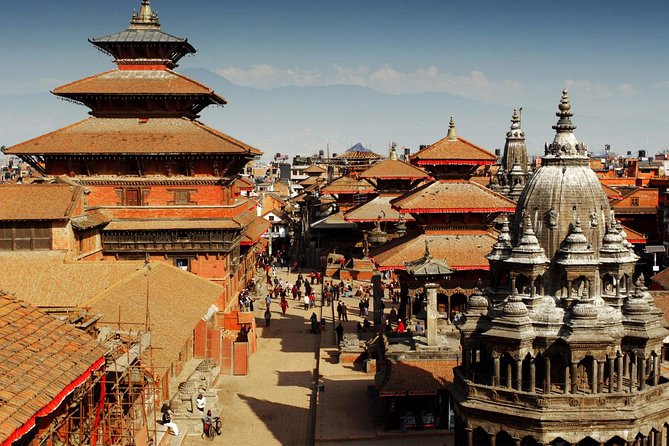
Patan Durbar Square receives the longest visit, at about 90 minutes. Located in Lalitpur, Patan is described as a center of beauty and artistic scenes, with Buddhism and Hinduism meeting in its buildings and religious life.
This is a wise place to allow extra time. The square is surrounded by palaces, courtyards, and temples, and the area rewards a slower look. Compared with a quick photo stop, 90 minutes gives your guide enough time to explain the main structures while leaving you a little room to observe details for yourself.
Patan is also useful for understanding the valley as a place where religious traditions overlap. You are not looking at two completely separate worlds. Buddhist and Hindu influences appear side by side, and the architecture reflects that long connection.
The stop is not only about grand buildings. Patan is associated with the Newar community, and the tour information identifies it as an area largely inhabited by Newars. That detail gives the visit a human setting. You are seeing a historic city area that remains connected to local culture, not just a preserved outdoor museum.
Admission is separate. Ask your guide what is covered by the ticket and where the main highlights are, since the square contains enough to fill the available time quickly. A guide who explains without rushing is especially helpful here. Dipendra was praised for giving detailed information without becoming tiring, a quality that suits a place with so many architectural details.
Kathmandu Durbar Square in the old city
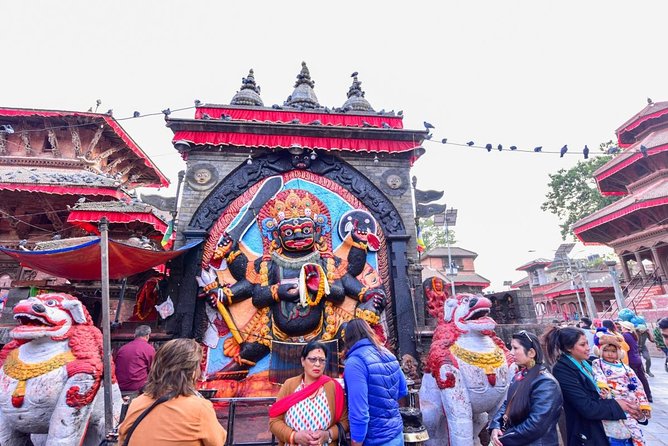
Kathmandu Durbar Square sits in the heart of old Kathmandu. Palaces, courtyards, and temples surround the square, making it one of the city’s most important historic areas.
You receive about one hour here. That is enough for an organized overview, especially after Patan, but you should not expect to see every corner in detail. The two durbar squares work well together because they let you compare different royal and religious settings within the Kathmandu Valley.
The square can also help you understand how central Kathmandu developed around royal buildings and temple spaces. Your guide can point out the relationship between the courtyards, palaces, and shrines, rather than leaving you to view them as unrelated structures.
Entrance is not included. Since this is the fifth major heritage stop of the day, fatigue may begin to show here. I would keep your expectations practical: use the hour for the main highlights, listen to the guide’s explanation, and save any longer wandering for another visit if you have extra time in Kathmandu.
This stop is a good reason to choose a private tour instead of trying to organize every ride yourself. After several sites, you can return to the taxi without having to negotiate another vehicle or route.
Narayanhiti Palace Museum, a change of pace
Narayanhiti Palace Museum brings the tour into a more recent period of Nepal’s story. The museum is in Kathmandu, east of Kaiser Mahal and next to Thamel.
After a day of temples, stupas, courtyards, and old royal squares, the palace museum provides a noticeable change of pace. You spend about one hour here, looking at a former royal setting rather than an ancient religious monument.
Its position near Thamel also makes the stop convenient if you are staying in that area. The tour does not give further details about the museum’s rooms, exhibits, or former royal functions, so you should treat the visit as a chance to see the site and learn from your guide rather than arrive with a promised list of specific displays.
Admission is extra. The museum is a useful addition because it prevents the day from focusing only on distant history. You get a link to Nepal’s modern political past, placed after the older sacred and royal sites.
If ancient architecture is your only interest, you might consider this the least essential stop. If you want a broader picture of Nepal, it earns its place. The contrast between Narayanhiti and the durbar squares is one of the tour’s more useful features.
What the guide and driver add
The quality of a day like this depends heavily on the people running it. The package includes an English-speaking licensed guide, not just a driver who drops you at the gates. That distinction matters at religious sites, where a short explanation can change what you notice.
Dipendra was singled out for being friendly, patient, and able to explain culture and history without making the day dull. Another detailed account praised his well-informed commentary at each site and credited the driver with handling narrow lanes smoothly. Those are the exact qualities I would want here: clear interpretation and calm driving.
The guide also helps with the practical side of the route. You can ask about entrance tickets, respectful behavior, timing, and which parts of each complex deserve your limited time. Since the sites are not all alike, good guidance keeps the day from becoming a blur of domes, courtyards, and temple roofs.
The vehicle is private, and the group is limited to your own party. Pickup is offered, and the tour is near public transportation, though the private taxi means you do not need to depend on buses during the day. Most people can take part, according to the supplied tour information.
Is $75 a fair price?
The listed price is $75 per person. I would judge that as a convenience-focused price rather than an all-inclusive bargain, because the major admission tickets and lunch are not covered.
You are paying for a full day of private transportation, an English-speaking driver, and an English-speaking licensed guide. If you are traveling with other people, group discounts may improve the value. The private arrangement becomes more attractive when the cost is shared across a small group, since you are not paying for separate taxis between six stops.
You must add entrance fees to your budget. Lunch is also extra, as are alcoholic and cold drinks. One piece of feedback praised the tour but warned that the suggested lunch venue was expensive. I would ask about restaurant choices and prices before agreeing to stop for lunch, or make your own preference clear.
The value is strongest if you have only one free day and want broad coverage. Hiring taxis, finding each site, and arranging explanations separately may take more time and energy. The value is weaker if you already know Kathmandu well, have several days, or prefer to explore one neighborhood at a time.
Timing, pace, and practical planning
The stated duration is about seven to eight hours. That is a long but reasonable day for six stops. The scheduled visits add up to five and a half hours, leaving the rest for driving, traffic, pickup, and lunch.
Kathmandu traffic can affect the pace, so do not plan an important evening commitment too close to the tour’s expected finish. The private vehicle helps, but it cannot remove congestion or shorten the distances between parts of the valley.
Wear comfortable shoes and keep the day flexible. The schedule includes several historic squares and religious compounds, so you will likely spend much of the time walking once you leave the taxi. The supplied details do not promise a particular vehicle size, meal, or special access, so ask the provider if any of those points matter to you.
The tour accepts mobile tickets, and confirmation is provided at booking. Free cancellation is available if you cancel at least 24 hours before the start time. Cancellations or changes made within 24 hours are not accepted for a refund.
Who should book this tour?
I would choose this experience if you have one open day in Kathmandu and want a broad introduction without organizing local transport yourself. It suits first-time visitors, couples, families, and small private groups who want a guide’s explanation rather than a simple taxi ride.
It is also a good match for anyone interested in both Hindu and Buddhist traditions. The route does not force you to choose between stupas, temples, old royal squares, and a palace museum. You get all four types of place in one day.
I would hesitate if you dislike a fixed schedule or want long visits at each site. Six stops require discipline. The route gives you a strong overview, not a slow study of every monument.
Should you book it?
Book this tour if you want efficient coverage of Kathmandu’s major cultural sights, private transport, and an English-speaking guide who can make the buildings and rituals easier to understand. The praise for Dipendra, the careful driving through narrow lanes, and the private format all support its practical value.
Before booking, ask for the expected entrance costs and lunch plan. If you accept those extras and can handle a busy day, $75 per person is a reasonable way to see a large portion of Kathmandu’s heritage in one organized outing. If your priority is quiet exploration, choose fewer sites and spend longer in each place instead.
FAQ
How long does the Kathmandu heritage tour last?
The tour lasts approximately seven to eight hours.
How much does the tour cost?
The listed price is $75 per person.
Is hotel pickup available?
Yes. Pickup is offered.
Is this a private tour?
Yes. Only your group takes part in the activity.
Which sites are included in the route?
The route includes Swayambhunath, Pashupatinath Temple, Bouddhanath Stupa, Patan Durbar Square, Kathmandu Durbar Square, and Narayanhiti Palace Museum.
Are entrance fees included?
No. Entrance fees are not included in the tour price.
Is lunch included?
No. Lunch is not included.
Is a guide included?
Yes. The experience includes an English-speaking licensed tour guide and an English-speaking driver.
What is the cancellation policy?
You can cancel at least 24 hours before the start time for a full refund. Cancellations or changes made less than 24 hours before the start time are not accepted for a refund.
More Museums
- Pokhara in 5 Hours: Lake, Museum, Cave, Falls & Pagoda Hill
★ 4.5 · 16 reviews - Pokhara in 5 Hours: Lake, Museum, Cave, Falls & Pagoda Hill
★ 5.0 · 10 reviews
Just added around Kathmandu
- Private Shopping Tour in Kathmandu★ 5.0 · 3 reviews
- Nagarkot Sunrise With 7 UNESCO World Heritage Private Tour★ 5.0 · 3 reviews
- Kathmandu: Nightlife and Pub Crawl Tour★ 5.0 · 3 reviews
- Mount Everest Scenic Flight 50 Minutes★ 5.0 · 3 reviews
- Kathmandu: Nagarkot, Bhaktapur, Doleswor & Sanga Statue Tour★ 5.0 · 3 reviews
- Momo Cooking Class -The Art Of Making MoMo with Home Chef★ 5.0 · 3 reviews
- Makalu Base Camp Trek★ 5.0 · 3 reviews
- Everest Experience Trek 6 Day Hiking Adventure★ 5.0 · 3 reviews
Kathmandu UNESCO Heritage Tours, compared.

Private Kathmandu Sightseeing Tour | UNESCO World Heritage sites
Read our review →
Full Day 7 UNESCO Tour with Lunch – Private/Group
Read our review →
Full Day Top 4 UNESCO Tour with Lunch – Private/Group
Read our review →
Full-Day 7 UNESCO Tour with Lunch – Private/Group
Read our review →
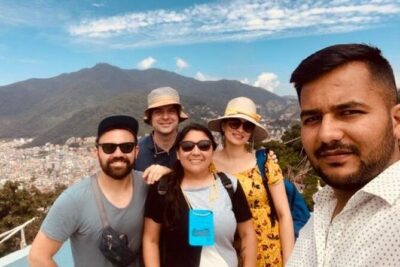
Kathmandu Private Sightseeing Tour | UNESCO World Heritage Sites
Read our review →Browse the lists this tour appears in