
Reviewed · KATHMANDU UNESCO HERITAGE TOURS
UNESCO Seven World Heritage Tour in Kathmandu
Seven sites, one very long day. This private Kathmandu tour links the valley’s major UNESCO heritage areas by car, giving you a fast, useful introduction to Nepalese art, religion, architecture, and daily life. I especially like the private vehicle, which saves time on Kathmandu’s crowded roads, and the chance to visit Changu Narayan, a hilltop temple many short itineraries leave out. The main tradeoff is simple: twelve hours and plenty of walking can feel like a cultural feast or a serious information overload.
I also like that entry fees for all seven heritage sites are included, along with hotel pickup and drop-off. Guides such as Shanti, Pankaj, Kabita, Sarita, and Som are praised for explaining both Hindu and Buddhist traditions clearly and adjusting the pace when possible. Still, you will not study each monument in depth. This is a broad first look, not a slow archaeological tour.
In This Review
- The essential details at a glance
- Is the $180 price good value?
- Starting above Kathmandu at Swayambhunath
- Kathmandu Durbar Square and the living goddess
- Patan’s stone Krishna Temple and Golden Temple
- Bhaktapur, where the old streets feel more complete
- Changu Narayan, the hilltop detour
- Pashupatinath and the sacred Bagmati area
- Boudhanath, a powerful final stop
- The guide and driver make or break the day
- How to prepare for the walking and pace
- Who should book this Kathmandu day tour?
- Final verdict: a strong first look, not a relaxed day
- FAQ
- How long does the UNESCO Seven World Heritage Tour last?
- What are the seven UNESCO heritage areas included?
- Is hotel pickup and drop-off included?
- Is transportation provided between the sites?
- Is a guide included?
- Are entrance fees included?
- Is lunch included in the price?
- Is the tour suitable for most people?
- What is the cancellation policy?
The essential details at a glance
- Seven UNESCO heritage areas in one day: Visit Swayambhunath, Kathmandu Durbar Square, Patan, Bhaktapur, Changu Narayan, Pashupatinath, and Boudhanath.
- Private car and driver: Move between widely scattered sites without arranging taxis or bargaining for every ride.
- A full twelve-hour schedule: The day is designed for visitors with limited time, but expect many stairs, courtyards, and walking surfaces.
- Entry fees included: The $180 per-person price covers admission to the seven heritage sites, plus an English-speaking guide and hotel transfers.
- Flexible guiding: Several guides have adjusted timing for shopping, photography, lunch, and personal interests.
- Lunch is extra: You choose and pay for lunch in Bhaktapur, where several eateries are available.
Is the $180 price good value?
At $180 per person, this is not the cheapest way to see Kathmandu. It is a private tour, though, and the price includes a car, driver, English-speaking guide, hotel pickup and drop-off, and required entry fees at seven heritage sites.
That package matters in Kathmandu. The sights are spread across the valley, and road delays can eat up a large part of your day. A private driver also gives you one point of contact for the whole route. You do not need to arrange transport between Swayambhunath, Patan, Bhaktapur, Changu Narayan, Pashupatinath, and Boudhanath.
The value is strongest if you have only one free sightseeing day, are visiting Kathmandu before or after a trek, or prefer having the history explained as you go. It is less attractive if you have several days and enjoy returning to one square for a slower look.
Lunch and tips are not included. Bring money for both, and remember that the tour price does not cover personal shopping or other optional purchases. Group discounts are offered, so the cost may work better for couples, families, or friends booking together.
More UNESCO Heritage Days:
- Private Kathmandu Sightseeing Tour | UNESCO World Heritage sites
★ 5.0 · 756 reviews - Kathmandu: Full Day 7 UNESCO Tour with Lunch – Private/Group
★ 5.0 · 415 reviews - Kathmandu: Full Day Top 4 UNESCO Tour with Lunch – Private/Group
★ 5.0 · 269 reviews
Starting above Kathmandu at Swayambhunath
Swayambhunath, often called the Monkey Temple, begins the cultural story on a hill above the city. The approach includes 365 stairs, so this is where your legs receive their first serious warning about the day ahead.
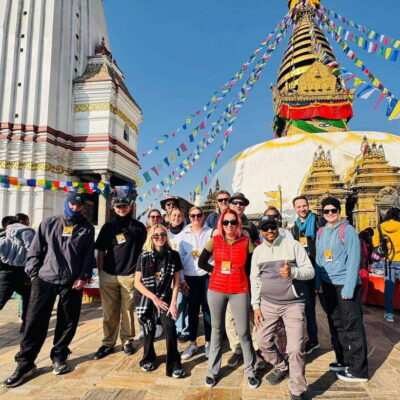
At the top, you can walk around the stupa and turn prayer wheels while looking across Kathmandu. The site also includes Hindu shrines and images, a useful early lesson in how Buddhist and Hindu traditions share sacred space in Nepal.
The stop is listed as about fifteen minutes, although your actual time may depend on traffic, walking speed, and the guide’s plan. If you want photographs or need a slower climb, tell your guide early. The view is one of the clearest reasons to begin here.
At the far side of the hill, Amideva Buddha Park adds a brief but worthwhile stop. Three large Buddha statues create a strong visual finish to the Swayambhunath visit. The ten-minute visit is short, but it helps you see more of the hill complex than you would from the main stupa alone.
Kathmandu Durbar Square and the living goddess
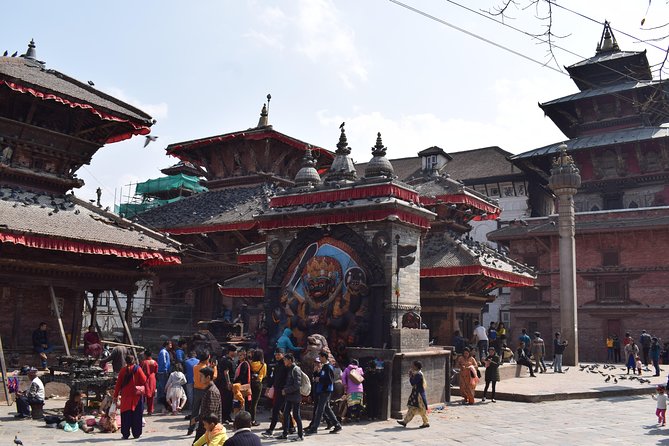
Kathmandu Durbar Square brings you into the old royal center of the city. Some buildings and religious structures remain under reconstruction, but there is still plenty to see among the courtyards, carved woodwork, shrines, and palace buildings.
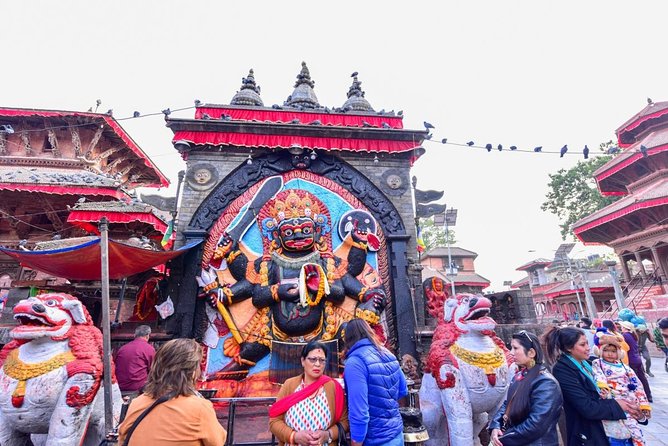
The most distinctive stop here is Kumari Chowk. This red-brick, three-level building contains the courtyard associated with the Kumari, the girl chosen to serve as Kathmandu’s living goddess until puberty.
A visit does not guarantee that you will see the Kumari herself, so keep your expectations sensible. The courtyard is the important part of the stop, along with the chance to ask your guide about the tradition and its place in Nepalese religious life.
The listed visit is about ten minutes. That is enough for an introduction, but not enough for a leisurely architectural study. I would use this stop to get the basic story, then return on your own later if Kathmandu Durbar Square becomes a favorite.
Patan’s stone Krishna Temple and Golden Temple
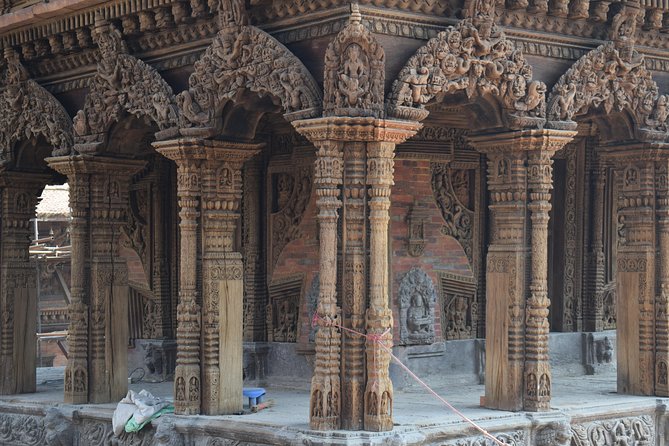
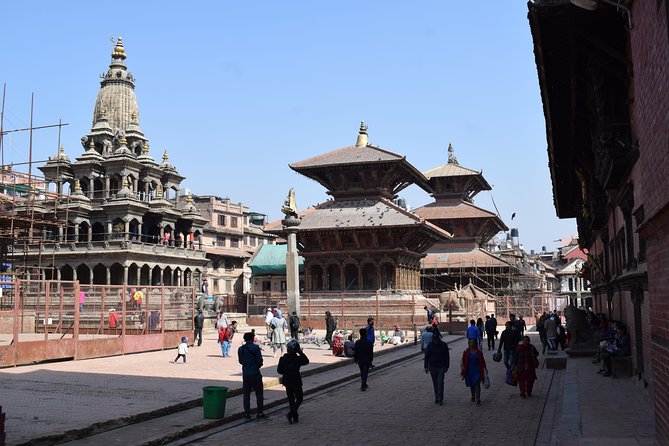
Patan Durbar Square, in Lalitpur, is one of the day’s best places to focus on Newar design. The old palace courtyard is lined with red brick structures and detailed religious architecture, and the square has a strong connection with the local Newar community.
The central square includes Krishna Temple, a stone-built temple with 21 shrines. Its stone construction gives it a different feel from the many brick and timber pagodas elsewhere in the valley. Your guide can help you notice the details rather than treating the square as one large photograph.
The visit to the central square is listed at about 25 minutes. That is still brief, but it gives you time to see the main temple and hear the setting explained.
The Golden Temple, formally Hiranya Varna Mahavihar, is a 12th-century pagoda-style temple north of the main square. Bronze figures, silver details, and the small-scale courtyard make this a more intimate stop than Patan’s larger palace complex.
The Golden Temple visit lasts about ten minutes. Watch your footing and be respectful around worshippers. This is an active religious place, not just an old monument.
Patan Museum follows, with about fifteen minutes in Keshav Narayan Chowk. It adds historical and cultural context to the buildings you have just seen. The short visit will not allow a careful look at every display, but it can help you connect art, religion, and palace life.
More History Tours:
- Kathmandu Private Sightseeing Tour | UNESCO World Heritage Sites
★ 5.0 · 109 reviews - Kathmandu: Full Day Private Top 4 UNESCO Heritage Tour W/Lunch.
★ 5.0 · 86 reviews - Kathmandu World Heritage Tour
★ 5.0 · 74 reviews - Nagarkot Sunrise & Bhaktapur UNESCO Heritage Private Tour
★ 5.0 · 66 reviews
Bhaktapur, where the old streets feel more complete
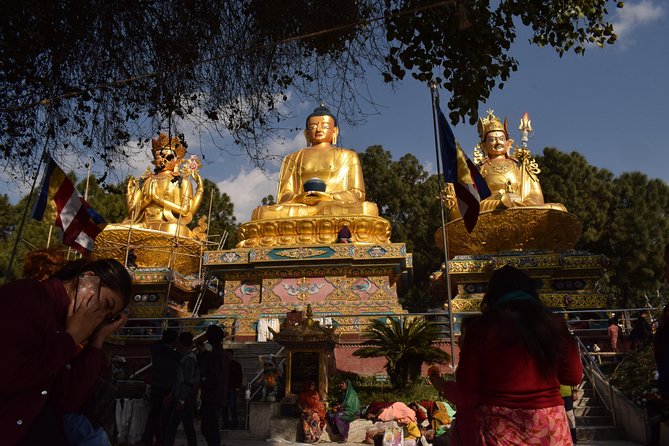
Bhaktapur is often the day’s visual highlight. Known as the City of Devotees, it retains many traditional houses and older structures, giving the historic center a more unified appearance than parts of Kathmandu that have seen heavier rebuilding.
Nyatapola Temple is the first major stop here. This five-level pagoda is one of the tallest pagodas in the area, with sculpted elements that show the skill of Newar builders and artists. The ten-minute visit is enough to take in the stepped approach and overall shape, though you will want more time if architecture is your main interest.
Dattatreya Temple, in Dattatreya Square, has its own unusual tradition. It is believed to have been built using a single tree trunk. The claim gives the structure a memorable story, and the surrounding square offers another view of Bhaktapur beyond the better-known central palace area.
The Palace of Fifty-Five Windows is one of the grand structures of Bhaktapur Durbar Square. Its name comes from the 55 carved windows in the palace facade. Ten minutes may feel short here, especially if you enjoy woodcarving, but the guide can point out the main features before the route continues.
Siddha Pokhari is a human-made pond near the old town gate. The listed stop is only five minutes, making it more of a pause than a full attraction. It gives you a change of rhythm after the temple squares and a glimpse of a public space used by local people.
Lunch in Bhaktapur is not included. That is actually useful in one way: you can choose from the available eateries instead of being locked into a fixed meal. Ask your guide for help if you want a view over a square or need to keep the schedule moving.
Changu Narayan, the hilltop detour
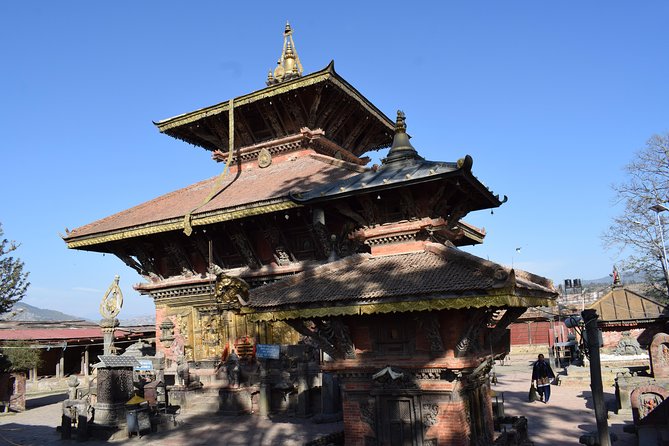
Changu Narayan is the most remote stop on the route and one of its most worthwhile. The temple dates back to the Licchavi period of Nepal’s history and is known for stone and wood carvings.
The schedule allows about one hour here, much longer than at several earlier stops. That extra time makes sense. Changu Narayan is not simply another courtyard on a crowded city route. Its hilltop setting gives the day a different pace, and the carvings reward a closer look.
You should also understand the practical cost of reaching it: the drive takes time, and the day is already long. If you want all seven heritage areas, this is the stop that makes the itinerary feel ambitious. If you prefer a relaxed day, Changu Narayan is also the place most likely to expose the limits of a packed schedule.
Pashupatinath and the sacred Bagmati area
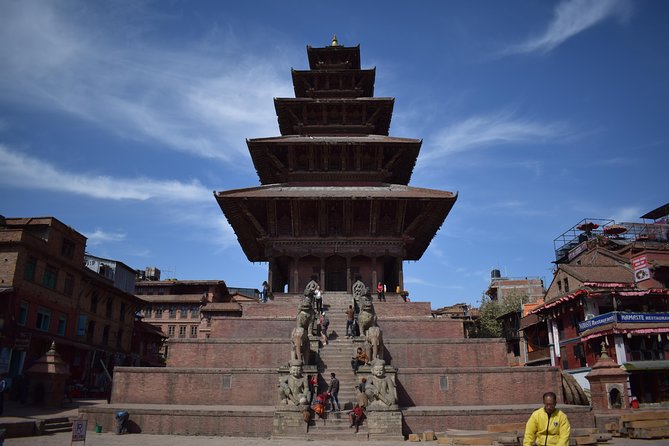
Pashupatinath is one of Nepal’s largest temple complexes, containing more than 500 temples and shrines across about 0.64 hectares. It is a major Hindu religious center, and the scale can be difficult to absorb in a quick visit.
The schedule gives you about one hour. Use it to notice the variety of shrines and the active religious setting rather than trying to count every structure. Your guide’s explanation is especially helpful here because the complex has layers of ritual meaning that are not obvious from the architecture alone.
One review describes seeing Hindu cremation activity in the evening. That is a reminder that Pashupatinath is a living sacred site, not a museum display. Approach respectfully, follow your guide’s instructions, and avoid treating ceremonies as entertainment.
The site may be emotionally intense for some people. That is not a flaw in the tour, but it is something to consider before booking a route built around major religious centers.
Boudhanath, a powerful final stop
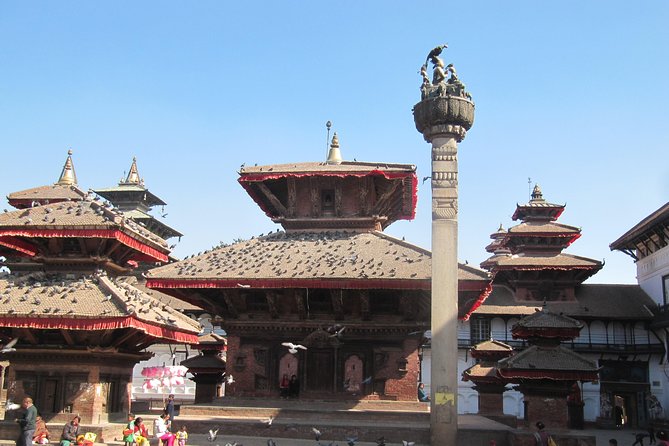
Boudhanath Stupa is a fitting late-day stop. The stupa rises about 36 meters and is surrounded by more than 50 gompas, or Buddhist monasteries.
The one-hour visit gives you time to walk around the stupa, observe the surrounding religious activity, and hear how the site functions as an important Buddhist pilgrimage center. After the many palace squares and Hindu temples earlier in the day, Boudhanath adds a clear Buddhist counterpoint.
The stupa is also a place where the private guide can tie the day together. You have seen Buddhist and Hindu elements sharing space at Swayambhunath, Newar art in Patan and Bhaktapur, royal architecture, temple worship, and older religious traditions. Boudhanath helps place those pieces in a wider picture.
The guide and driver make or break the day
The strongest part of this experience is not just the route. It is the human help along the way.
Guides named in the feedback include Shanti, Pankaj, Kabita, Sarita, Som, and others. Shanti is praised for adjusting the schedule, helping with photographs, answering questions, and even accommodating souvenir shopping. Kabita is noted for allowing a flexible pace and explaining history, mythology, religion, and local life. Pankaj is praised for clear explanations of both Hinduism and Buddhism.
Those details matter because the itinerary is packed. A good guide can decide when to give you a short explanation, when to let you look around quietly, and when to move on before traffic causes trouble. Several accounts also describe drivers as careful, professional, and skilled at handling Kathmandu’s difficult roads.
The private format means only your group participates. That allows more room for personal requests than a large coach tour, though flexibility cannot remove the basic limits of a twelve-hour day.
How to prepare for the walking and pace
Wear your most comfortable walking shoes. The 365 steps at Swayambhunath are only the most obvious example. You will also walk through courtyards, temple areas, palace squares, and uneven historic streets.
Carry water and sun protection. One particularly useful tip from the experience is to bring patience as well as energy. You may be moving quickly between sites, and the amount of information can pile up by afternoon.
Smart casual dress is requested. Since the route includes Hindu and Buddhist religious sites, modest clothing is a sensible choice. Be ready to remove shoes if a particular sacred area requires it, although the supplied details do not specify every site’s individual rule.
The tour is described as suitable for most people, but the long duration and walking should guide your decision. If you have mobility concerns, ask the provider before booking about the day’s stairs and walking surfaces.
Who should book this Kathmandu day tour?
I would choose this tour if you have one day in Kathmandu and want to see the major heritage areas without spending your limited time organizing taxis, admission tickets, and route planning.
It also suits solo visitors. One solo participant appreciated the help with photographs and traditional dress, while another used the tour as a quick introduction before deciding where to spend more time independently.
It works well before or after a trek, too. Several people used the day to get their bearings in Kathmandu before continuing elsewhere in Nepal. The tour gives you a broad sense of the city and valley, even if it cannot provide a slow study of every site.
I would be more cautious if you dislike early starts, long car rides, repeated stops, or strict sightseeing schedules. The tour can be adjusted to some degree, but you are still trying to cover seven UNESCO areas in one day. One person ended the day early after finding twelve hours too long.
Final verdict: a strong first look, not a relaxed day
This is one of the most efficient ways to see Kathmandu Valley’s seven UNESCO heritage areas in a single day. The private car, included admission fees, hotel transfers, and strong guide support make the $180 price easier to justify, especially when your time is short.
Book it if you want broad coverage, clear cultural background, and practical help on Kathmandu’s crowded roads. Skip it if you would rather spend half a day studying one square, museum, or temple in detail.
My best advice is to treat the tour as an introduction. Take notes on the places you like most, then return later at a slower pace if your schedule allows. Bring good shoes, water, sun protection, and enough curiosity for a very full day.
FAQ
How long does the UNESCO Seven World Heritage Tour last?
The tour lasts approximately 12 hours. The full route is designed as an action-packed day covering all seven UNESCO heritage areas in Kathmandu Valley.
What are the seven UNESCO heritage areas included?
The route includes Swayambhunath, Kathmandu Durbar Square, Patan Durbar Square, Bhaktapur, Changu Narayan, Pashupatinath, and Boudhanath.
Is hotel pickup and drop-off included?
Yes. Hotel pickup and drop-off are included in the tour.
Is transportation provided between the sites?
Yes. You travel by private vehicle with a driver between the heritage locations.
Is a guide included?
Yes. An English-speaking guide is included. The tour is private, so only your group participates.
Are entrance fees included?
Yes. Required entry fees for the seven heritage sites are included.
Is lunch included in the price?
No. Lunch in Bhaktapur is not included. You can choose from the available eateries there.
Is the tour suitable for most people?
The experience states that most people can participate. You should still be prepared for a long day, walking, and many stairs, including 365 steps at Swayambhunath.
What is the cancellation policy?
You can cancel at least 24 hours before the start time for a full refund. Cancellations or changes made less than 24 hours before the start time are not accepted and are not refunded.
Just added around Kathmandu
- Nagarkot Sunrise With 7 UNESCO World Heritage Private Tour★ 5.0 · 3 reviews
- Private Shopping Tour in Kathmandu★ 5.0 · 3 reviews
- Mount Everest Scenic Flight 50 Minutes★ 5.0 · 3 reviews
- Kathmandu: Nightlife and Pub Crawl Tour★ 5.0 · 3 reviews
- Kathmandu: Nagarkot, Bhaktapur, Doleswor & Sanga Statue Tour★ 5.0 · 3 reviews
- Momo Cooking Class -The Art Of Making MoMo with Home Chef★ 5.0 · 3 reviews
- Everest Experience Trek 6 Day Hiking Adventure★ 5.0 · 3 reviews
- Kathmandu: Momo Making Class with a Local Chef★ 5.0 · 3 reviews
Kathmandu UNESCO Heritage Tours, compared.

Private Kathmandu Sightseeing Tour | UNESCO World Heritage sites
Read our review →
Full Day 7 UNESCO Tour with Lunch – Private/Group
Read our review →
Full Day Top 4 UNESCO Tour with Lunch – Private/Group
Read our review →Full-Day 7 UNESCO Tour with Lunch – Private/Group
Read our review →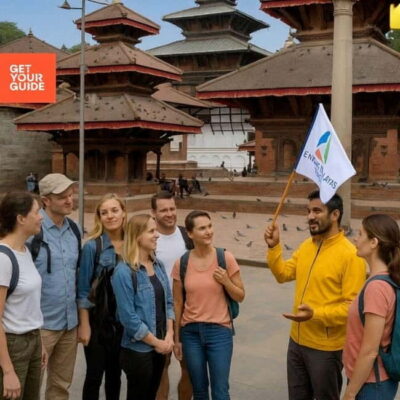
Kathmandu Private Sightseeing Tour | UNESCO World Heritage Sites
Read our review →Full Day 7 UNESCO Tour with Lunch – Private/Group
Read our review →Browse the lists this tour appears in