
Reviewed · KATHMANDU UNESCO HERITAGE TOURS
UNESCO Five World Heritage Tour in Kathmandu
Kathmandu rewards a full day. This private tour brings together the valley’s major Buddhist and Hindu landmarks, with hotel pickup, entry fees, a private car, and a guide included. I like the wide cultural range, from the hilltop Swayambhunath Stupa to the solemn Pashupatinath complex. I also like the way guides such as Shanti, Sarita, Tej, and Rabina have been praised for making Nepal’s religion, art, and history easier to understand. The main drawback is pace: sixteen listed stops in seven to eight hours can leave little time for lingering.
At $130 per person, this is not the cheapest way to see Kathmandu, but it can be good value if you are short on time or dislike arranging several taxis. Hotel transfers inside the Ring Road area and included admission fees remove much of the day’s usual fuss. You should still expect traffic, crowds, stairs, and a steady stream of information.
This suits you best if you want an organized first look at Kathmandu’s major heritage sites. It is less suited to anyone who prefers slow photography, long café breaks, or detailed visits to only one or two monuments.
In This Review
- Key points at a glance
- What this Kathmandu heritage day is really like
- Swayambhunath and Amideva Buddha Park
- Kathmandu Durbar Square and the living goddess tradition
- Patan’s palace courtyards and Newari craftsmanship
- Pashupatinath, Kathmandu’s most powerful Hindu complex
- Boudhanath Stupa and a calmer finish
- Why the private car and guide improve the value
- Who should book this experience
- Should you book the Kathmandu UNESCO heritage tour?
- FAQ
- How long does the UNESCO Five World Heritage Tour in Kathmandu last?
- What time does the tour start?
- Is hotel pickup included?
- Is this a private tour?
- What transportation is provided?
- Are entrance fees included?
- Is food included in the price?
- Which main sites are visited?
- What is the cancellation policy?
Key points at a glance
- Six major cultural areas in one day: Swayambhunath, Kathmandu Durbar Square, Patan, Pashupatinath, and Boudhanath form the main arc of the day.
- Private transport matters: A private car saves you from haggling with taxi drivers and keeps the schedule under your guide’s control.
- Patan deserves your full attention: Its palace courtyards, museum, temples, and Golden Temple offer some of the finest Newari art in the valley.
- The guides are a major strength: Shanti, Sarita, Tej, and Rabina have been singled out for clear explanations, flexibility, and friendly service.
- The schedule is demanding: The listed stops add up to much more than a leisurely sightseeing day, so expect short visits at several temples.
- The price includes useful extras: Entry to all heritage sites, a professional guide, private car transport, and hotel pickup and drop-off within the Ring Road are included.
What this Kathmandu heritage day is really like
The tour begins at 9:00 a.m. and lasts about seven to eight hours, though the exact rhythm depends on traffic and how long you spend at each place. You travel by private car with only your own group, which gives the day a calmer feel than a large coach outing.
The route links sacred Buddhist sites, Hindu temples, royal courtyards, museums, and traditional Newari architecture. That variety is the point. You are not seeing a single period or faith, but the way Kathmandu Valley’s Buddhist and Hindu traditions have developed side by side.
I would treat this as an introduction rather than a final word on Kathmandu. The guide’s explanations are important because many courtyards contain several shrines, statues, and symbols that can look confusing at first. Shanti has been praised for making a full day stress-free and for explaining both architecture and local culture. Sarita has been described as a scholar of Nepali history who could answer detailed questions while keeping the day enjoyable.
More UNESCO Heritage Days:
- Private Kathmandu Sightseeing Tour | UNESCO World Heritage sites
★ 5.0 · 756 reviews - Kathmandu: Full Day 7 UNESCO Tour with Lunch – Private/Group
★ 5.0 · 415 reviews - Kathmandu: Full Day Top 4 UNESCO Tour with Lunch – Private/Group
★ 5.0 · 269 reviews
Swayambhunath and Amideva Buddha Park
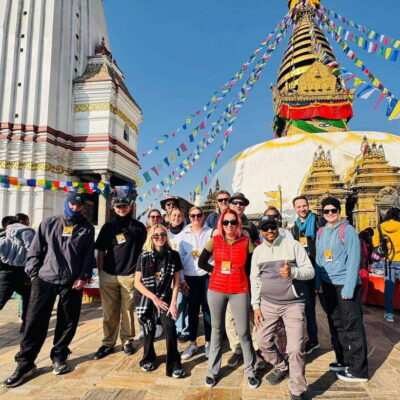
Your first main stop is Swayambhunath Stupa, often called the Monkey Temple. It is one of Kathmandu’s most recognizable sacred sites and is important to both Buddhist and Hindu communities.
The one-hour visit gives you time to look at the stupa, prayer features, religious images, and the setting on the hill. The site’s importance is not only visual. It offers an early lesson in how the valley’s two major religious traditions share sacred ground.
The nearby Amideva Buddha Park adds a shorter stop of about fifteen minutes. Three large Shakyamuni Buddha statues make this a simple but attractive place to pause. It is not a major museum or long sightseeing visit, but it fits well after Swayambhunath and gives you another view of Buddhist devotional art.
The practical issue is the hill setting. You should be ready for some walking and uneven surfaces, although the supplied information does not specify the exact number of steps or accessibility arrangements. Your guide can help put the religious details into context, but you may need to keep moving to stay on schedule.
Kathmandu Durbar Square and the living goddess tradition
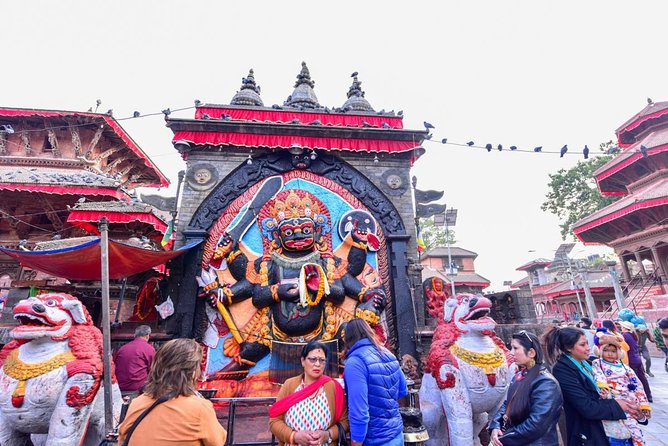
Kathmandu Durbar Square receives about an hour, followed by shorter visits to Basantapur Tower, Degu Taleju Temple, Kumari Chowk, and Kaal Bhairab. In practice, these are connected parts of one historic royal and religious area.
The square contains palaces, courtyards, temples, and carved architectural details. Some structures are still being reconstructed, so do not expect every building to appear untouched. That ongoing work is part of the present-day story of Kathmandu’s heritage, but it can affect what you see and photograph.
Basantapur Tower receives thirty minutes. It is one of the attractive points in the square and helps you appreciate the vertical style of the old royal complex. Degu Taleju Temple, built in 1564, is a quick ten-minute stop. The short time suggests that your guide will focus on the essential story and key details rather than provide a long interior visit.
Kumari Chowk is one of the most distinctive stops. This red-brick, three-level building was once home to the Kumari, a girl selected to serve as the town’s living goddess until puberty. The tour allows ten minutes here, and that may be enough to see the courtyard and hear the explanation, but it is not a guarantee that you will see the Kumari herself.
One person on this tour happened to see her, which shows why the stop can feel special, but you should not build your expectations around that possibility. Kaal Bhairab, a powerful statue of Bhairav, receives only five minutes. That is a quick look, yet the image helps explain the more intense side of Kathmandu’s religious art.
Patan’s palace courtyards and Newari craftsmanship
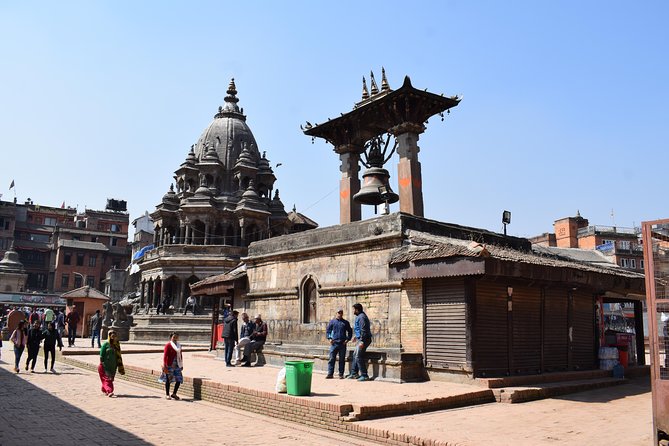
Patan takes a larger share of the day, and rightly so. The former royal city of Lalitpur is known for Newari architecture, metalwork, wood carving, and temple design. The route includes the Patan Royal Palace, Patan Durbar Square, Taleju Mandir, Patan Museum, the Golden Temple, Vishwanath Mandir, and Bhimsen Temple.
You have about an hour around the palace area and forty-five minutes in Patan Durbar Square. The old royal complex includes Krishna Temple, Tulaja Devi Temple, the museum, and many carved architectural features. Rather than rushing past the details, ask your guide to point out the windows, pillars, and temple forms that distinguish Newari workmanship.
Taleju Mandir was rebuilt by Srinivasa Malla after a fire in 1676. That detail gives you a useful reminder that Kathmandu’s historic buildings have often been repaired, rebuilt, and adapted over centuries. The monument is allotted fifteen minutes, so listen closely before moving on.
The fifteen-minute visit to Patan Museum is brief, but worthwhile. Inside, you can see old statues, carved windows, and wooden pillars. If you care about art or architecture, you may wish the schedule allowed more time here. Still, the museum offers a helpful break from outdoor courtyards and gives you a closer look at objects that are easy to miss in a temple complex.
The Golden Temple, or Hiranya Varna Mahavihar, is another short stop at ten minutes. This twelfth-century, pagoda-style Buddhist temple is known for its bronze figures and gold and silver decoration. The name can create an expectation of a huge monument, but the appeal is in the close detail and devotional atmosphere.
Vishwanath Mandir is dedicated to Shiva and was built during the reign of Siddhi Narsingh Malla. Five minutes is enough for a quick explanation and exterior look. Bhimsen Temple, built in 1680 by Srinivasa Malla, is associated with business and trade in the Newar community. Its fifteen-minute visit gives the guide a chance to explain how commerce, worship, and city life have long been connected.
Patan is the portion of the tour where a strong guide makes the biggest difference. Without context, you see beautiful brick, timber, bronze, and stone. With clear commentary, you begin to understand why the buildings are arranged as they are and how the city’s religious and royal roles overlapped.
More History Tours:
- UNESCO Seven World Heritage Tour in Kathmandu
★ 5.0 · 253 reviews - Kathmandu Private Sightseeing Tour | UNESCO World Heritage Sites
★ 5.0 · 109 reviews - Kathmandu: Full Day Private Top 4 UNESCO Heritage Tour W/Lunch.
★ 5.0 · 86 reviews - Kathmandu World Heritage Tour
★ 5.0 · 74 reviews
Pashupatinath, Kathmandu’s most powerful Hindu complex
Pashupatinath receives about an hour and brings a different tone to the day. This Hindu temple complex contains more than 500 shrines and temples and is the main sacred center for devotees of Shiva.
You can expect a large collection of pagoda-style structures and religious sites spread through the complex. The importance of Pashupatinath is easy to sense, but the details may be less immediately clear than at a museum. This is another place where your guide’s explanation can help you understand what you are seeing and how the complex functions as a living place of worship.
The supplied information does not state that non-Hindu visitors may enter every temple, so you should follow posted rules and your guide’s instructions. Dress and behavior should be respectful. Keep your camera ready, but do not let photography distract you from the religious setting.
An hour is enough to gain a strong first impression. It may not be enough for every shrine, and the pace can feel tight if you stop often. Still, placing Pashupatinath after Patan gives the day a useful contrast: you move from royal art and carefully arranged courtyards into a much larger active Hindu complex.
Boudhanath Stupa and a calmer finish
The final major stop is Boudhanath Stupa, with about an hour set aside. The large dome rises approximately 36 meters and is surrounded by prayer wheels and images connected with Buddhist practice.
Boudhanath works well as the final stop because it gives you time to slow down after the many short temple visits. Walk around the stupa, look at the layers of the structure, and notice how the surrounding religious details frame the central dome. The site offers a clear visual contrast with Swayambhunath, even though both are important Buddhist places.
An hour is a sensible amount of time here. You can listen to the guide, take photographs, and look around without the same pressure created by the five-minute stops at Kaal Bhairab or Vishwanath Mandir. If the day has felt packed, Boudhanath gives you a chance to gather the pieces.
The itinerary describes hotel pickup and drop-off inside the Ring Road, including the Boudha area. If your hotel lies outside that zone, do not assume the transfer is included. Confirm the pickup area before booking.
Why the private car and guide improve the value
At $130 per person, the tour’s value depends on how much you want done in one day. You are paying for a private car, a professional guide, admission to all heritage sites, and hotel transfers within the stated area.
That bundle can be worthwhile if you are visiting Kathmandu for a short stay. Arranging separate taxis to Swayambhunath, the two Durbar Squares, Pashupatinath, and Boudhanath would take time and require repeated negotiations. The private format also means you are not tied to a large group’s interests.
The downside is that the cost is harder to justify for a solo visitor on a tight budget. Food and drinks are not included, and the day is long enough that you should plan to buy meals or refreshments separately. Group discounts are offered, so the per-person value may improve when several people book together.
The guide is arguably the most important part of the package. Tej has been praised for explaining how religion and culture developed in Nepal. Shanti has been singled out for professionalism, patience, and careful timing. One person also appreciated her flexibility with shopping and a later-than-expected finish. Rabina was praised for organizing a visit to Patan and Bhaktapur, though Bhaktapur is not part of the main route described here. These accounts point to a useful strength: the guides can adjust the day when circumstances allow, but you should not assume unlimited extra time.
Who should book this experience
I would recommend this tour to you if you want a broad introduction to Kathmandu Valley in a single day. It is especially useful for first-time visitors, people with a short stop in Kathmandu, and anyone who prefers a guide to explain religious symbols and architectural details.
It also suits solo visitors who would find the route difficult to arrange alone. One solo participant specifically valued having a professional guide and driver handle the logistics. That is a practical benefit, not just a comfort.
You may want a different plan if your priority is slow photography, extended museum time, or a relaxed lunch. The schedule covers a lot. You will see more sites than you could easily manage on your own, but you will not have unlimited time at each one.
Wear comfortable walking shoes and keep your schedule flexible. The tour starts at 9:00 a.m., runs for seven to eight hours, and includes many short stops. Ask your guide questions early, especially at Swayambhunath and Patan, because the explanations build on one another.
Free cancellation is available if you cancel at least 24 hours before the start time. Cancellations or changes made inside that window are not refunded or accepted.
Should you book the Kathmandu UNESCO heritage tour?
Book it if you want to see the major sites efficiently and understand what you are looking at. The private car, included admission, hotel transfers, and highly praised guides make $130 a reasonable price for a full day, particularly for a small group.
Skip it if you want to spend half a day in Patan Museum, linger at one temple, or set your own pace. For most short stays, though, this is a strong first-day plan. It gives you royal squares, living religious centers, Buddhist stupas, Newari art, and a useful introduction to the cultural connections that shape Kathmandu.
FAQ
How long does the UNESCO Five World Heritage Tour in Kathmandu last?
The tour lasts approximately seven to eight hours.
What time does the tour start?
The stated start time is 9:00 a.m.
Is hotel pickup included?
Yes. Hotel pickup and drop-off are included for locations inside Kathmandu’s Ring Road, including the Boudha area.
Is this a private tour?
Yes. Only your own group participates in the private activity.
What transportation is provided?
Transport is provided by private car.
Are entrance fees included?
Yes. Admission fees for all the heritage sites visited are included.
Is food included in the price?
No. Food and drinks are not included.
Which main sites are visited?
The route includes Swayambhunath, Amideva Buddha Park, Kathmandu Durbar Square, Patan Royal Palace, Patan Durbar Square, Pashupatinath Temple, and Boudhanath Stupa, along with several temples and monuments within those areas.
What is the cancellation policy?
You can cancel at least 24 hours before the experience for a full refund. Cancellations or changes made less than 24 hours before the start time are not refunded.
Just added around Kathmandu
- Private Shopping Tour in Kathmandu★ 5.0 · 3 reviews
- Nagarkot Sunrise With 7 UNESCO World Heritage Private Tour★ 5.0 · 3 reviews
- Mount Everest Scenic Flight 50 Minutes★ 5.0 · 3 reviews
- Kathmandu: Nightlife and Pub Crawl Tour★ 5.0 · 3 reviews
- Kathmandu: Nagarkot, Bhaktapur, Doleswor & Sanga Statue Tour★ 5.0 · 3 reviews
- Momo Cooking Class -The Art Of Making MoMo with Home Chef★ 5.0 · 3 reviews
- Everest Experience Trek 6 Day Hiking Adventure★ 5.0 · 3 reviews
- Kathmandu: Momo Making Class with a Local Chef★ 5.0 · 3 reviews
Kathmandu UNESCO Heritage Tours, compared.

Private Kathmandu Sightseeing Tour | UNESCO World Heritage sites
Read our review →
Full Day 7 UNESCO Tour with Lunch – Private/Group
Read our review →
Full Day Top 4 UNESCO Tour with Lunch – Private/Group
Read our review →
Full-Day 7 UNESCO Tour with Lunch – Private/Group
Read our review →
Kathmandu Private Sightseeing Tour | UNESCO World Heritage Sites
Read our review →Browse the lists this tour appears in