Reviewed · TOURS
Life and spirituality tour of Kathmandu
Kathmandu reveals itself through ritual. This private day tour connects Hindu and Buddhist traditions with daily life, taking you from old courtyards to cremation ghats and the prayer flags of Boudhanath. I like the hotel pickup in an air-conditioned vehicle, and I like the chance to visit four major sites with a guide who can explain what you are seeing. The main thing to note is that entrance fees, lunch, and tips cost extra, so the $55 price is not your final bill.
The tour lasts about six to eight hours, with roughly two hours at each Durbar Square and one hour at Pashupatinath and Boudhanath. It is private, so you can ask questions freely and set a comfortable pace, though the schedule covers a lot of ground in one day.
In This Review
- Key points to know before booking
- Why this Kathmandu tour works well in one day
- Kathmandu Durbar Square and the old city
- Patan Durbar Square, the city of fine art
- Pashupatinath Temple and Hindu life beside the river
- Boudhanath Stupa and Kathmandu’s Tibetan Buddhist center
- What the $55 price really includes
- The private format and the pace of the day
- Who will get the most from this experience
- How the guides shape the experience
- Should you book the Life and Spirituality Tour of Kathmandu?
- FAQ
- How long does the Life and Spirituality Tour of Kathmandu last?
- Is hotel pickup included?
- Are entrance fees included in the price?
- Is this a private tour?
- Is the tour wheelchair and stroller accessible?
- What is included besides transportation and a guide?
Key points to know before booking
- Four major spiritual and historic sites: See Kathmandu Durbar Square, Patan Durbar Square, Pashupatinath Temple, and Boudhanath Stupa in one full day.
- Private hotel pickup: Your guide collects you in Kathmandu and provides an air-conditioned vehicle, which saves you from arranging transport between widely separated sites.
- Strong guide-led interpretation: Guides such as Indra, Ripu, Rabi, and Rudi are praised for explaining Hindu and Buddhist ideas in clear, approachable language.
- A look beyond the main monuments: The route includes old lanes, courtyards, local markets, artisans, pilgrims, ascetics, astrologers, and everyday religious practice.
- Wheelchair and stroller accessible: The experience is listed as accessible for both wheelchairs and strollers, although historic squares and busy religious compounds can still require patience.
- Allow extra money for admissions: Pashupatinath and Boudhanath list admission as not included, and the tour also excludes lunch, tips, fees, and taxes.
Why this Kathmandu tour works well in one day
Kathmandu is not a city that explains itself quickly. A shrine may look like a small roadside decoration until someone tells you which deity it honors. A stupa may seem like a single monument until you understand why pilgrims walk around it in a clockwise direction. This is where the tour earns its keep.
The guide’s role is more than pointing out buildings. You get context for how Hinduism and Buddhism appear in ordinary life, how medieval cities were organized, and why these sacred places still function as living religious centers. The best praise for the guides focuses on their ability to explain difficult spiritual ideas without making them feel like a lecture.
Indra is singled out for answering questions with impressive command of the subject. Ripu is praised for making complicated ideas easy to follow, while Rabi is described as calm, friendly, and personal in his approach. Rudi is also noted for his strong grasp of Buddhism and Hinduism. Guide assignments can change, but the pattern is clear: this experience depends heavily on the person leading it.
That personal format is useful if you want to ask about beliefs, ceremonies, architecture, or local customs without holding back a larger group. It also gives the guide some room to adjust the pace. One booking was shortened because of the customer’s own scheduling problem, and the guide accommodated the change.
A few more trips worth weighing up before you book
- Everest Base Camp Trek – 14 Days
★ 5.0 · 1,499 reviews - Private Kathmandu Sightseeing Tour | UNESCO World Heritage sites
★ 5.0 · 756 reviews - Everest Base Camp Helicopter Tour landing at Everest View Hotel
★ 5.0 · 668 reviews
Kathmandu Durbar Square and the old city
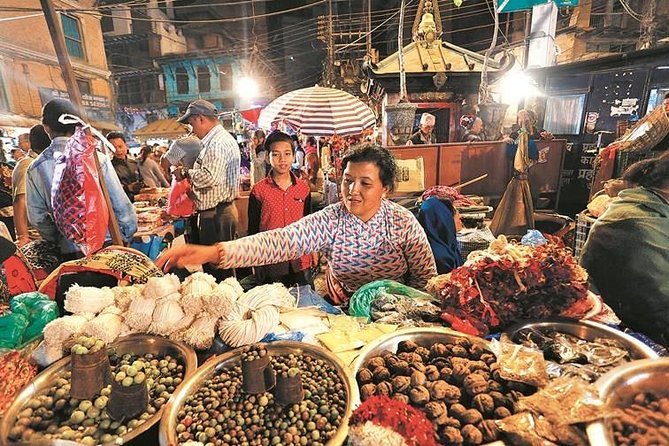
The tour begins at Kathmandu Durbar Square, where the focus is on walking rather than simply checking off a monument. You move through old Kathmandu and its courtyards, with attention to medieval spiritual and cultural practices.
The courtyards are important because they show how religious life was built into the city itself. Instead of treating faith as something found only inside a large temple, this part of the walk helps you notice smaller spaces and architectural details. The tour also points out Vastu principles, the traditional system that shaped the placement and design of buildings.
Plan on about two hours here. That is enough time to look closely rather than rush from one photo stop to the next. You may also encounter local markets and ordinary street life along the way, which adds a useful contrast to the formal monuments.
Kathmandu Durbar Square can be busy and visually crowded, so a guide is especially helpful. Without interpretation, the layered shrines, carved wood, courtyards, and religious activity can blur together. With the right explanation, you begin to see the square as a working part of the city, not only a historic site.
The listed itinerary shows no admission ticket for this stop, but the tour information also says entrance fees are extra overall. Ask your guide or provider what applies on your date, since local site arrangements can change.
Patan Durbar Square, the city of fine art
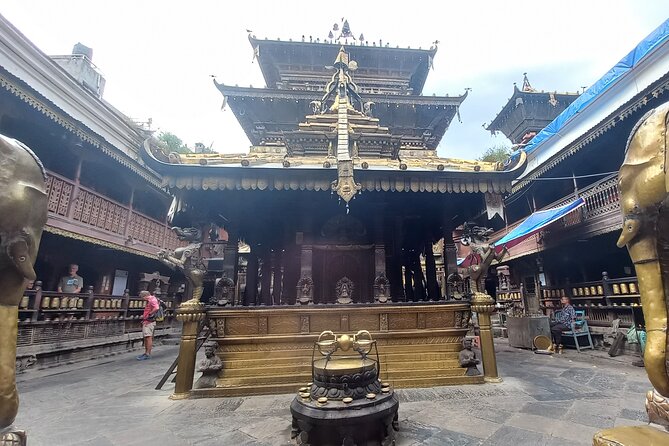
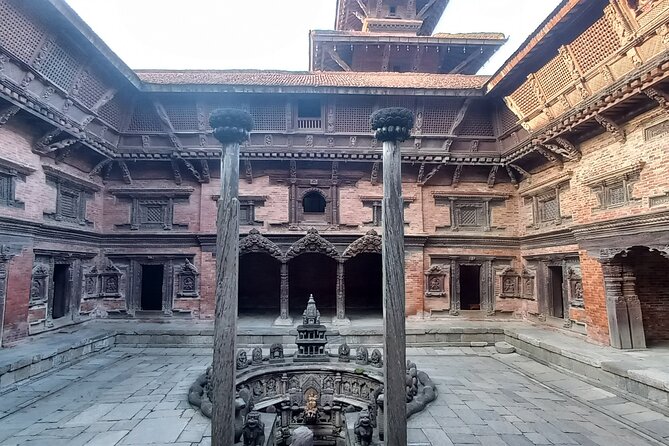
From Kathmandu, you drive to Patan, also called Lalitpur. The journey changes the mood of the day. Patan is presented as a city shaped by fine art and craftsmanship, and the tour explains how work made here reached India, Tibet, and China during the medieval period.
The most useful detail is that craftsmanship is not treated as a dead tradition. The tour notes that many people in Patan still work as artisans. That gives the square a stronger connection to present-day life. You are not just looking at old brick and carved wood. You are seeing a place where artistic skills remain part of the local identity.
Allow around two hours at Patan Durbar Square. This is a good section for anyone who enjoys architecture, metalwork, sculpture, and the relationship between religion and art. The guide can help explain how the objects and buildings reflect both Hindu and Buddhist practice.
I would pay close attention here even if you are beginning to feel tired. Patan rewards a slower look, and its value is not limited to one famous structure. The setting connects workshops, religious buildings, public spaces, and historic craftsmanship.
The trade-off is time. Four major stops in a single day leave limited room for long independent wandering. If Patan is your main interest, you may prefer a separate visit on another day. If your time in Kathmandu is short, though, two hours gives you a useful introduction.
Pashupatinath Temple and Hindu life beside the river
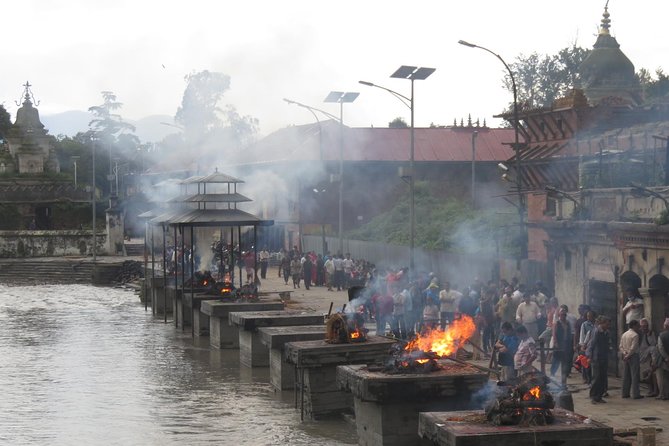
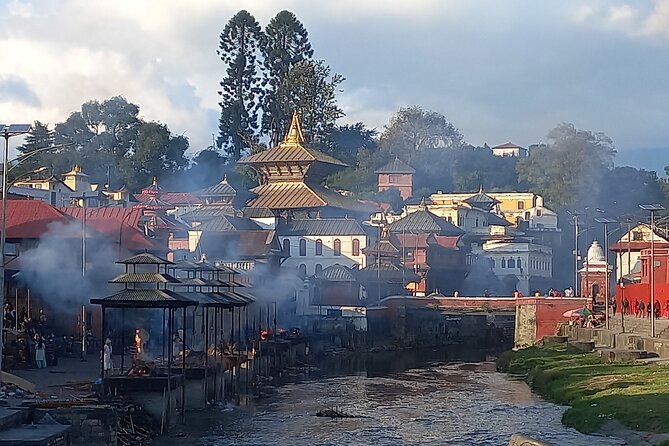
Pashupatinath brings the spiritual focus into sharper view. This temple complex is dedicated to Shiva, and the tour uses it to explain Hindu ways of life, devotion, and death.
You may see Hindu ascetics, astrologers, and devotees in the complex. You may also witness open cremation. That can be confronting, especially if you are not used to religious ceremonies taking place in public view. Approach the area quietly and respectfully, and follow your guide’s advice about where to stand and what is appropriate to photograph.
The visit lasts about one hour. That may sound brief, but Pashupatinath is an intense stop, and the purpose is not to hurry through every corner. The guide helps you understand what is happening rather than leaving you to guess at the meaning of the rituals.
This is one of the tour’s strongest points for anyone interested in living religion. You see that spirituality in Kathmandu is not confined to a museum or a ceremonial performance for outsiders. It is connected to family, death, devotion, pilgrimage, astrology, and public space.
Pashupatinath is also where the tour may feel least comfortable for some people. Open cremation is a real part of the site, not an abstract historical topic. If you prefer a gentle sightseeing day with only decorative temples, this stop may be more serious than expected. If you want to understand how faith is practiced in Nepal, it is essential.
Admission is not included here. The tour price covers the vehicle, bottled water, and guide, but not all fees and taxes.
A different sort of day from Kathmandu:
- Half day cooking class in Thamel kathmandu
★ 5.0 · 607 reviews - Everest Base Camp Trekking
★ 5.0 · 485 reviews - Nagarkot Sunrise View and Day Hiking from Kathmandu
★ 5.0 · 471 reviews - Kathmandu: Full Day 7 UNESCO Tour with Lunch – Private/Group
★ 5.0 · 415 reviews
Boudhanath Stupa and Kathmandu’s Tibetan Buddhist center
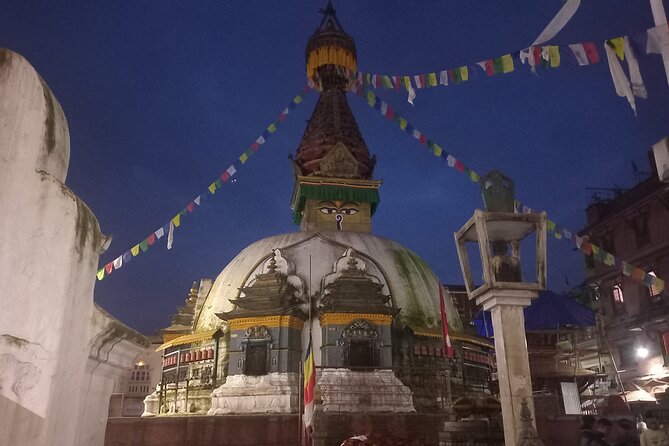
The final stop is Boudhanath Stupa, in an area often called Little Tibet of Kathmandu. The tour describes about 60 Tibetan Buddhist monasteries in the surrounding area and presents Boudhanath as a major gathering place for pilgrims from Himalayan villages.
The one-hour visit gives you a focused look at Tibetan Buddhist practice. The stupa’s form, the surrounding monasteries, and the movement of pilgrims all make more sense when your guide explains the religious customs behind them. You can expect this stop to feel different from Pashupatinath, even though both are active sacred places.
One useful feature of the route is the comparison. At Pashupatinath, the focus is Shiva, Hindu devotion, ascetics, astrology, and cremation. At Boudhanath, the focus shifts to Tibetan Buddhist communities, monasteries, and pilgrimage. Seeing both in one day gives you a clearer sense of the two traditions without pretending they are the same.
The short visit also has a limitation. Boudhanath deserves time to observe quietly, and one hour can pass quickly if you want to explore the surrounding monasteries or linger around the stupa. Still, as part of a full-day introduction, it provides a strong final chapter.
Admission is not included at Boudhanath either. Keep small additional costs in mind when comparing the $55 tour price with the total cost of the day.
What the $55 price really includes
At $55 per person, this tour offers fair value for a private full-day experience, particularly if you are sharing it with another person or a small group. Your price includes an air-conditioned vehicle, bottled water, hotel pickup in Kathmandu, and an expert guide.
The largest value comes from transport and interpretation. Kathmandu’s four major stops are not all in one compact area, and arranging separate rides can take time and energy. A private vehicle also gives you a more controlled day than joining a large group.
The price does not include lunch, tips, entrance fees, or all fees and taxes. That matters because the advertised cost is a starting price, not an all-inclusive total. You should budget for those additions before booking.
Group discounts are offered, but no discount amount is provided. If you are traveling with several people, check the current group rate. A larger private group may make the per-person price more attractive, provided everyone is comfortable with the same full-day schedule.
The private format and the pace of the day
The private setup is one of the tour’s best practical features. Only your group participates, so you can ask detailed questions about Hindu and Buddhist traditions, request clarification, and speak openly about subjects that may be unfamiliar.
The duration is listed as six to eight hours. The four stops account for about six hours of scheduled sightseeing, with the remaining time used for driving and transitions. Kathmandu traffic can affect the pace, so treat the timing as an estimate rather than a guarantee.
Hotel pickup is offered in Kathmandu. The meeting hours are listed as 9:15 AM to 5:15 PM, Monday through Sunday, for the stated operating period. Confirmation is provided at booking, and most people can participate.
The tour is listed as wheelchair and stroller accessible. That is useful, but accessibility does not remove the challenges of historic religious sites. Old squares, courtyards, crowds, and changing surfaces may require extra time. If you use a wheelchair or stroller, confirm the exact route and current access conditions before booking.
Wear comfortable shoes and bring patience for walking. Bottled water is included, but lunch is not, so plan for that during a day that can last most of your daylight hours.
Who will get the most from this experience
I would recommend this tour to you if you want more than a quick photograph at Kathmandu’s main monuments. It suits people who enjoy asking questions, learning how religious customs work, and seeing sacred places as part of ordinary city life.
It is particularly useful for:
- A first visit to Kathmandu with only one full day available
- Couples or small groups wanting a private guide
- People curious about both Hinduism and Buddhism
- Visitors interested in architecture, ritual, art, and local history
- Anyone who prefers a personal explanation to a large group tour
- Families needing hotel pickup and a private vehicle
You may want something else if you dislike a tightly scheduled day, prefer to explore independently, or feel uncomfortable around open cremation. You may also find the tour too broad if your main goal is detailed photography or extended time at one site.
How the guides shape the experience
The guide is the difference between a pleasant sightseeing circuit and a meaningful cultural visit. The strongest descriptions focus on clear explanations, patience, friendliness, and the ability to connect spiritual ideas to daily life.
Indra is praised for answering questions across Nepali culture, history, and religion. Ripu is noted for his articulate explanations, especially when discussing difficult concepts from both faiths. Rabi’s calm, laid-back manner suits people who want a relaxed conversation rather than a formal speech.
Rudi is also described as professional and well versed in Buddhism and Hinduism. Other feedback highlights a guide whose explanation of both traditions helped create a personal and reflective experience. The individual names may vary on your date, but you can reasonably expect the provider to match you with a local guide focused on cultural interpretation.
Ask questions as you go. This tour is at its best when you use the private format. If a ritual, symbol, or architectural feature puzzles you, speak up. The value is not only in what you see, but in how clearly the guide connects it to Nepalese life.
Should you book the Life and Spirituality Tour of Kathmandu?
Book it if you want a concentrated introduction to Kathmandu’s spiritual life, especially if you have one full day and prefer private transport. The combination of Kathmandu Durbar Square, Patan, Pashupatinath, and Boudhanath gives you four different angles on the city: medieval courtyards, artistic tradition, Hindu devotion, and Tibetan Buddhist pilgrimage.
The $55 starting price is reasonable for a private vehicle and guide, but remember that admissions, lunch, tips, and taxes are extra. Choose this tour for explanation and access to everyday religious life, not for a slow, unstructured day at one monument.
I would make this one of my first-day choices in Kathmandu. It gives you useful cultural bearings, introduces two major faiths without flattening their differences, and leaves you with better questions for the rest of your time in Nepal.
FAQ
How long does the Life and Spirituality Tour of Kathmandu last?
The tour lasts approximately six to eight hours. The planned sightseeing time is about two hours at Kathmandu Durbar Square, two hours at Patan Durbar Square, one hour at Pashupatinath Temple, and one hour at Boudhanath Stupa.
Is hotel pickup included?
Yes. You can be collected from your hotel in Kathmandu in a private, air-conditioned vehicle.
Are entrance fees included in the price?
No. Entrance fees are extra. Pashupatinath Temple and Boudhanath Stupa specifically list admission as not included, and the tour also excludes all fees and taxes.
Is this a private tour?
Yes. Only your group participates in the activity.
Is the tour wheelchair and stroller accessible?
Yes. The experience is listed as wheelchair and stroller accessible. Historic religious sites may still require additional time because of courtyards, walking areas, and site conditions.
What is included besides transportation and a guide?
The tour includes an air-conditioned vehicle, bottled water, and an expert guide. Lunch and tips are not included.
Just added around Kathmandu
- Private Shopping Tour in Kathmandu★ 5.0 · 3 reviews
- Nagarkot Sunrise With 7 UNESCO World Heritage Private Tour★ 5.0 · 3 reviews
- Mount Everest Scenic Flight 50 Minutes★ 5.0 · 3 reviews
- Kathmandu: Nightlife and Pub Crawl Tour★ 5.0 · 3 reviews
- Kathmandu: Nagarkot, Bhaktapur, Doleswor & Sanga Statue Tour★ 5.0 · 3 reviews
- Momo Cooking Class -The Art Of Making MoMo with Home Chef★ 5.0 · 3 reviews
- Makalu Base Camp Trek★ 5.0 · 3 reviews
- Kathmandu: Momo Making Class with a Local Chef★ 5.0 · 3 reviews
Tours, compared.

Private Kathmandu Sightseeing Tour | UNESCO World Heritage sites
Read our review →
Everest Base Camp Helicopter Tour landing at Everest View Hotel
Read our review →
Full Day 7 UNESCO Tour with Lunch – Private/Group
Read our review →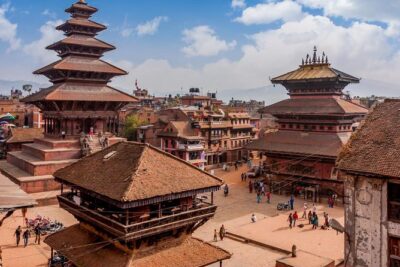
Private Bhaktapur and Nagarkot Day Tour From Kathmandu
Read our review →
Full Day Top 4 UNESCO Tour with Lunch – Private/Group
Read our review →