
Reviewed · ANNAPURNA BASE CAMP TREKS
12 Days Annapurna Base Camp Trek
The mountains make you earn every view. This 12-day Annapurna Base Camp trek pairs rhododendron forests, stone villages, terraced hillsides, and huge Himalayan peaks with the comfort of local teahouses. I especially like the sunrise walk to Poon Hill and the chance to soak in Jhinu Danda’s natural hot springs after several demanding days. The private format is another strong point, since your group can trek with its own guide rather than follow a large party. The main consideration is physical effort: this is classed as moderate, but long ascents, steep stone steps, and an altitude of 4,130 meters require preparation.
I also like the practical start and finish in Kathmandu, with time in Pokhara and airport pickup offered. The route gives you both famous viewpoints and quieter sections through bamboo, oak, and rhododendron forest. Still, the price of $1,200 does not include public transportation or airport departure tax, and the wording around transport, meals, baggage, and WiFi is broad enough that I would confirm the exact inclusions before paying.
- 3,000-plus stone steps to Ulleri: The first serious climb arrives early, so you quickly learn what the trek demands.
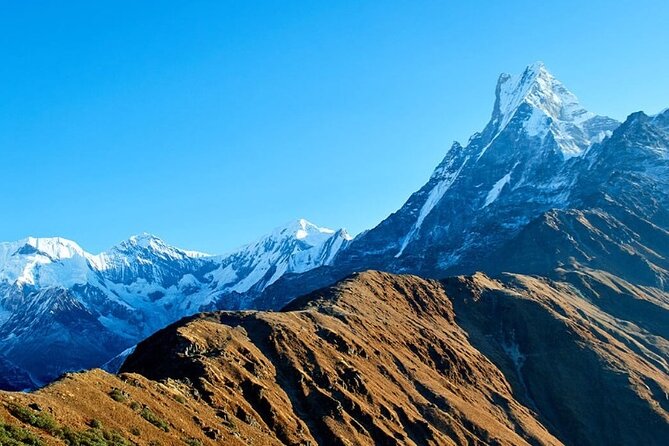
- Poon Hill sunrise: An early morning viewpoint for Dhaulagiri, Annapurna, and Machapuchare.
- Annapurna Base Camp at 4,130 meters: The route ends in an amphitheater of high peaks after forests give way to open alpine ground.
- Jhinu Danda hot springs: A natural reward beside the river near the end of the trek.
- Private guiding: Only your own group participates, with guide support throughout the route.
- Two transport choices to Pokhara: You can take a six to eight hour overland drive or a 25-minute flight.
In This Review
- What This 12-Day Himalayan Route Really Offers
- Days 1 and 2: Kathmandu Preparations and Pokhara
- Days 3 and 4: Nayapul, Ulleri, and Ghorepani
- Day 5: Poon Hill Sunrise and the Forest Trail
- Day 6: Chhomrong and the Gurung Hillside
- Days 7 and 8: Bamboo Forests to Annapurna Base Camp
- Days 9 and 10: The Long Return and Jhinu Danda
- Days 11 and 12: Returning to Pokhara and Kathmandu
- Is $1,200 Good Value?
- Who Should Book This Trek?
- Practical Booking Details to Check
- Should You Book the Annapurna Base Camp Trek?
- FAQ
- Where does the Annapurna Base Camp Trek start?
- How high does the trek go?
- How long is the experience?
- How do I get from Kathmandu to Pokhara?
- Is this trek private?
- What happens if bad weather cancels the trek?
What This 12-Day Himalayan Route Really Offers
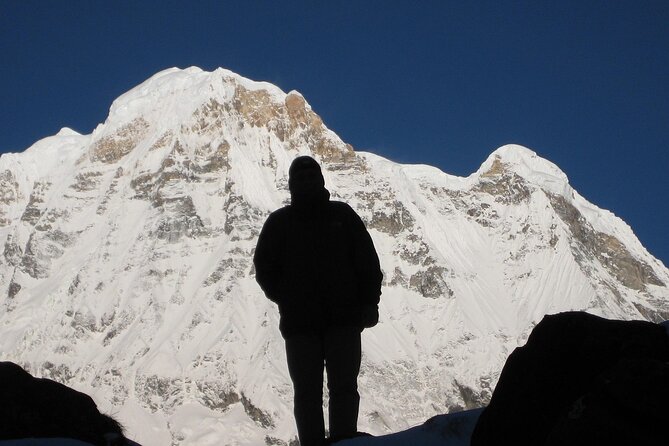
This is not simply a walk to a famous sign at base camp. The appeal comes from the changing scenery and the steady shift in daily life as you gain height. You begin in Kathmandu, move to lakefront Pokhara, pass through Gurung and Magar villages, and then follow a well-established mountain trail toward the Annapurna Sanctuary.
The route reaches 4,130 meters, so the word moderate needs a little explanation. You do not need to be an elite mountaineer, but you should be ready for full days on your feet, repeated climbs and descents, uneven stone paths, and thinner air near base camp.
The private setup matters here. A guide can help your group keep a sensible pace, manage the long descent, and respond when someone needs a slower morning. The company’s past service has been praised for polite, caring guides, and Mandip Ji received particular praise for his calm manner, mountain knowledge, and ever-present smile. Your assigned guide may differ, so confirm the name before departure if that personal connection matters to you.
Days 1 and 2: Kathmandu Preparations and Pokhara
Your first day begins at Tribhuvan International Airport. Pickup takes you to a hotel in the Thamel area, where you later meet the guide for a trek briefing and permit preparation. That first meeting is more important than it sounds. Use it to ask about the walking pace, meals, luggage arrangements, transport choices, and what happens if weather disrupts the plan.
Thamel is a practical base for a short stay because it puts you in Kathmandu’s main visitor district. The day is listed as lasting about 12 hours, but much of that depends on your arrival time and airport transfer. Do not plan an ambitious sightseeing schedule around it.
On Day 2, you choose between an overland trip of six to eight hours and a flight of about 25 minutes to Pokhara. The drive takes much longer but gives you a road journey through Nepal. The flight saves time and gets you to the trek gateway quickly, though the itinerary does not state that the flight cost is included.
Pokhara sits beside Phewa Lake and offers a gentler pause before the hills. You can use the afternoon or evening to rest, sort your bag, and enjoy the mountain views rather than treating the city as a full sightseeing day. Since public transportation is not included, ask exactly which transfers are arranged and which you must pay for separately.
More Annapurna Base Camp Treks:
- Annapurna base camp trek 5 Days
★ 5.0 · 252 reviews - Annapurna Base Camp Trek
★ 5.0 · 111 reviews - Kathmandu to Annapurna Base Camp (ABC) 5-Day Trek
★ 5.0 · 102 reviews
Days 3 and 4: Nayapul, Ulleri, and Ghorepani
Day 3 starts with a roughly 90-minute drive to Nayapul, where the walking begins. The route passes through Birethanti and Tikhedhunga before the famous climb to Ulleri. More than 3,000 stone steps make this a sharp introduction to the trek.
That staircase is both a challenge and a useful test. If you start too fast, your legs may pay for it over the next few days. Keep your pace steady, drink regularly, and take short breaks rather than waiting until you are exhausted. Ulleri is a village stop with a high hillside setting and an immediate sense that the city is far behind.
On Day 4, the route continues uphill through rhododendron and oak forest. Waterfalls and Magar villages add interest, and the trees provide a welcome change from the exposed steps of the previous day.
Ghorepani is one of the route’s best-known overnight stops. It has a cool alpine feel and broad mountain views. The drawback is simple: it is a popular halt, so the atmosphere may feel more like a busy trekking stop than a remote village. That is not a reason to skip it. It is where the route’s first major sunrise walk becomes possible.
Day 5: Poon Hill Sunrise and the Forest Trail
Poon Hill requires an early start, but the timing is the point. From the viewpoint, you may see first light spread across Dhaulagiri, Annapurna, and Machapuchare. The itinerary includes admission for this stop, while other entrance and government charges are listed among the included items.
The climb to the viewpoint comes before breakfast, followed by a return to Ghorepani. That makes this a two-part walking day rather than a simple morning stroll. You need enough energy for the later trail through forest, and you should carry warm clothing for the pre-sunrise wait.
After breakfast, the route continues through wooded country. This section gives you a more varied day than a direct push toward base camp. The forest can feel enclosed and peaceful, while the previous morning’s wide views remain fresh in your mind.
This is one of my favorite parts of the schedule because it gives you a memorable mountain panorama without waiting until the final destination. The drawback is the early hour. If you dislike pre-dawn starts, Poon Hill may feel like work, but the timing is necessary for the sunrise.
Day 6: Chhomrong and the Gurung Hillside
The trail descends steeply to a stream, then climbs again through terraced farmland and forest. This repeated up-and-down pattern is typical of the trek and can be more tiring than a steady climb. You lose elevation only to regain it later, so do not judge the day by distance alone.
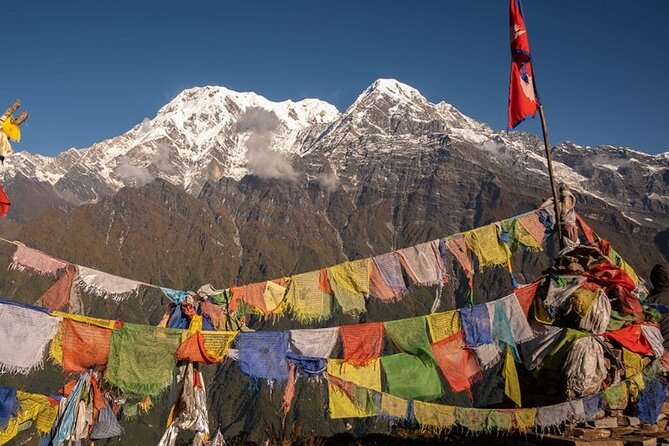
Chhomrong is a large Gurung village with striking views toward Annapurna South and the sacred Machapuchare. Its position gives you a strong sense of the route’s geography. You are no longer simply walking through foothills. The higher peaks begin to dominate the day.
The village also offers an opportunity to notice how the route connects mountain scenery with local communities. Terraced fields and traditional settlements are not decorative stops placed beside the trail. They are part of the working environment you pass through.
The practical tip is to protect your knees on the descent and save something for the climb into Chhomrong. This day rewards patience. Rushing the downhill section can make the final ascent feel unnecessarily harsh.
More Treks and Hikes:
- Everest Base Camp Trek – 14 Days
★ 5.0 · 1,499 reviews - Everest Base Camp Trekking
★ 5.0 · 485 reviews - Nagarkot Sunrise View and Day Hiking from Kathmandu
★ 5.0 · 471 reviews - Annapurna Circuit Trek with Tilicho Lake
★ 5.0 · 368 reviews
Days 7 and 8: Bamboo Forests to Annapurna Base Camp
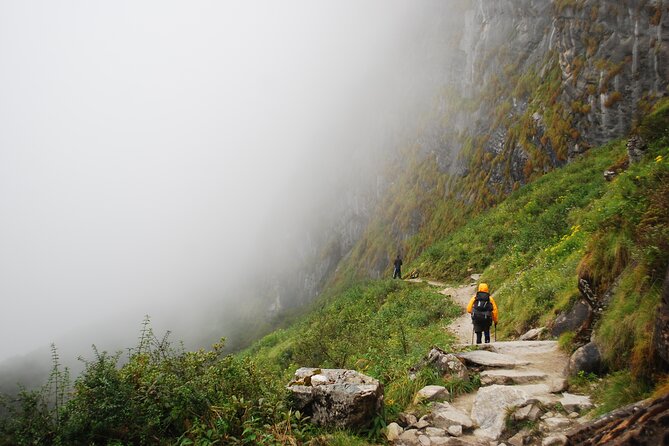
Day 7 begins with another descent to the river, followed by a climb to Sinuwa. From there, the trail moves through lush bamboo forest and reaches Bamboo, Dovan, and finally Himalaya, which sits in a quiet gorge.
The names can sound close together on a map, but this is a full walking day. The forest is attractive, yet the shade and repeated climbing can hide how much work you are doing. Keep your feet secure on the established trail and let the guide set a comfortable rhythm.
On Day 8, you climb past Deurali and Machapuchare Base Camp, often shortened to MBC. The forest begins to thin, replaced by open alpine meadows and a much broader view of the surrounding peaks. The gradual climb may feel manageable at first, but altitude becomes more important here.
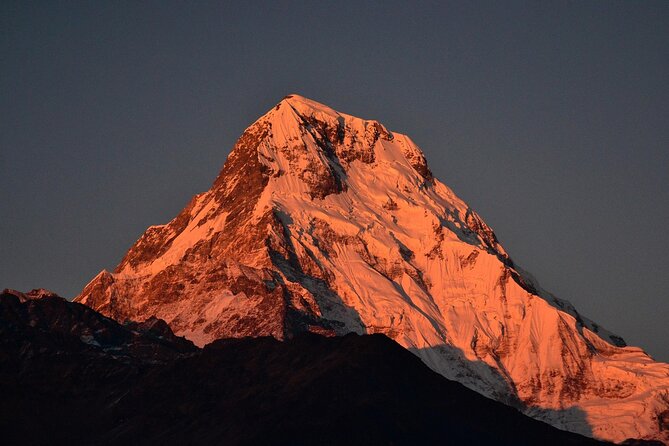
Annapurna Base Camp sits at 4,130 meters. Reaching it is the central achievement of the trek, but the setting is what makes the stop memorable: towering peaks surround the base camp on several sides, creating a dramatic mountain bowl.
The schedule allows for sunset at base camp, weather permitting. That detail adds value because the final destination is not treated only as a quick photo stop. You have time to take in the peaks and the changing light. At this height, however, keep your expectations flexible. Weather can affect visibility, and the tour’s cancellation terms specifically recognize the role of poor conditions.
Days 9 and 10: The Long Return and Jhinu Danda
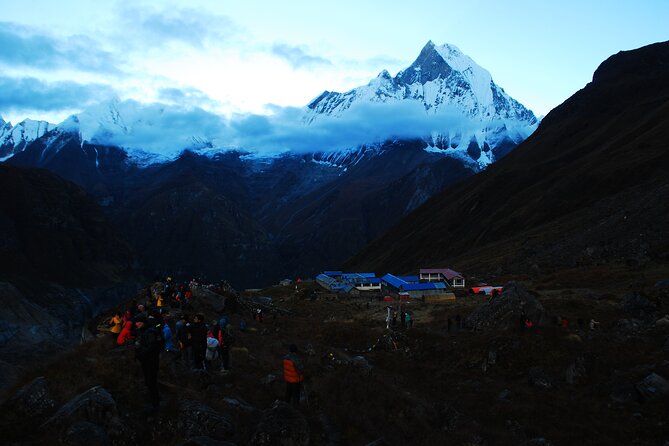
Day 9 begins with an early sunrise over the Annapurna range, then follows the route back through MBC, Deurali, and Dovan to Bamboo. The descent is easier in one sense because you are losing altitude, but it is still long. Descending stone paths can be hard on your knees and feet, especially after the effort of reaching base camp.
This is a day for slow, deliberate walking. A private group has an advantage here because your guide can help adjust the pace instead of forcing everyone to match a fixed large-group schedule.
Day 10 brings another climb to Chhomrong, followed by a steep descent to Jhinu Danda. The route’s many reversals may seem inefficient, but they reflect the shape of the hills. Nepal trekking rarely gives you a straight line from one major stop to the next.
The natural hot springs by the riverside are the highlight. After days of climbing and descending, soaking in warm water offers a genuine break rather than another viewpoint to tick off. Bring a modest sense of timing, since the itinerary places the visit in the afternoon and the day still includes a substantial descent.
Days 11 and 12: Returning to Pokhara and Kathmandu

On Day 11, you take a short final trek to Siwai or Nayapul, then drive back to Pokhara. The exact endpoint is presented as either Siwai or Nayapul, so ask your operator which one applies to your departure date.
Back in Pokhara, the plan leaves room for a lakeside dinner, a massage, or simple rest. I like this buffer after the mountain section. You get a chance to reflect on the trek before returning to city travel, rather than rushing straight from the trail to an international flight.
Day 12 brings the return to Kathmandu by flight or road. The itinerary allows you either to go directly to the international airport or spend an extra night in the city, depending on your flight schedule. If you have an important international departure, confirm the return transport and build in enough time. Mountain weather can affect plans, and a tight connection removes your margin for error.
Is $1,200 Good Value?
At $1,200 per person, the price can be sensible for a private 12-day trek if the stated inclusions match your expectations. Meals, government fees, admission charges, entrance fees, WiFi on board, and excess baggage are listed as included. Airport pickup is offered, and the trek includes guiding, mountain transport, and overnight stops in the itinerary.
The unclear part is the transport wording. Public transportation and airport departure tax are listed as excluded, while the plan also offers a flight or drive between Kathmandu and Pokhara and drives at the start and end of the trek. Before booking, ask for a written breakdown covering:
- Which Kathmandu and Pokhara transfers are included
- Whether the Pokhara flight is included or costs extra
- What meals are covered on trekking days
- How excess baggage is handled
- Which entrance and government fees are paid by the operator
- Whether airport departure tax is your responsibility
The private format adds value if you want personal attention and a flexible pace. It is less compelling if you prefer a very low-cost group trek and do not need private guiding. The four available ratings are all at the top level, with praise focused on friendly, caring, responsive service. That is encouraging, though the small number of ratings means I would still ask detailed questions before committing.
Who Should Book This Trek?
This route suits you if you want a classic Himalayan trek without technical climbing. It is also a good fit if you value a mixture of mountain scenery, village life, forest walking, hot springs, and time in Pokhara.
You should have moderate physical fitness and be comfortable with long days outdoors. The 3,000-plus steps to Ulleri, the repeated climbs near Chhomrong, and the altitude at base camp are the parts to take most seriously.
It may not suit you if you want short walks, guaranteed clear views, or a relaxed holiday with only occasional exercise. The private group arrangement helps with pacing, but it does not remove the physical demands of the route.
The company’s strongest personal-service signal comes from its guides. Past praise highlights friendly help, polite care, and Mandip Ji’s calm, smiling approach. Ask who will lead your group, how many people can join your private party, and how the guide handles a slower pace or a weather change.
Practical Booking Details to Check
Confirmation is provided when you book. The meeting point is listed at P924+79H Kathmandu, Nepal, and the activity ends back there. Pickup is offered, but confirm the exact airport or hotel arrangement rather than assuming every transfer is door to door.
Service animals are allowed, and the meeting point is near public transportation. Those details are useful, but the bigger questions concern the trail and altitude. Ask about the expected daily walking hours and the exact meal plan before you go.
Free cancellation is available up to 24 hours before the experience starts for a full refund. Inside 24 hours, the amount paid is not refunded, and changes are not accepted. If poor weather cancels the trip, you are offered another date or a full refund.
Should You Book the Annapurna Base Camp Trek?
I would book this trek if you want a well-known Nepal route with a private guide, a clear 12-day outline, and several memorable high points rather than one single destination. Poon Hill sunrise, the forest route through Bamboo and Dovan, base camp at 4,130 meters, and the Jhinu Danda hot springs give the trip a satisfying rhythm.
I would first clarify the transport and baggage details, especially the Kathmandu to Pokhara flight or road option. If the $1,200 price includes the services you need, the private format and personal guide support make it a fair package. If you are fit, patient with steep trails, and ready for changing mountain weather, this is a strong choice for a first major Himalayan trek.
FAQ
Where does the Annapurna Base Camp Trek start?
The tour starts in Kathmandu, Nepal. The listed meeting point is P924+79H Kathmandu, Nepal, with pickup offered.
How high does the trek go?
The route reaches Annapurna Base Camp at an altitude of 4,130 meters.
How long is the experience?
The trek lasts approximately 12 days, beginning in Kathmandu and ending back at the Kathmandu meeting point.
How do I get from Kathmandu to Pokhara?
You can choose between an overland drive of about six to eight hours or a flight of about 25 minutes. The provided information does not clearly state whether the flight cost is included.
Is this trek private?
Yes. Only your group participates in this private tour or activity.
What happens if bad weather cancels the trek?
If poor weather causes cancellation, you can choose a different date or receive a full refund. You can also cancel up to 24 hours before the start time for a full refund.
Just added around Kathmandu
- Private Shopping Tour in Kathmandu★ 5.0 · 3 reviews
- Nagarkot Sunrise With 7 UNESCO World Heritage Private Tour★ 5.0 · 3 reviews
- Kathmandu: Nightlife and Pub Crawl Tour★ 5.0 · 3 reviews
- Mount Everest Scenic Flight 50 Minutes★ 5.0 · 3 reviews
- Momo Cooking Class -The Art Of Making MoMo with Home Chef★ 5.0 · 3 reviews
- Kathmandu: Nagarkot, Bhaktapur, Doleswor & Sanga Statue Tour★ 5.0 · 3 reviews
- Makalu Base Camp Trek★ 5.0 · 3 reviews
- Everest Experience Trek 6 Day Hiking Adventure★ 5.0 · 3 reviews
Annapurna Base Camp Treks, compared.



Kathmandu to Annapurna Base Camp (ABC) 5-Day Trek
Read our review →

Browse the lists this tour appears in