
Reviewed · ANNAPURNA BASE CAMP TREKS
Annapurna Base Camp Trekking
The mountains begin long before base camp. This private Annapurna Base Camp trek combines Kathmandu’s UNESCO sites, Pokhara, Poon Hill, traditional teahouses, and the high mountain basin below Annapurna. I like the private guide and porter support, which take much of the planning and luggage work off your shoulders. I also like that permits, ground transport, accommodation, and trekking meals are arranged in advance.
The main caution is the pace and itinerary wording. The tour is described as both 14 and 15 days, and several walking days run five to seven hours with steep stone steps. You need a moderate level of fitness, plus patience for long tourist-bus rides and basic teahouse conditions.
In This Review
- Key points at a glance
- What this Annapurna trek actually offers
- Kathmandu begins with four major sights
- The six-hour road to Pokhara
- Nayapul to Ulleri begins with villages and stone steps
- Ghorepani and Poon Hill deliver the first big view
- Tadapani to Chhomrong crosses classic hill country
- Bamboo forest, Dovan, and Deurali mark the high route
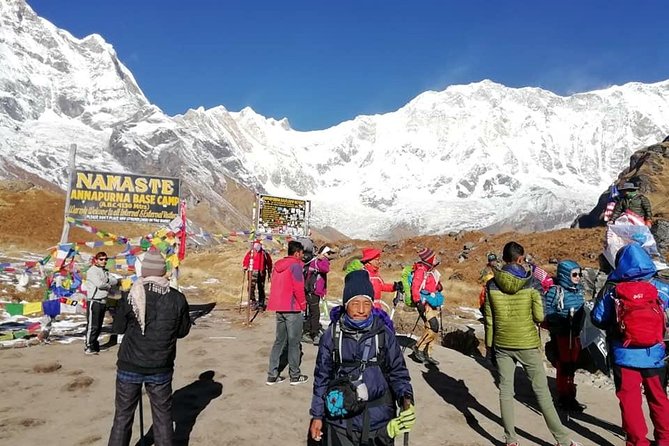
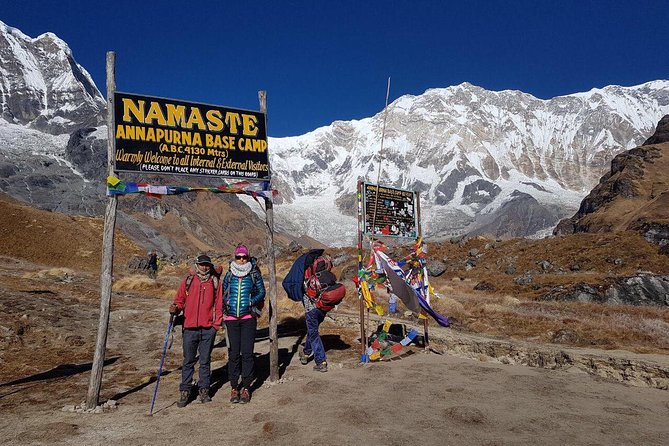
- Annapurna Base Camp is the trek’s main goal
- Bamboo, Chhomrong, and Jhinu complete the return
- The return to Kathmandu takes most of a day
- What the personal service is like
- Who should book this route
- What to pack and budget for
- Should you book the Annapurna Base Camp trek?
- FAQ
- How long is the Annapurna Base Camp trekking experience?
- What is the price of the trek?
- Is airport pickup included?
- Is this a private tour?
- What level of fitness is required?
- Are meals included?
- Is accommodation included?
- Is transportation included?
- Are trekking permits included?
Key points at a glance
- Poon Hill sunrise: An early climb to 3,210 meters brings wide views of the Annapurna and Dhaulagiri ranges.
- Private support: Your group has an English-speaking guide, with one porter assigned for every two trekkers.
- Classic Annapurna route: You walk through rhododendron and bamboo forests, Gurung and Magar villages, suspension bridges, and mountain valleys.
- Annapurna Base Camp finish: The route reaches the base camp area after passing Machhapuchhre Base Camp and Deurali.
- Jhinu hot springs: The return includes a stop at Jhinu Danda, known for its hot spring.
- Strong personal care: Guides named Bishnu Bhatta, Vishnu, and Prem dai have been praised for friendly, attentive service and help with food and comfort.
What this Annapurna trek actually offers
At $899 per person, this is a packaged private trek designed to remove the fiddly parts of a Nepal journey. Airport pickup, Kathmandu and Pokhara hotels, tourist-bus transfers, trekking permits, teahouse stays, meals during the trek, a guide, and porter service are all included.
That price is useful if you value a fixed plan and direct help on the trail. Booking each piece separately can take time, especially when you are arranging permits, transport, local accommodation, and a porter. Here, the company handles those details.
The price is not all-inclusive in the broad resort sense. Lunch and dinner in Kathmandu and Pokhara cost extra. So do bottled or boiled water, hot showers, hot drinks, soft drinks, laundry, phone calls, charging, bar bills, sightseeing entrance fees, and tips. Extra hotel nights caused by early arrival, late departure, or an early return from the mountains are also excluded.
The most important value is the support system. A private English-speaking guide gives you one point of contact throughout the trek. Porters carry luggage at a ratio of one porter for every two trekkers, while the company covers their salary, insurance, equipment, food, lodging, and transport.
More Annapurna Base Camp Treks:
- Annapurna base camp trek 5 Days
★ 5.0 · 252 reviews - Annapurna Base Camp Trek
★ 5.0 · 111 reviews - Kathmandu to Annapurna Base Camp (ABC) 5-Day Trek
★ 5.0 · 102 reviews
Kathmandu begins with four major sights
Your first day is simple. A representative from Himalayan Sanctuary Adventure picks you up at Tribhuvan International Airport and takes you to the hotel in Kathmandu. That airport transfer matters after a long flight, since arriving in Kathmandu can feel confusing even before you have adjusted to Nepal time.
Day two is devoted to Kathmandu Valley sightseeing and trek preparation. You visit Boudhanath Stupa, Pashupatinath Temple, Patan Durbar Square, and Swayambhunath Stupa.
Boudhanath is a huge Buddhist stupa east of central Kathmandu. Its white dome and great painted eyes give you a strong first look at Nepal’s Buddhist traditions. Pashupatinath, beside the Bagmati River, is one of the country’s most important Hindu shrines. The two sites together show the religious variety of the valley.
Patan Durbar Square brings carved palace courtyards, pagoda temples, bronze statues, and the stone Krishna Temple. Swayambhunath sits on a hill above the valley and is also called the Monkey Temple. The stairs and hilltop setting make it a useful preview of Nepal’s constant ups and downs.
Entrance fees are not included, so keep that cost separate. The day is also more than sightseeing. It gives you time to meet the guide, prepare for the trail, and settle into the trip before the long road to Pokhara.
The six-hour road to Pokhara
On day three, staff collect you from your Kathmandu hotel around 6:30 a.m. and escort you to the tourist bus station. The bus is scheduled to leave around 7:00 or 7:30 a.m., and the ride to Pokhara takes about six hours.
Pokhara is a calmer base than Kathmandu, set beside Phewa Lake and framed by views toward Annapurna, Machhapuchare, Dhaulagiri, Lamjung Himal, and Manaslu. The journey is not a quick transfer, so plan for a full travel day rather than a relaxed morning followed by an afternoon stroll.
This is one place where the organized format earns its keep. You do not need to find the bus station or work out the onward connection to Nayapul yourself. The tradeoff is that a tourist coach is slower and less flexible than private transport.
Nayapul to Ulleri begins with villages and stone steps
The trek starts on day four after a private vehicle takes you from Pokhara to Nayapul. A short walk beside the Modi Khola leads to Birethanti, a sizable village with shops and teahouses.
From there, the route follows the Bhurungdi Khola through Hille and Tikhedhunga before reaching Ulleri. The first day is described as five to seven hours, though the route notes also call it relatively short and easy. That difference reflects the reality of mountain walking: your time depends on pace, stops, weather, and how your legs handle the early climb.
Ulleri is a large Magar village at roughly 2,070 meters. The route from the low valley to this height gives you an immediate feel for the trek. It is not technical mountaineering, but the trail can be tiring, especially when stone steps begin to dominate the route.
More Treks and Hikes:
- Everest Base Camp Trek – 14 Days
★ 5.0 · 1,499 reviews - Everest Base Camp Trekking
★ 5.0 · 485 reviews - Nagarkot Sunrise View and Day Hiking from Kathmandu
★ 5.0 · 471 reviews - Annapurna Circuit Trek with Tilicho Lake
★ 5.0 · 368 reviews
Ghorepani and Poon Hill deliver the first big view
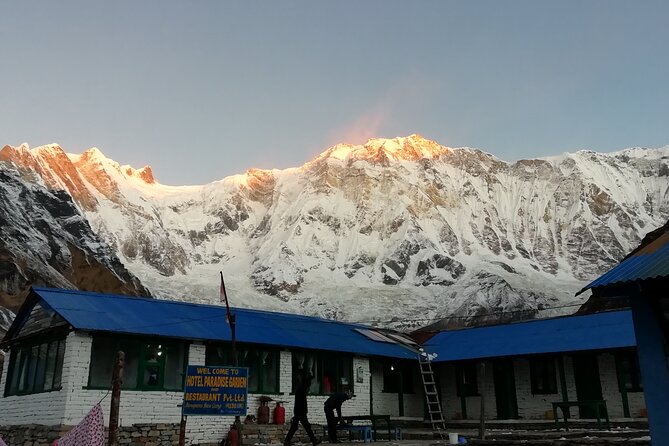
Day five climbs through oak and rhododendron forest toward Banthanti and Nangethanti, then continues to Ghorepani. The stated walking time is four to five hours, and Ghorepani sits around 2,750 to 2,840 meters depending on the itinerary figure used.
The next morning is the scenic high point for many people. You rise early for the one-hour walk to Poon Hill at 3,210 meters. The reward is sunrise over the Annapurna and Dhaulagiri ranges, with views toward Mustang, Pokhara, and more than 20 high peaks.
You return to Ghorepani for breakfast, then continue toward Tadapani. The trail climbs a ridge before dropping through rhododendron forest, past waterfalls, and into Tadapani. The full day takes about six to seven hours.
Poon Hill is valuable because it gives you a major Himalayan viewpoint without waiting until the final base camp days. It also tests how your body responds to an early climb at altitude. Bring warm layers for the morning, since the schedule begins before sunrise.
Tadapani to Chhomrong crosses classic hill country
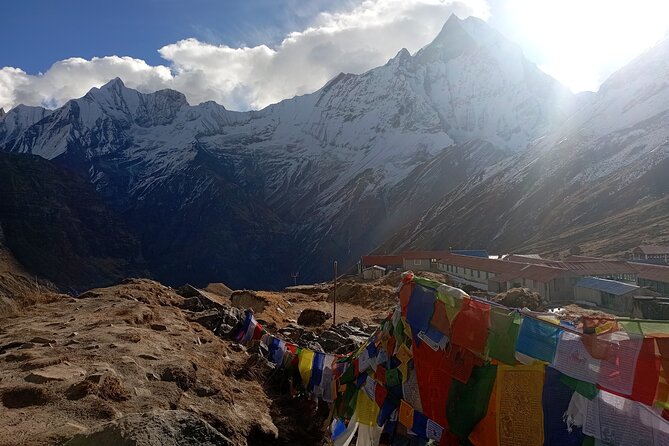
From Tadapani, the trail descends through a large rhododendron forest and opens onto terraced fields. You pass waterfalls and a suspension bridge before continuing through a mix of uphill and downhill sections to Chhomrong.
Chhomrong sits below the Annapurna massif at about 2,170 meters. It is a memorable village stop because the route begins to feel more enclosed by the mountains. The day takes around five to six hours.
This section is not simply a steady climb. Nepal’s trails often trade height for distance, dropping into a valley before climbing again. That pattern can be harder than a smooth ascent, so use the guide’s pace and do not spend all your energy early in the day.
Bamboo forest, Dovan, and Deurali mark the high route
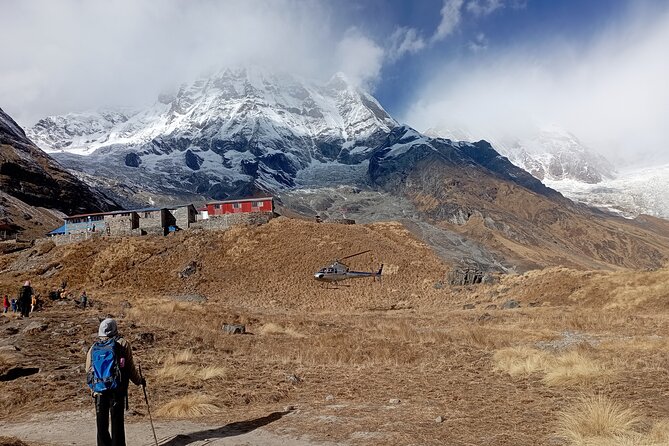
Day eight leads from Chhomrong toward Dovan through damp bamboo forest. The trail can be steep, and the vegetation gradually thins as you gain height.
Beyond Himalaya Hotel, the forest opens and the views become broader. You pass Hinku Cave, descend to a river, then climb again toward Dovan. Waterfalls, cliffs, the river below, and views toward Dhaulagiri add variety to a day that lasts about five to six hours.
From Dovan to Deurali, the route follows the valley in a steady climb. It sometimes clings to a rocky cliff and can be steep. The walk takes roughly five to six hours.
At this point, the simple teahouse arrangement becomes important. Accommodation is basic, and hot water, showers, drinks, charging, and bottled or boiled water are not included. You should budget for these extras and expect mountain comfort rather than hotel comfort.
Annapurna Base Camp is the trek’s main goal
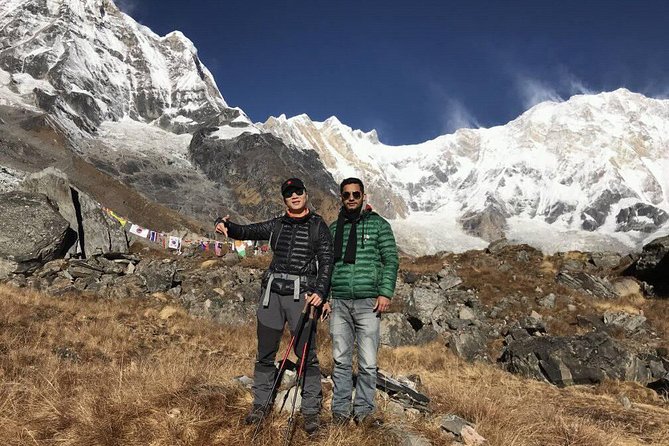
The route from Deurali to Annapurna Base Camp takes about five to seven hours. It follows a rocky valley trail and passes Machhapuchhre Base Camp before continuing toward Annapurna Base Camp.
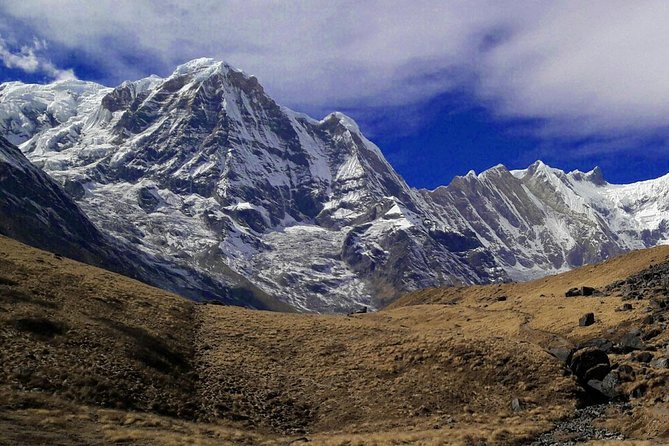
The setting changes as the forest gives way to a more open, high mountain environment. The final approach is not a casual walk, but the schedule allows a full day for the ascent. Your guide’s role is especially useful here, since pace, rest breaks, and conditions matter more at higher elevation.
The supplied itinerary uses Deurali in one day heading upward, then lists Deurali again on the return. The detailed plan clarifies the intended sequence: reach Annapurna Base Camp, then retrace the route down through Machhapuchhre Base Camp, Deurali, Himalayan Hotel, and Doban before spending the night at Bamboo.
That return day takes five to seven hours and is downhill, but downhill does not mean easy. The stone and rocky sections can be rough on knees, particularly after the effort of reaching base camp.
Bamboo, Chhomrong, and Jhinu complete the return
From Bamboo, you retrace the trail toward Chhomrong and stop for lunch. The route then makes a steep descent toward the Modi Khola valley, including stone steps that can be tricky in both directions.
The next stage reaches Jhinu Danda. This is one of the trip’s most welcome recovery points. You have time to enjoy the hot spring and the surrounding hills before continuing through western Nepal’s countryside.
The schedule says you overnight at Jhinu and then walk toward Nayapul before driving back to Pokhara. The route information gives day 13 as the return to Pokhara, with about five hours of walking and driving included in the day’s plan.
After the full trek, you spend the night in Pokhara. That gives you a softer landing before the final road journey, though lunch and dinner in Pokhara are your responsibility.
The return to Kathmandu takes most of a day
After breakfast on day 14, you take a tourist bus from Pokhara to Kathmandu. The ride is listed as seven to nine hours, so do not plan an important evening commitment in Kathmandu.
The tour is advertised as approximately 14 days, while the overview also calls it a 15-day experience. Ask the provider to confirm the exact number of hotel nights, the final departure day, and how the Pokhara return is counted before paying.
The listed meeting time is 6:45 a.m., but several daily instructions use nearby times such as 6:30 or 7:00 a.m. Confirm the pickup details locally with the company.
What the personal service is like
The strongest praise connected with this company centers on care. Bishnu Bhatta and Vishnu have been named as guides, while Prem dai has been singled out for being friendly. One solo participant described being looked after from airport arrival through departure, including attention to food and stomach comfort.
That matters on a trek where small problems can grow quickly. A good guide can help you keep a sensible pace, manage the day’s logistics, and decide how to handle changing conditions. The company has also received praise for supporting older, average-fit trekkers and for making the experience feel manageable.
Still, this is a private trek, not a luxury trek. Your guide can provide personal attention, but the trail remains steep, the bus rides remain long, and teahouse facilities remain basic.
Who should book this route
I would recommend this trip to you if you want a classic Nepal trekking experience without planning every permit, transfer, and overnight stop yourself. It suits people with moderate fitness who can handle repeated five to seven-hour walking days, steep climbs, descents, and high-altitude conditions.
It is also a good fit if you want Kathmandu culture before the mountains, Poon Hill as an early scenic reward, and a hot spring on the way back. The private format works well for friends, couples, families with suitable fitness, or a small group that wants some control over pace.
I would be more cautious if you want short walking days, polished hotels throughout, private road transfers, or a fixed luxury budget. You should also ask about weather planning. One past group could not continue to base camp because of weather, and the company arranged the trip around that limitation. Mountain itineraries need room for changes.
What to pack and budget for
The supplied price covers the major structure, but you should bring extra money for:
- Kathmandu and Pokhara lunches and dinners
- Sightseeing entrance fees
- Bottled or boiled water
- Hot drinks and showers
- Phone use, laundry, charging, and bar bills
- Tips for your guide and porter
- Extra hotel nights if the schedule changes
Pack for a wide range of conditions. The route moves from lower valleys into cold bamboo forest and high mountain terrain, with an early morning at Poon Hill. Warm layers, practical walking shoes, rain protection, and a day bag are sensible choices, though the exact equipment list is not provided.
Free cancellation is available if you cancel at least 24 hours before the local start time. Changes made inside that window are not accepted, and the payment is not refunded.
Should you book the Annapurna Base Camp trek?
Book it if you want a well-supported Annapurna route at a clear package price, and you are comfortable with basic teahouses, long road transfers, and demanding walking days. The combination of Poon Hill, Annapurna Base Camp, Kathmandu’s major religious sites, and Jhinu hot spring gives you a lot of Nepal in one trip.
Before booking, confirm the 14-day versus 15-day wording, the exact hotel nights, current road arrangements, and what happens if weather blocks the base camp route. If those details suit you, the private guide, porter support, included permits, and personal care make this a solid value for an active first trek in Nepal.
FAQ
How long is the Annapurna Base Camp trekking experience?
It is advertised as approximately 14 days, while the overview also describes it as a 15-day tour. Confirm the exact duration and number of nights with the provider before booking.
What is the price of the trek?
The listed price is $899 per person.
Is airport pickup included?
Yes. A representative picks you up from Tribhuvan International Airport and transfers you to your Kathmandu hotel.
Is this a private tour?
Yes. Only your group participates in the trekking activity.
What level of fitness is required?
A moderate level of physical fitness is required. Walking days generally last about four to seven hours and include steep climbs, descents, rocky trails, and stone steps.
Are meals included?
Breakfast is included at the Kathmandu and Pokhara hotels. During the trek, teahouse accommodation includes breakfast, lunch, and dinner. Lunch and dinner in Kathmandu and Pokhara are not included.
Is accommodation included?
Yes. Three-star category hotels in Kathmandu and Pokhara include breakfast, while teahouses provide accommodation during the trek.
Is transportation included?
Transportation includes tourist-coach service between Kathmandu and Pokhara, airport pickup, the Pokhara to Nayapul transfer, and the return drive from the trekking area to Pokhara.
Are trekking permits included?
Yes. The Annapurna Conservation Area Permit, or ACAP, TIMS, required paperwork, government taxes, and local taxes are included. Sightseeing entrance fees are not included.
Just added around Kathmandu
- Private Shopping Tour in Kathmandu★ 5.0 · 3 reviews
- Nagarkot Sunrise With 7 UNESCO World Heritage Private Tour★ 5.0 · 3 reviews
- Kathmandu: Nightlife and Pub Crawl Tour★ 5.0 · 3 reviews
- Mount Everest Scenic Flight 50 Minutes★ 5.0 · 3 reviews
- Kathmandu: Nagarkot, Bhaktapur, Doleswor & Sanga Statue Tour★ 5.0 · 3 reviews
- Momo Cooking Class -The Art Of Making MoMo with Home Chef★ 5.0 · 3 reviews
- Makalu Base Camp Trek★ 5.0 · 3 reviews
- Everest Experience Trek 6 Day Hiking Adventure★ 5.0 · 3 reviews
Annapurna Base Camp Treks, compared.



Kathmandu to Annapurna Base Camp (ABC) 5-Day Trek
Read our review →

Browse the lists this tour appears in