
Reviewed · TEMPLES & MONASTERIES
PashupatiNath and BoudhaNath – Private/Small Group
Sacred places tell Kathmandu’s story best. This three-hour tour links Pashupatinath and Boudhanath, giving you a clear introduction to Hindu and Buddhist beliefs, rituals, symbols, and Nepal’s unusual religious harmony. I like the small group size, limited to five people, and I like the guide-led explanations, especially when Santosh is available. The main consideration is the extra entrance cost, about $13 per person in cash, which brings the practical total close to $28.
You begin near Gaushala Bus Stop and finish at the Boudhanath Gate, a useful arrangement if you want to keep exploring the stupa area afterward. The schedule is full, and the cremation grounds can feel confronting, so this suits you best if you want cultural understanding rather than a quick photo stop.
In This Review
- Key points to know before booking
- Why this short Kathmandu tour works
- Starting at Pashupatinath Temple
- Aryaghat and the Hindu cremation tradition
- The deer park and Shiva’s local legend
- Gorakhnath and Guhyeshwari
- Arriving at Boudhanath Stupa
- Guru Lhakhang Monastery and Buddhist practice
- Thangka painting and singing bowls
- What the $15 price really covers
- Guide quality and the small-group advantage
- Timing, comfort, and practical limits
- Who should book this experience?
- Should you book Pashupatinath and Boudhanath?
- FAQ
- How long does the tour last?
- How many people can join the tour?
- Where does the tour start?
- Where does the tour end?
- Is the entrance fee included?
- Can non-Hindus enter the main Pashupatinath temple?
- Is the tour offered in English?
- Can I cancel for a full refund?
Key points to know before booking
- Two major faith sites in three hours: Visit Pashupatinath, Aryaghat, Guhyeshwari, and Boudhanath in one compact outing.
- A maximum of five people: The small group makes it easier to ask questions and discuss sensitive religious customs.
- Hindu and Buddhist traditions explained together: Learn about the 16 Hindu rites of passage, Buddhist teachings, prayer flags, the five elements, and the Four Noble Truths.
- The main Pashupatinath temple is restricted: Only Hindus may enter the central temple, though the route continues toward Aryaghat and other nearby shrines.
- A practical finish at Boudhanath: The tour ends at the stupa gate, so you can remain in the area or make your own way back.
- Strong guide feedback: Santosh is praised for his explanations, flexibility, and interest in culture, food, history, and archaeology.
Why this short Kathmandu tour works
Kathmandu has no shortage of temples and shrines. The challenge is knowing what you are looking at. A carved figure may represent a god, a protective symbol, a teaching, or a story that makes little sense without local context.
This tour solves that problem by pairing two important religious centers. Pashupatinath introduces you to Hindu worship, death rituals, Shiva traditions, and the idea of life passing through a series of sacred stages. Boudhanath then shifts the focus to Tibetan Buddhism, meditation, monastic life, and Buddhist ideas about suffering and release.
I like this pairing because it gives you contrast without turning the visit into a classroom lecture. You see how two traditions use sacred space in different ways, then notice how closely they exist beside each other in Kathmandu. The guide also discusses cultural links and the way religious communities influence local food and daily life.
The group limit matters. With no more than five people, you can stop to ask what a ceremony means or request a clearer explanation of a symbol. Past feedback gives Santosh special praise for answering many questions and adjusting the timing when someone wanted to see an aarati ceremony. That kind of flexibility can make a big difference, though an aarati stop should be treated as a possibility, not a promise.
More Temples, Stupas and Monasteries:
- Kathmandu Spiritual Sites: Bodhnath & Pashupatinath Tour
★ 5.0 · 185 reviews - Kathmandu: Chandragiri Cable Car and Monkey Temple Tour
★ 4.8 · 139 reviews - From Kathmandu: 2 Stupas and Kopan Monastery Spiritual Tour
★ 4.8 · 115 reviews
Starting at Pashupatinath Temple
The meeting point is Gaushala Bus Stop on Ring Road, near Pashupatinath. Confirmation arrives when you book, and the site is close to public transportation.
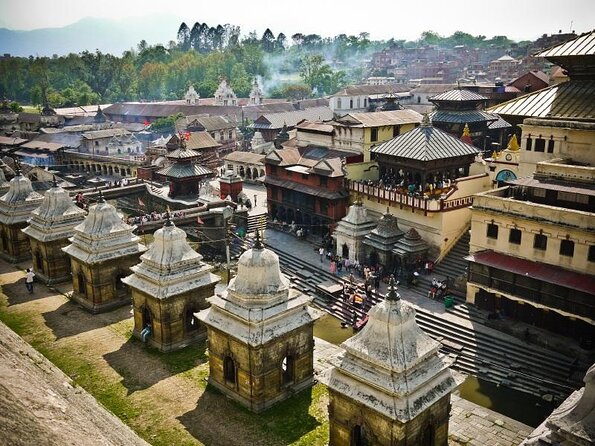
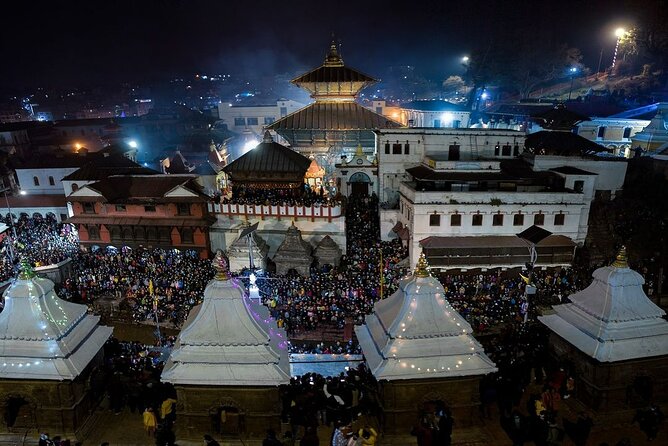
Pashupatinath is the oldest Hindu temple in Kathmandu Valley and one of the most important Hindu pilgrimage sites in the region. Its central temple is not open to non-Hindus. Your visit therefore focuses on the surrounding religious area and the route toward Aryaghat rather than entry into the main shrine.
That restriction is not a flaw in the tour. It is an important part of understanding the site. Religious buildings often have rules that shape the visit, and a good guide helps you see the place respectfully without treating the closed door as a disappointment.
The guide explains the role of Shiva and the stories tied to Pashupatinath. You will also hear about the 16 Samskaras, or Hindu rites of passage. These customs mark key stages in a person’s life, from birth through death. The subject gives you a useful framework for understanding why the temple complex is connected not only with worship, but also with family ceremonies and final rites.
The scheduled time here is about 15 minutes, so expect a focused introduction rather than a long, unhurried exploration. If you want extensive time for photography or quiet observation, this portion may feel brief.
Aryaghat and the Hindu cremation tradition
The next stop is Aryaghat, the cremation area beside the Bagmati River, with about 30 minutes set aside for explanation. This is the most emotionally demanding section of the tour.
You may see cremation activity, and the guide explains how Hindu last rites are carried out. The purpose is not spectacle. It is to place what you see within Hindu beliefs about death, the body, family duty, and the passage from one stage of existence to another.
This is where the discussion of the 16 Samskaras becomes more concrete. You can ask questions about how the rites fit into a person’s life and why the final ceremony has such importance for the family. Santosh has been praised for explaining religious ceremonies and their symbolism in a way that makes the setting easier to understand.
You should approach Aryaghat with discretion. This is an active religious and funeral site, not a performance arranged for visitors. Keep your behavior quiet and respectful, and follow your guide’s advice about where to look and when photography is inappropriate.
Some people will find this stop unforgettable. Others may find it upsetting or simply too direct. If you prefer temples, art, and architecture without confronting death rituals, this tour may not be the right fit.
The deer park and Shiva’s local legend
Mrigasthali Deer Park receives about 15 minutes. The guide tells the story of Lord Shiva’s journey to this place and explains how the area got its name.
The stop gives the schedule a small change of pace after Aryaghat. You can explore the surrounding area while hearing how local mythology shapes the names and identities of Kathmandu’s sacred sites.
Do not expect a long wildlife visit. The itinerary allows only a short period here, and the main purpose is the story and religious setting. I see it as a connecting stop rather than a major attraction on its own.
A few more trips worth weighing up before you book
- Everest Base Camp Trek – 14 Days
★ 5.0 · 1,499 reviews - Private Kathmandu Sightseeing Tour | UNESCO World Heritage sites
★ 5.0 · 756 reviews - Everest Base Camp Helicopter Tour landing at Everest View Hotel
★ 5.0 · 668 reviews - Half day cooking class in Thamel kathmandu
★ 5.0 · 607 reviews
Gorakhnath and Guhyeshwari
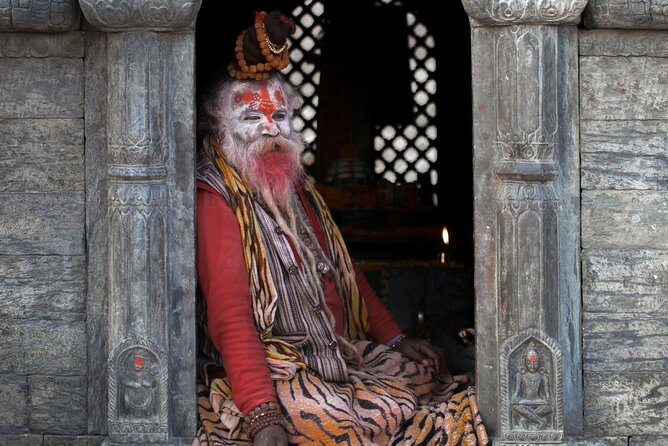
At Gorakhnath Mandir, the group takes a short rest and hears the story of Guru Gorakhnath. This stop lasts about 30 minutes, giving the guide time to explain the temple and its place in the route toward Boudhanath.
The schedule then continues through Guhyeshwari Shaktipeeth Temple. The guide discusses Satidevi and the idea of a Shaktipeeth, a sacred place linked with the divine feminine in Hindu tradition. The route takes about 20 minutes to reach Boudhanath, with the story continuing along the way.
These stops are valuable because they widen the Hindu section beyond Pashupatinath. You are not seeing one famous temple in isolation. You are hearing how legends, shrines, pilgrimage, and local geography connect.
The itinerary lists admission as included at Gorakhnath and free at Guhyeshwari. At Pashupatinath, the admission fee is not included. The stated fee is NRP 1,000, about $9, paid in cash at the entrance.
Arriving at Boudhanath Stupa
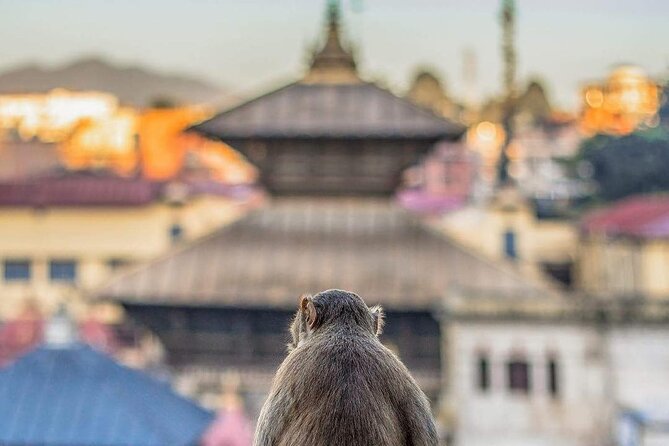
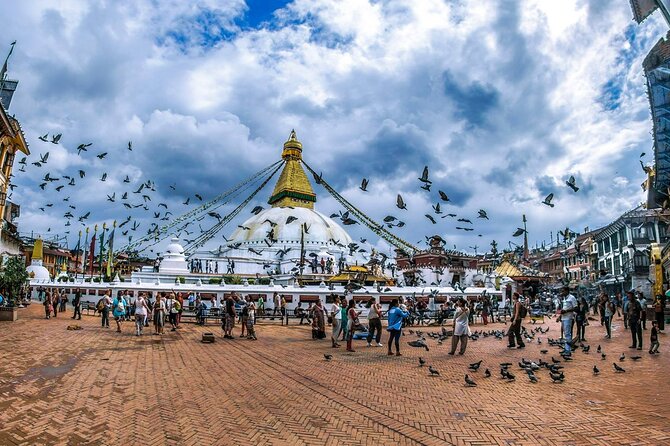
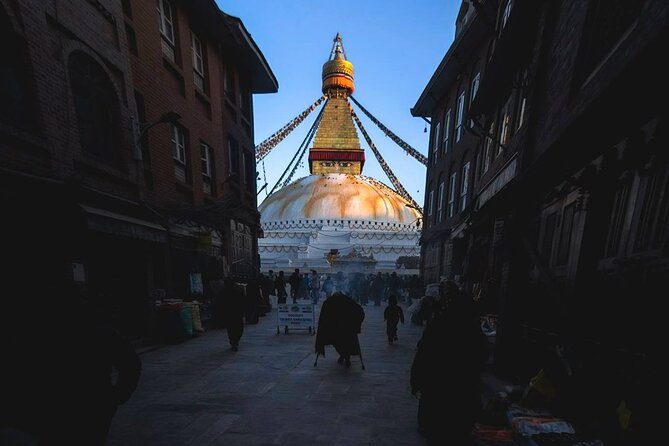
Boudhanath is the tour’s main Buddhist setting, with about 45 minutes planned here. It is described as the second-largest stupa of its kind in the world and is especially associated with Tibetan, or Vajrayana, Buddhism.
The guide introduces the basic teachings of Buddhism, including the Four Noble Truths and the Eightfold Path. You also learn about prayer flags and the five elements. These explanations help turn the stupa from a striking white-and-gold structure into a place with a religious purpose.
The stupa is designed for movement and attention. You will learn about prayer practices and the meaning of the structure while observing the surrounding Buddhist activity. Rather than simply circling the monument for photographs, you gain a way to read its symbols.
Boudhanath also shows a different religious atmosphere from Pashupatinath. The Hindu site is closely tied to temple worship, Shiva, family rites, and cremation. Boudhanath focuses more on Buddhist teachings, devotional practice, monastic life, and the visual language of Vajrayana Buddhism.
The entrance fee is not included here either. The stated charge is NRP 400, about $4, payable in cash. Together, the two main entrance fees total approximately $13 per person.
Guru Lhakhang Monastery and Buddhist practice
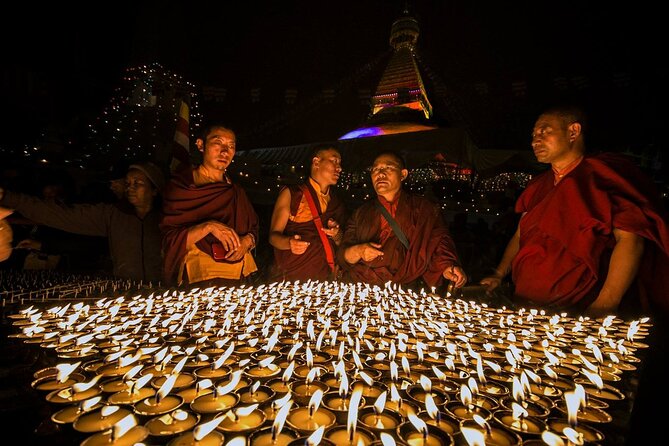
Guru Lhakhang Monastery is a short 10-minute stop. The guide explains what a typical Buddhist monastery looks like and discusses Guru Padmasambhava and Dharma Chakra Pariwartana.
This is a quick visit, but it adds a human scale to the monumental stupa. You see how Buddhist practice exists in a monastery setting rather than only in a large public pilgrimage site.
Because the stop is short, you should expect an introduction instead of a detailed monastery study. The admission is listed as included, and the guide’s explanation is the main reason to include it in the route.
Thangka painting and singing bowls
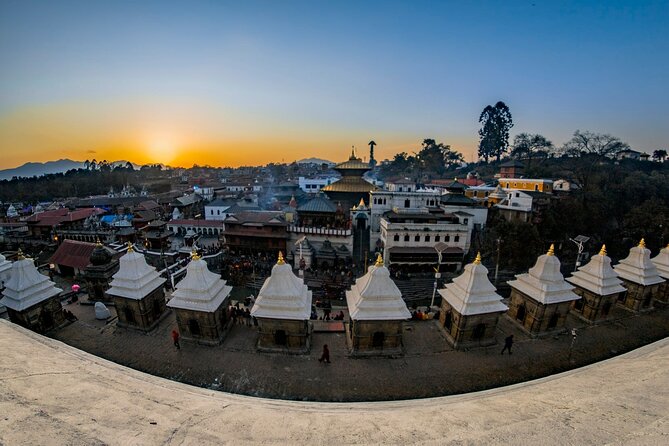
The final stop is the Boudha Stupa Thangka Center, with about 15 minutes set aside. Here you learn about thangka painting, mandalas, and the basics of healing bowls.
Thangka art is a detailed Buddhist painting tradition, and the mandala gives you another way to understand Buddhist ideas through geometry and symbol. The visit can be especially useful if you have seen thangka paintings in shops but never understood their religious purpose.
The center is also described as a school, so the stop has an educational angle rather than being only a shopping visit. Still, you should keep your expectations measured. Fifteen minutes is enough for an introduction, not for a full art lesson.
The tour ends at the Boudhanath Gate. You are free to continue exploring around the stupa after the guide leaves, which is one of the best practical features of the route. The ending also means you are not returned to the starting point, so plan your onward transport or arrange your own way back.
What the $15 price really covers
At $15 per person, the tour is priced as an affordable guided introduction. That fee covers the English-speaking guide, not the two major entrance tickets.
Add about $9 for Pashupatinath and $4 for Boudhanath, both paid in cash, and your likely total becomes about $28 per person. For a three-hour tour with a maximum of five people, that is fair value if you want interpretation rather than a self-guided walk.
The value comes mainly from the guide. The sites themselves are easy to locate, but the meanings behind cremation rites, Shaktipeeth traditions, prayer flags, mandalas, and Buddhist teachings are harder to grasp on your own. Several comments praise Santosh for his culture, history, archaeology, and food knowledge, which suggests the conversation can extend beyond basic facts.
Group discounts are available, and a mobile ticket makes booking simple. The tour is often reserved about 18 days ahead, so you should not leave it until the last minute if your Kathmandu schedule is fixed.
Guide quality and the small-group advantage
The strongest theme in the available feedback is the guide’s personal attention. Santosh is repeatedly praised for being friendly, patient, enthusiastic, and willing to answer questions. One person also noted that he adjusted the schedule to make room for an aarati ceremony.
Another strong point is flexibility. Santosh has accommodated questions, personal interests, and even a change in pace when someone was not feeling well. That does not guarantee every guide will make the same adjustment, but it is worth telling your guide what you hope to understand before the tour begins.
Shreya is also named in feedback for other Kathmandu and Bhaktapur touring, with praise for patient explanations and adapting the visit to personal interests. The guide assigned to this booking may vary, so confirm the name if having Santosh is important to you.
With only five people, the tour should feel more like a conversation than a march behind a flag. You can ask about religious harmony, local customs, cuisine, or a ceremony that puzzles you. That is especially useful at Pashupatinath, where context and sensitivity matter.
Timing, comfort, and practical limits
The total duration is about three hours. The timing is tight, with several short stops and a route that continues from Pashupatinath toward Boudhanath. You should arrive ready to keep moving and avoid bringing a schedule that requires a precise finish beyond the stated end time.
The tour begins at a bus stop and ends at the Boudhanath Gate, not back at the start. It is near public transportation, and most people can participate. Service animals are allowed.
The two main entrance fees require cash. Bring enough Nepalese rupees for both, since the stated prices are NRP 1,000 and NRP 400. The English-speaking guide is included, while the entrance tickets are not.
You can cancel for a full refund up to 24 hours before the start time. Cancellations or changes made within 24 hours are not accepted for a refund, and the cut-off uses local time.
Who should book this experience?
I would choose this tour if you are visiting Kathmandu for the first time and want a clear introduction to two major faith traditions. It also suits you if you enjoy asking questions and prefer a guide who can explain symbolism instead of only naming buildings.
It is a good match for people interested in religious studies, local customs, art, archaeology, and the way food and culture cross religious lines in Nepal. The small group is helpful for solo visitors and couples who want conversation without paying for a fully private guide.
You may want a different plan if you need a slow photography tour, dislike discussions of death, or want long visits inside each religious site. The schedule gives you breadth, not deep time at every stop. The central Pashupatinath temple is also closed to non-Hindus, so expectations matter.
Should you book Pashupatinath and Boudhanath?
Book it if you want the meaning behind Kathmandu’s religious sites, not just the buildings. The combination of Pashupatinath’s Hindu rites and Boudhanath’s Buddhist teachings is well chosen, and the group limit keeps the visit personal.
Before booking, budget the extra $13 entrance cost, carry cash, and remember that the tour ends at Boudhanath. If possible, ask whether Santosh is available and mention any special interest, such as aarati, Buddhist art, or Hindu ceremonies. For a modest starting price and a focused three-hour route, this is a useful first look at Kathmandu’s spiritual life.
FAQ
How long does the tour last?
The tour lasts approximately three hours.
How many people can join the tour?
The group has a maximum of five people.
Where does the tour start?
It starts at Gaushala Bus Stop, P84V+VR2, Ring Road, Kathmandu 44600, Nepal.
Where does the tour end?
It ends at the Boudhanath Gate, near Buddha Stupa in Kathmandu. You are free to continue exploring Boudhanath afterward or return to your accommodation.
Is the entrance fee included?
No. Pashupatinath costs NRP 1,000, about $9, and Boudhanath costs NRP 400, about $4. Both fees are paid in cash at the entrance.
Can non-Hindus enter the main Pashupatinath temple?
No. Only Hindus may enter the main temple. The tour continues through the surrounding area and toward Aryaghat.
Is the tour offered in English?
Yes. An English-speaking guide is included.
Can I cancel for a full refund?
Yes. You can cancel at least 24 hours before the local start time for a full refund. Cancellations or changes made less than 24 hours before the start time are not refunded or accepted.
Just added around Kathmandu
- Private Shopping Tour in Kathmandu★ 5.0 · 3 reviews
- Nagarkot Sunrise With 7 UNESCO World Heritage Private Tour★ 5.0 · 3 reviews
- Mount Everest Scenic Flight 50 Minutes★ 5.0 · 3 reviews
- Kathmandu: Nightlife and Pub Crawl Tour★ 5.0 · 3 reviews
- Kathmandu: Nagarkot, Bhaktapur, Doleswor & Sanga Statue Tour★ 5.0 · 3 reviews
- Momo Cooking Class -The Art Of Making MoMo with Home Chef★ 5.0 · 3 reviews
- Makalu Base Camp Trek★ 5.0 · 3 reviews
- Kathmandu: Momo Making Class with a Local Chef★ 5.0 · 3 reviews
Temples & Monasteries, compared.
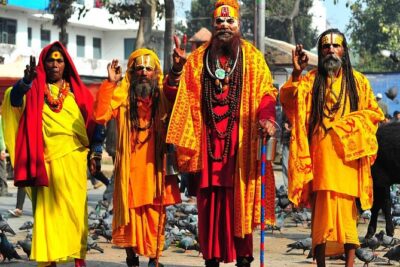
Kathmandu Spiritual Sites: Bodhnath & Pashupatinath Tour
Read our review →
Monkey Temple – Swayambhunath Tour – Private/Small Group
Read our review →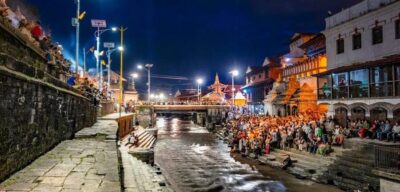
Dhulikhel, Namobuddha & Panauti: A Scenic Day Tour from Kathmandu
Read our review →Browse the lists this tour appears in