
Reviewed · ANNAPURNA CIRCUIT TREKS
10 Days Annapurna Circuit Trek
The high point is truly high. This 10-day Annapurna Circuit Trek takes you from Kathmandu through Manang, across Thorong La at 5,416 meters, and down toward Mustang. I like the blend of hard mountain walking and cultural stops, especially Manang village, Gangapurna Lake, and Muktinath Temple. I also like that the $1,430 price includes guides, porters, all meals, a sleeping bag, and the Jomsom to Pokhara flight. The main caution is simple: this is a serious high-altitude trek, not a gentle sightseeing holiday.
The route also has a practical strength: the trek is organized for a maximum of 15 people, with one porter assigned to every two people. Guides such as Babu and Resham have been praised for their care, while porter Rojit is remembered for being friendly and helpful. Still, road transfers, basic mountain accommodation, narrow trails, and fast altitude gain mean you should arrive fit and ready for long days.
In This Review
- Key points to know before booking
- What this Annapurna Circuit Trek really offers
- Day 1: Kathmandu to Besisahar by way of Manakamana
- Day 2: Forest trails and the arrival in Chame
- Day 3: Bridges, forest, and Paungda Danda
- Day 4: Pine forest and the approach to Manang
- Day 5: Manang village and Gangapurna Lake
- Day 6: Manang to Yak Kharka and Ledar
- Day 7: The narrow trail to Thorung Phedi
- Day 8: Thorong La and Muktinath
- Day 9: Down the Kali Gandaki Valley to Jomsom
- Day 10: Jomsom flight to Pokhara
- What the $1,430 price covers
- Guides, porters, and group size
- Who should book this trek
- Practical details before you go
- Should you book the Annapurna Circuit Trek?
- FAQ
- Where does the Annapurna Circuit Trek start?
- How long does the trek last?
- What is the highest point on the route?
- Is the Jomsom to Pokhara flight included?
- Are meals included?
- Is a porter included?
- Is bottled water included?
- How many people can join the group?
Key points to know before booking
- Thorong La reaches 5,416 meters: The pass is the trek’s great test and its biggest reward, with views toward the Dhaulagiri range.
- The price covers major costs: Meals, guide service, porters, sleeping bag, private transport, taxes, and the Jomsom to Pokhara flight are included.
- Manang gives the trek its best cultural pause: You have time to explore the village and walk to Gangapurna Lake.
- The route changes dramatically: Expect forest, pine, bare high mountain terrain, Tibetan-style villages, and the dry Kali Gandaki Valley.
- The final flight saves time: A morning flight from Jomsom to Pokhara replaces a long return journey by road.
- You need moderate fitness and altitude readiness: Narrow paths, steep climbs, and unstable slopes appear before Thorong La.
What this Annapurna Circuit Trek really offers
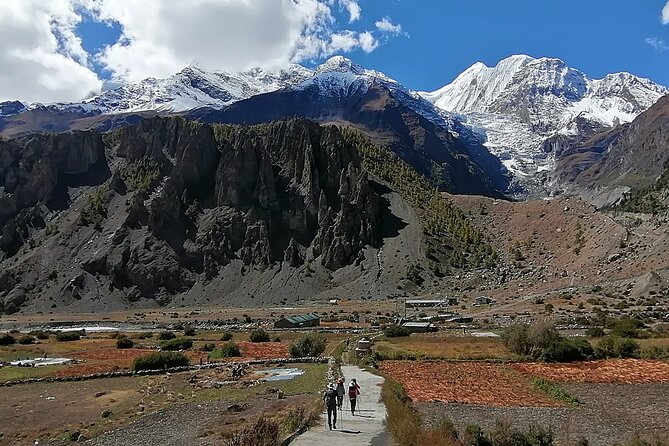
The Annapurna Circuit is famous because it keeps changing. You begin with a long drive from Kathmandu, then move through river valleys and forests before reaching the dry, high country around Manang and Mustang. The scenery shifts from green hills to pine woods, giant rock walls, snowy peaks, and stark mountain valleys.
This version covers roughly 160 to 230 kilometers, or about 100 to 145 miles, depending on the exact road and trail conditions. The 10-day schedule is fairly quick for such a demanding route. I would choose it if you want to see the circuit’s key sections and have limited time, but I would not treat it as a relaxed walking trip.
The route has a clear rhythm. Lower days involve transport and trail walking. The middle section brings altitude and long climbs. The climax comes at Thorong La, followed by a sharp descent into Muktinath and the Kali Gandaki Valley. That change is what makes the circuit so memorable, but it also means you need to take the early warning signs of altitude trouble seriously.
More Annapurna Circuit Itineraries:
- Annapurna Circuit Trek with Tilicho Lake
★ 5.0 · 368 reviews - Annapurna Circuit Trek
★ 5.0 · 94 reviews - Annapurna Circuit Trek
★ 5.0 · 35 reviews
Day 1: Kathmandu to Besisahar by way of Manakamana
Pickup is scheduled from the Himalayan Trekking and Tours office in Kathmandu at about 7:15 am, with the staff collection noted for 7:00 am. The drive to Besisahar covers about 185 kilometers and takes around seven hours. That is a long first day, so do not expect a warm-up walk of any real length.
The route includes Manakamana Temple. This gives the opening transfer a cultural stop rather than making it one long road haul. You then continue toward Besisahar, where the Annapurna scenery begins to feel more immediate.
The main drawback is the amount of time spent in the vehicle. Road conditions in Nepal can make a stated seven-hour journey feel tiring, and the itinerary does not provide much spare time. Still, reaching Besisahar on day one puts you in position for the mountain section that follows.
Day 2: Forest trails and the arrival in Chame
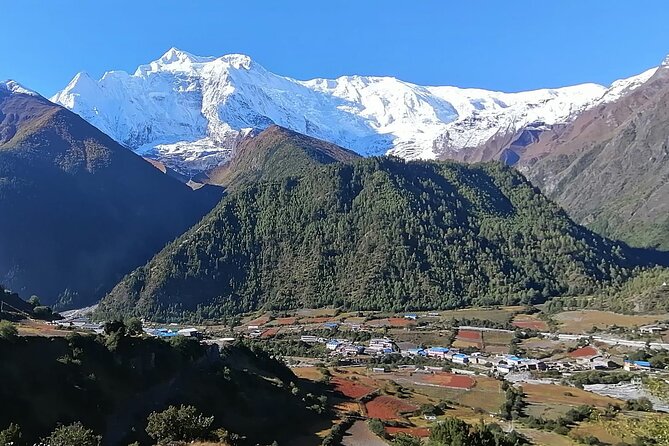
The trail climbs toward Tyanja at about 2,360 meters and continues through forest near the river to Kopar at roughly 2,590 meters. The day ends in Chame, headquarters of Manang district.
This is where the trek starts to feel like a proper Himalayan route. You gain height, walk beside the river, and move through wooded country before arriving at views of Annapurna II. Chame is not just a sleep stop. Its district headquarters role gives it a little more life and importance than a small trail settlement.
The climb is gradual in parts but should not be underestimated. You are already moving toward higher ground, and every day of gain matters later. I would use this day to settle into the group’s walking pace, test your boots, and pay attention to how your body handles the height.
Day 3: Bridges, forest, and Paungda Danda
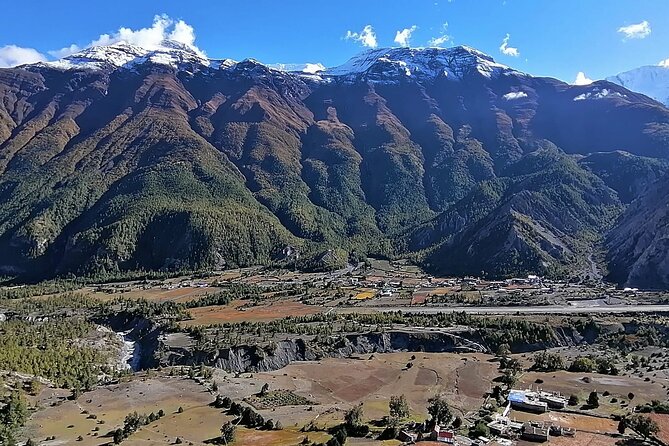
The route begins in a deep forest inside a steep, narrow valley. You cross a river on a long bridge at about 2,910 meters, then cross another bridge around 3,040 meters.
The striking feature here is Paungda Danda, a huge rock face that begins to reveal itself as you continue. The combination of high bridges, tight valley walls, and exposed rock gives the day a more dramatic feel than the earlier forest walking.
This is also a good reminder that the circuit is not a flat route with mountain views in the distance. You will cross uneven ground and deal with regular climbs. The trail descriptions point to real mountain terrain, so sturdy footwear and a measured pace matter more than speed.
More Treks and Hikes:
- Everest Base Camp Trek – 14 Days
★ 5.0 · 1,499 reviews - Everest Base Camp Trekking
★ 5.0 · 485 reviews - Nagarkot Sunrise View and Day Hiking from Kathmandu
★ 5.0 · 471 reviews - Everest Base Camp Trekking – 13 Day
★ 5.0 · 365 reviews
Day 4: Pine forest and the approach to Manang
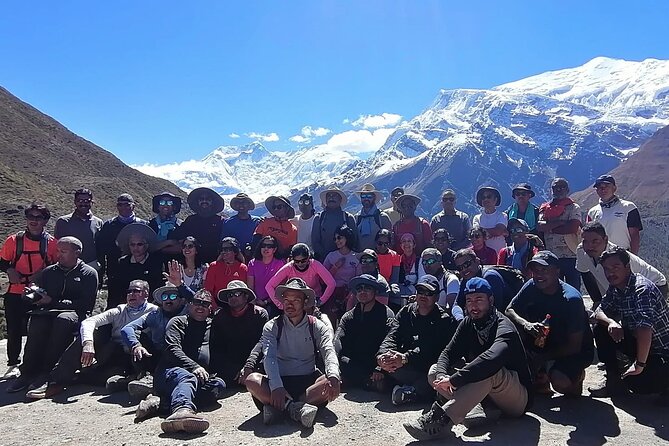
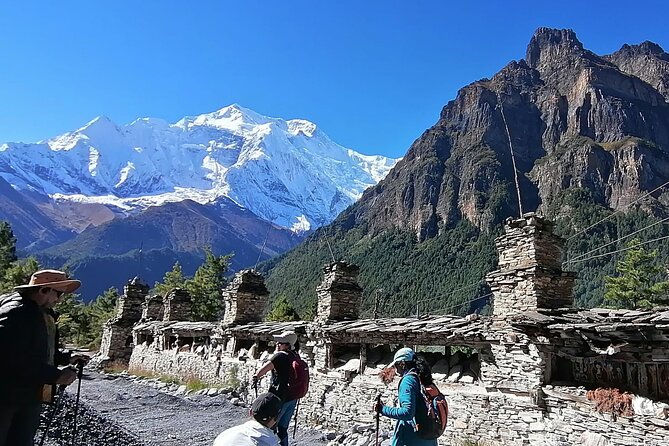
Aromatic pine woods lead you toward Manang. As the route opens, you can expect close views of Gangapurna, Annapurna II and III, Tilicho, Chulu East, and Pisang Peak.
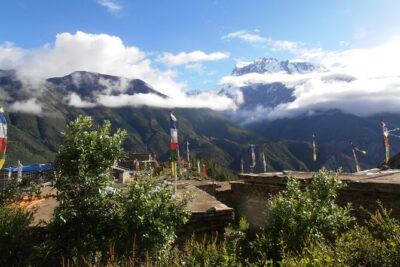
For many people, this is one of the most satisfying days. The forest gives way to wider views, and the great peaks feel much closer. Manang marks a major change in the trek, both visually and physically. You are now in a high mountain settlement with a stronger Tibetan influence in its setting and culture.
The key issue is altitude. Manang sits high enough that you should not rush through the evening or treat the dramatic scenery as proof that you are coping perfectly. Eat, drink what is available, sleep, and tell your guide promptly if you develop symptoms.
Day 5: Manang village and Gangapurna Lake
Day five is a welcome pause in Manang. You explore the village, interact with local people, and visit Gangapurna Lake.
I like this part of the schedule because it gives the trek a human center. The circuit is not only about collecting peaks and pass statistics. Time in Manang lets you see how mountain communities fit into the route and gives your legs a less punishing day before the harder climbs.
The itinerary lists a very long duration for this stop, but the practical value is the extra time in Manang rather than a literal 20-hour activity. Treat the day as a chance to adjust to the altitude and prepare for the upper valley.
Gangapurna Lake is especially worthwhile because it places you among the high peaks without requiring the effort of the Thorong La crossing. The exact walking distance and timing should be confirmed with your guide at the start of the trek.
Day 6: Manang to Yak Kharka and Ledar
You leave Manang and climb through the Marshyangdi Valley. The route includes strenuous ascents to Gunsang, then continues toward Yak Kharka and Ledar, where you stay overnight.
This is a demanding day because the air is thinner and the trail keeps climbing. The settlements become more scattered, and the scenery feels less sheltered than the lower forest sections. You may find the open setting beautiful, but you also lose the comfort of lower valleys and thick woods.
The schedule places you close to the pass without crossing it. That is useful, since the final ascent should not be rushed. Your guide’s judgment is especially important here. The strongest person in the group should not set the pace for everyone else.
Day 7: The narrow trail to Thorung Phedi
The trail follows the east bank of the Jorsang Khola toward Thorung Phedi. This section includes narrow paths and unstable slopes, with a tough approach before the overnight stop.
Thorung Phedi is the staging point for the pass crossing. It is not the place to spend your final evening wearing yourself out. Keep your kit organized, follow the guide’s instructions, and prepare for an early and strenuous next day.
This is one of the route’s less comfortable sections. The trail conditions described here are a real concern for anyone uneasy with exposed ground. The good news is that the itinerary does not try to cross Thorong La on the same day as the approach from Manang. You get an overnight stop before the biggest effort.
Day 8: Thorong La and Muktinath
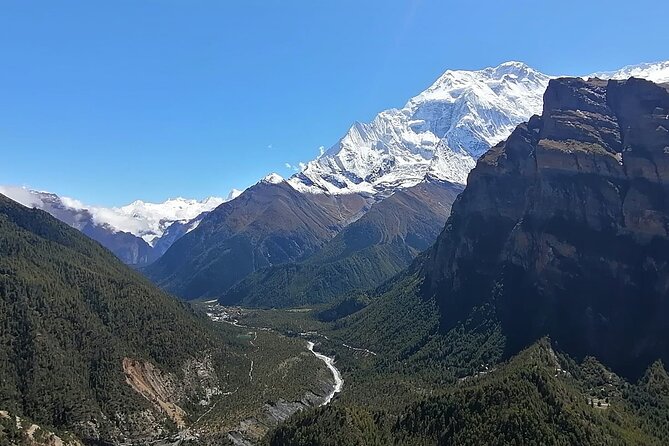
The pass crossing is the heart of the trek. Thorong La rises to 5,416 meters, and you follow rocky ridges toward the top. From there, the route offers views across the Dhaulagiri range.
Reaching the pass is a major physical achievement. The air will be thin, the climb can feel slow, and the high point may not be comfortable for long. The listed 15-minute stop at Thorong La reflects that reality: you may want photographs, but most people will not want to linger at this altitude.
The descent leads to Muktinath Temple, one of the most important religious sites in the Mustang region. This is a powerful contrast with the pass. Within the same day, you move from a stark high ridge into a sacred place with deep meaning for local worshippers.
The pass day is where the value of a good guide becomes clearest. One past trekker described the guides responding quickly when altitude trouble began. That is exactly the sort of support you want, but no guide can remove the need for careful pacing and honest communication.
Day 9: Down the Kali Gandaki Valley to Jomsom
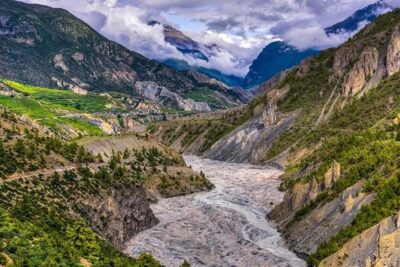
After Muktinath, the route descends through the dramatic Kali Gandaki Valley. The scenery becomes dry and almost desert-like, a sharp change from the pine forests and snowy upper valleys.
You pass through Jharkot and Khingar, described as typical Tibetan villages, then follow the valley floor toward Jomsom. This is a calmer day after the pass, though descending can still be hard on knees and ankles.
Jomsom is important because it links the walking route with the final flight. The town also gives you a chance to see how life in the Mustang area differs from the wetter, greener regions lower down. The contrast is one of the circuit’s strongest features.
Day 10: Jomsom flight to Pokhara
After breakfast, you take a morning flight from Jomsom to Pokhara. The flight follows the Kali Gandaki Gorge and offers views of Dhaulagiri and the Annapurna ranges.
This is an efficient ending. Instead of spending another long day on roads, you move quickly to Pokhara and have free time around the city. Boating on Fewa Lake is specifically suggested, giving you a gentler finish after nine demanding days.
Flights in mountain regions can be affected by conditions, so keep your final plans flexible. The itinerary includes the domestic flight, which is a major advantage, but you should still avoid scheduling an important same-day international connection without a buffer.
What the $1,430 price covers
At $1,430 per person, the package offers solid value for a guided 10-day high-altitude trek. It includes private transportation, all listed fees and taxes, a sleeping bag, guide service, porters, breakfast, lunch, dinner, and the Jomsom to Pokhara flight.
The porter arrangement is one porter for every two people. That gives you a practical way to reduce your load without expecting one porter to carry a full group’s equipment. You should still pack sensibly and confirm the baggage arrangement before departure.
Coffee and tea are included, while bottled water and alcoholic drinks are not. You will need to budget separately for drinking water and any alcohol. An air-conditioned vehicle is also not included, though that is not a meaningful concern for the high mountain walking sections.
The price becomes especially attractive because the flight and meals are already covered. It also removes much of the daily planning. You are paying not only for transport and food, but for a team that handles the route while you concentrate on walking.
Guides, porters, and group size
The group limit is 15 people, which is small enough to remain manageable but large enough that you will not be walking alone. The company’s service has received strong praise for organization and personal care.
Babu, also spelled Babo in one account, is described as helpful and good at introducing people to Nepal and the local area. Resham is praised for being accommodating, and porter Rojit is remembered for his friendly manner. Names matter here because they point to the human side of the service, not just the route.
You should confirm your guide’s name before departure, since staff assignments can change. Ask how the group handles altitude, what happens if someone needs to slow down, and how porter loads are divided. These questions are practical, not fussy.
Who should book this trek
I would recommend it to someone with moderate physical fitness who wants a fast, organized route across the Annapurna region. It suits you if you value mountain scenery, village life, cultural sites, and a clear support team more than private luxury.
It can also suit a first multi-day trek, provided you prepare properly. One first-time trekker described the organization and support as a major reason the trip worked well. That does not make the route easy, but it suggests the structure can help newcomers manage the challenge.
I would hesitate if you dislike long road transfers, basic mountain conditions, exposed trails, or rapid altitude gain. The 10-day schedule leaves less spare time than a slower itinerary, and the Thorong La crossing demands respect.
Practical details before you go
The meeting point is Himalayan Trekking and Tours on Yapikhya Marg 17 in Kathmandu. Pickup is listed for around 7:15 am, with staff arrival noted at 7:00 am, so be ready early.
Confirmation is provided when you book. The activity is near public transportation, although the trek itself moves far beyond the city and road access becomes limited.
Cancellation is free if you cancel at least 24 hours before the start time. Cancellations or changes made less than 24 hours before the start are not accepted for a refund. Cut-off times follow local time in Nepal.
Should you book the Annapurna Circuit Trek?
Book it if you want the essential Annapurna Circuit in a tightly organized 10-day format, especially if the included meals, porters, sleeping bag, private transport, and Pokhara flight simplify the planning. The strongest parts are the changing scenery, Manang rest day, Thorong La crossing, Muktinath, and the well-regarded guide and porter support.
Think twice if you want a slow trek with plenty of spare days or if high-altitude walking is new to you and you have not trained. Ask about current trail conditions, guide assignment, altitude procedures, and flight flexibility before paying.
For a fit walker who accepts a few hard days in exchange for an extraordinary route, this is a strong-value Nepal trek with a clear payoff at 5,416 meters.
FAQ
Where does the Annapurna Circuit Trek start?
The tour starts at Himalayan Trekking and Tours on Yapikhya Marg 17 in Kathmandu, Nepal.
How long does the trek last?
The experience lasts approximately 10 days.
What is the highest point on the route?
The highest point is Thorong La Pass at 5,416 meters.
Is the Jomsom to Pokhara flight included?
Yes. The domestic flight from Jomsom to Pokhara is included.
Are meals included?
Yes. Breakfast, lunch, and dinner are included throughout the scheduled trek.
Is a porter included?
Yes. Guide and porter service is included, with one porter assigned to every two people.
Is bottled water included?
No. Bottled water is not included. Alcoholic beverages are also excluded.
How many people can join the group?
The activity has a maximum group size of 15 people.
Just added around Kathmandu
- Private Shopping Tour in Kathmandu★ 5.0 · 3 reviews
- Nagarkot Sunrise With 7 UNESCO World Heritage Private Tour★ 5.0 · 3 reviews
- Mount Everest Scenic Flight 50 Minutes★ 5.0 · 3 reviews
- Kathmandu: Nightlife and Pub Crawl Tour★ 5.0 · 3 reviews
- Kathmandu: Nagarkot, Bhaktapur, Doleswor & Sanga Statue Tour★ 5.0 · 3 reviews
- Momo Cooking Class -The Art Of Making MoMo with Home Chef★ 5.0 · 3 reviews
- Everest Experience Trek 6 Day Hiking Adventure★ 5.0 · 3 reviews
- Kathmandu: Momo Making Class with a Local Chef★ 5.0 · 3 reviews
Annapurna Circuit Treks, compared.

15-Day Private Annapurna Circuit Trek from Kathmandu
Read our review →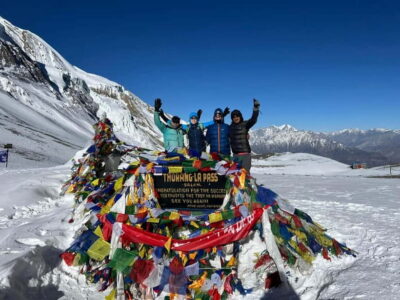
Browse the lists this tour appears in