
Reviewed · WORKSHOPS
Kathmandu: Wood Carving Workshop with Local Artisan (Thamel)
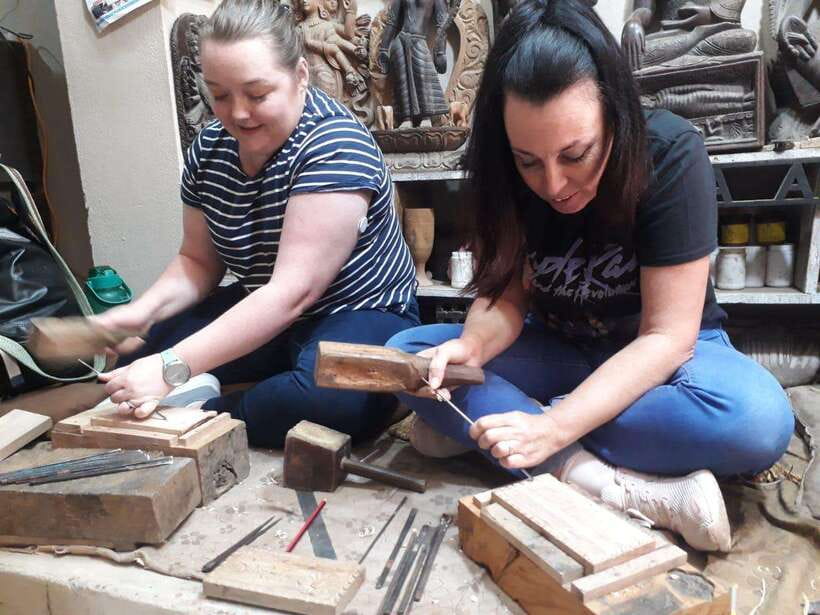
Small tools, lasting souvenirs. This three-hour class in Thamel gives you a hands-on way to meet Nepalese craft traditions, rather than simply looking at carved doors and temple windows. I like the small group size, limited to four people, and I like that your finished wooden piece goes home with you. The main consideration is that the historical explanation may be lighter than the practical instruction.
The workshop costs $42 per person, including tools, materials, instruction, taxes, and your finished artwork. That is fair value if you want a personal activity, especially since the class can become one-on-one during quieter periods. Bring comfortable clothes, and expect to spend most of the three hours seated and working carefully with wood.
In This Review
- Key points before you book
- Why wood carving matters in Kathmandu
- Entering a small artisan workshop in Thamel
- The opening lesson: wood, tools, and patterns
- From outline to first cut
- Detailing the design and finishing your piece
- Learning with Hera and his family
- What $42 includes, and what it does not
- Who should take this class
- Practical details that affect your day
- The main strengths and the one real weakness
- Should you book the Kathmandu wood carving workshop?
- FAQ
- How long does the Kathmandu wood carving workshop last?
- How much does the wood carving class cost?
- Where does the workshop take place?
- Is the class suitable for beginners?
- What techniques will I learn?
- Are tools and materials included?
- Can I take my carving home?
- Is the class taught in English?
- What is the cancellation policy?
Key points before you book
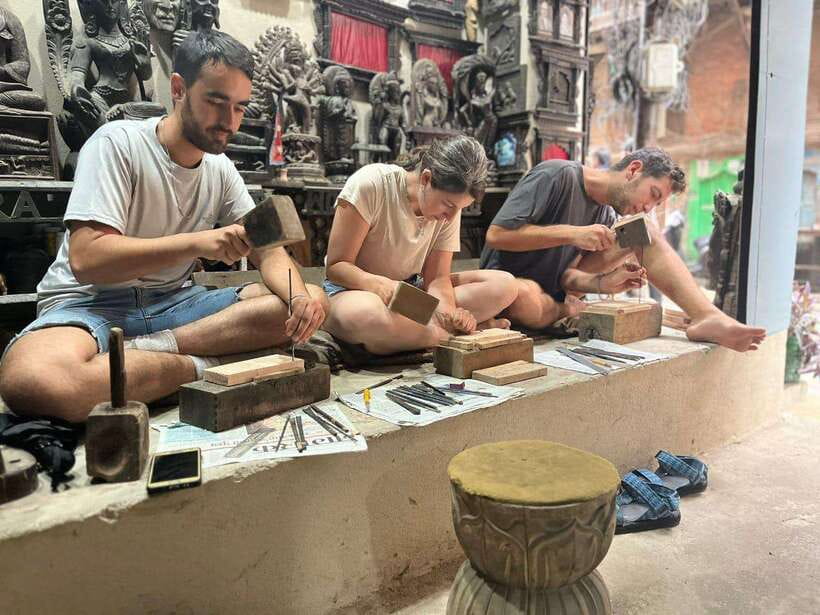
- A four-person maximum: The small group allows the artisan to watch your technique and offer corrections.
- A real handmade souvenir: You carve a wooden block yourself instead of buying a finished object in a shop.
- Traditional motifs explained: Lotus flowers, mandalas, mythical creatures, and religious symbols help connect the craft to Nepalese culture.
- Suitable for beginners: The class starts with basic tools and techniques, so previous carving experience is not required.
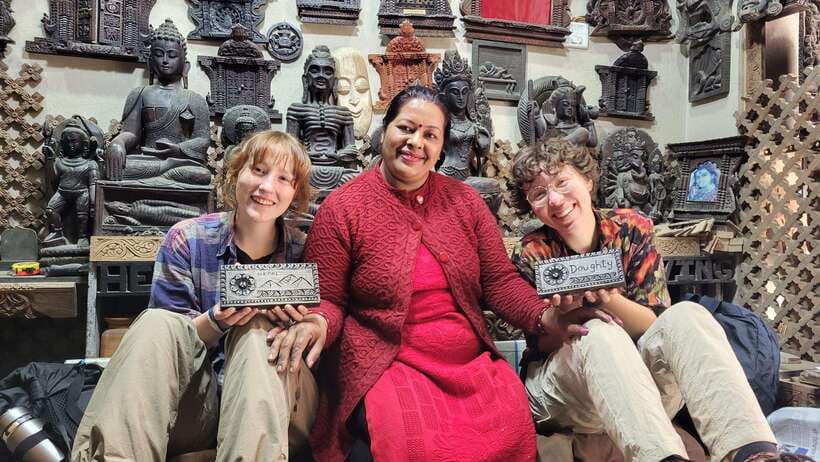
- A friendly teaching style: Hera and his wife have been praised for their warmth, patience, humor, and encouragement.
- A useful three-hour pace: You have enough time to learn outlining, chiseling, and detailing without turning the class into a full-day commitment.
Why wood carving matters in Kathmandu
Kathmandu Valley is filled with carved wood. Look closely at old temples, palace courtyards, windows, and doorways, and you will see flowers, deities, birds, mythical creatures, and geometric patterns worked into the timber.
Nepalese wood carving reaches back to the Licchavi period, from the fourth to the ninth century. The craft grew during the Malla dynasty, from the twelfth to the eighteenth century, when artisans decorated temples and palaces with increasingly detailed designs.
The Newar community of the Kathmandu Valley has preserved and developed this work across generations. Famous examples include the Kasthamandap, whose name means House of Wood, Bhaktapur’s 55-Window Palace, and the Peacock Window.
That background gives the class more weight than a basic craft lesson. When you carve a lotus or a symbolic pattern, you are not just making a pretty shape. You are working with forms that have religious and cultural meaning in Hindu and Buddhist art.
The class will not turn you into a master carver in three hours. It can, however, help you look at Nepal’s architecture with sharper eyes. After learning how a line is cut, how a recess is formed, and how small details are added, carved buildings become easier to read.
More Workshops:
- Half day cooking class in Thamel kathmandu
★ 5.0 · 607 reviews - Kathmandu: Local Women-Led Nepali Cooking & Momo Class
★ 4.9 · 360 reviews - Kathmandu: Local Lead Nepali Cooking & Momo-Making Class
★ 5.0 · 212 reviews
Entering a small artisan workshop in Thamel
The activity takes place in a workshop setting in Thamel, Kathmandu. The exact meeting point is not clearly specified in the provided details, so confirm the location carefully when booking and allow time to find it.
The group is limited to four people, with English instruction. That matters here. Wood carving is a close, practical skill, and you need to see how the chisel is held and how much pressure is used. In a large class, a beginner could spend too much time waiting for help. Here, the artisan has a better chance of catching small mistakes early.
The setting is described as serene, which fits the nature of the activity. This is not a loud sightseeing stop or a quick demonstration. You sit down with a piece of wood, listen, try the method, and adjust your hand as you go.
A quiet workshop also gives you a break from the busy streets around Thamel. You are still in central Kathmandu, but the pace changes once the tools come out.
The opening lesson: wood, tools, and patterns
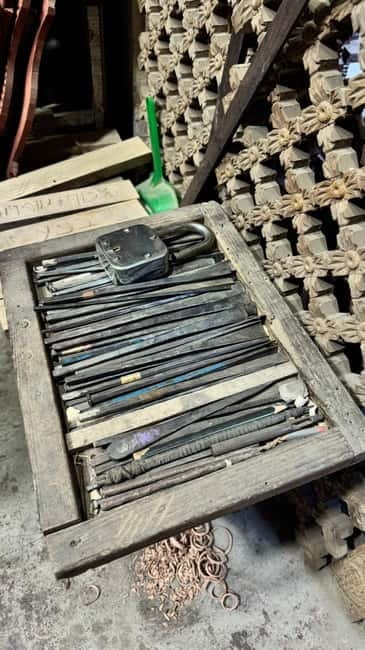
The session begins with an introduction to the materials and equipment. You learn about traditional chisels, hammers, and the types of wood commonly used in Nepalese carving, including sal and teak.
This first stage is useful because the tools can look simple while demanding care. A chisel is not a pencil. The angle, pressure, and direction of each cut affect the final surface. You will likely spend some time learning how the tool behaves before worrying about artistic detail.
The artisan also introduces common Nepalese designs. Lotus flowers and mandalas are important motifs, while mythical creatures and religious figures appear often in temple and architectural carving.
This is where the workshop can vary in emphasis. The practical teaching is a clear strength, but one participant felt the class could have offered more historical context. If the cultural story matters as much to you as the craft itself, ask questions as the patterns are explained. The instructor may provide more detail when you show interest.
I would not book this solely as a history lecture. Book it as a practical craft class with cultural background woven into the lesson.
From outline to first cut
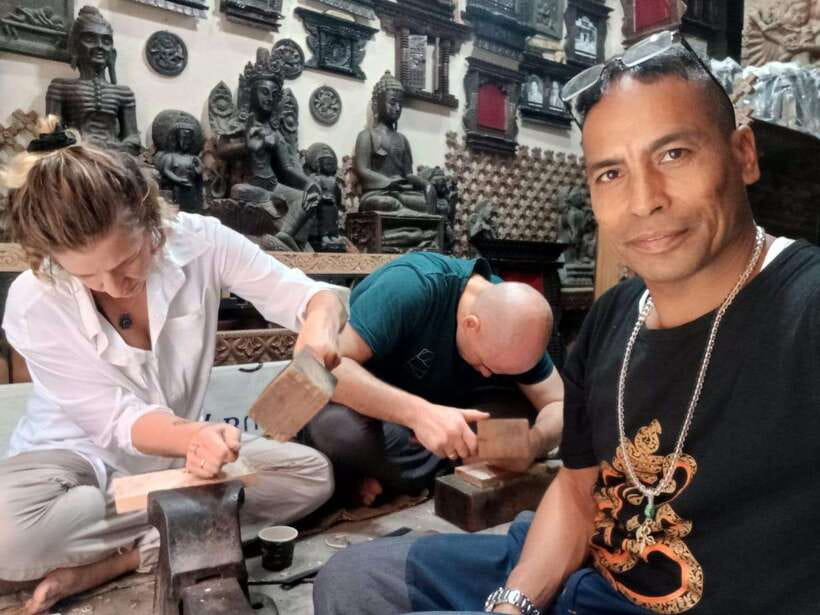
Once you understand the basic tools and patterns, you begin work on a pre-cut wooden block. The design may become a decorative panel, a small figurine, or a symbolic motif.
The first task is usually outlining. This gives your design its boundaries and helps prevent you from removing too much wood too soon. For a beginner, this stage is important because it makes the project feel manageable. You are not asked to create an entire temple door. You are building a small design one controlled mark at a time.
Next comes chiseling. You remove wood from selected areas to create shape and depth. The artisan guides your hand and points out corrections along the way. You should expect the instructor to focus on technique rather than simply doing the difficult parts for you.
That is a major benefit of the class. You leave with a piece that carries your own uneven lines and small decisions. It will not look like a museum carving, and that is part of its charm. A shop-bought object may be more polished, but your own block has a story attached to it.
The class is designed for beginners, so you do not need prior experience. Still, patience helps. Wood carving is slow work, and rushing can make the cuts rougher or less controlled.
A few more trips worth weighing up before you book
- Everest Base Camp Trek – 14 Days
★ 5.0 · 1,499 reviews - Private Kathmandu Sightseeing Tour | UNESCO World Heritage sites
★ 5.0 · 756 reviews - Everest Base Camp Helicopter Tour landing at Everest View Hotel
★ 5.0 · 668 reviews - Everest Base Camp Trekking
★ 5.0 · 485 reviews
Detailing the design and finishing your piece
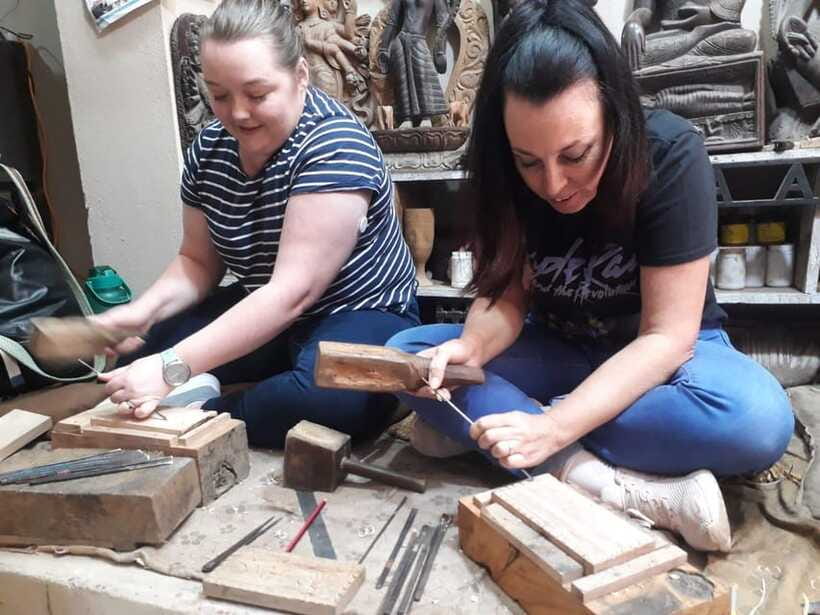
After the outline and larger cuts, you work on details. This is the stage where a simple motif begins to look finished. Small lines, edges, recesses, and surface marks give the design character.
The artisan offers tips and corrections during practice. Good instruction is especially valuable here because beginners may press too hard or focus only on removing wood instead of shaping the overall pattern.
You have plenty of time within the three-hour session to practice the main methods: outlining, chiseling, and detailing. The exact final object can vary, but the stated options include a decorative panel, a small figurine, or a symbolic design.
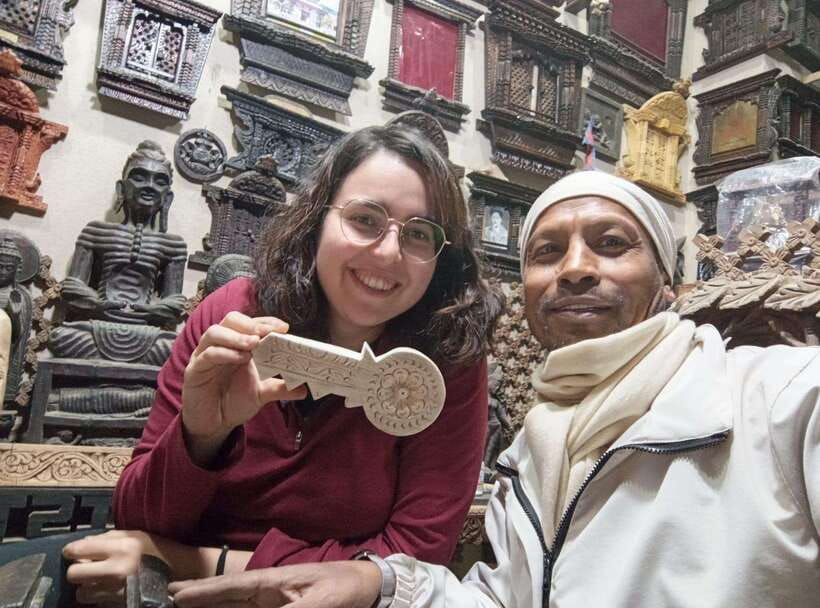
At the end, you take your wooden artwork with you. This makes the class a practical choice if you want a souvenir that is personal rather than mass-produced. It also gives you something connected to Kathmandu’s craft traditions without requiring you to carry a large object through the rest of your trip.
Do not expect a perfect finish if this is your first attempt. The value is in learning the process and making a small object yourself. A few irregularities can make the piece more meaningful.
Learning with Hera and his family
The instructor experience seems to be one of the strongest parts of this class. Hera has been praised for being kind, patient, helpful, and encouraging. His wife has also been described as warm, funny, and welcoming.
That tone matters in a beginner workshop. You may feel awkward during the first few cuts, especially if your hand does not follow the design as neatly as expected. A patient teacher keeps the class relaxed and lets you improve without making the mistakes feel serious.
One family who attended with a ten-year-old son found the class suitable for children as well as adults. The child’s age is a useful guide, but the activity still involves sharp tools, so an adult should stay attentive and follow the instructor’s directions.
During an off-season booking, one participant received a one-on-one class. That can happen when demand is low, but it is not guaranteed. The advertised format is a small group of up to four people. If you happen to have the artisan’s full attention, you may receive more direct help with your design and technique.
The teaching language is English. If you want to ask about the meaning of a particular motif, do so during the class. The lesson is more rewarding when you connect the design to the culture instead of treating it as a purely decorative exercise.
What $42 includes, and what it does not
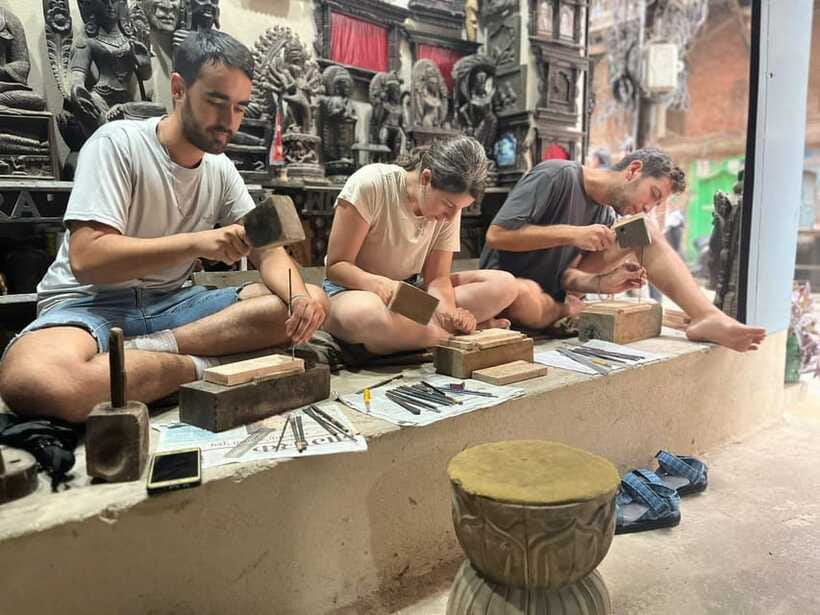
At $42 per person, this is not the cheapest creative activity you could find in Kathmandu. The price includes the artisan’s instruction, all required tools and materials, your wooden piece, and government taxes and VAT.
That package makes the cost easier to judge. You are not paying only for a demonstration. You receive a three-hour lesson, use the equipment, practice several techniques, and leave with something you made.
The small group also improves the value. A private class would normally cost more, while a large class could offer less personal help. With a maximum of four participants, the format sits in a useful middle ground.
The value is strongest for someone who wants an activity with a clear result. If you only want to watch an artisan work, the price may feel high. If you want to learn a basic skill and produce a personal souvenir, it is more reasonable.
The class also fits neatly into a Kathmandu itinerary. Three hours is long enough to feel substantial but short enough to pair with other plans in Thamel or nearby parts of the city.
Who should take this class
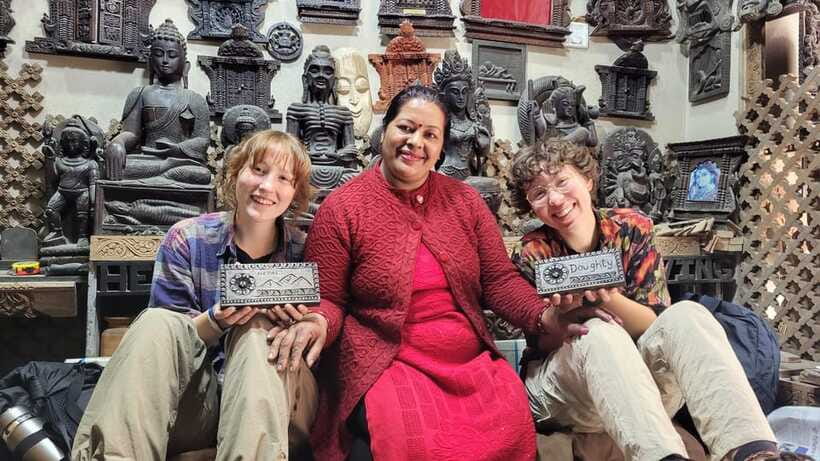
I would recommend the workshop to several kinds of visitors:
- First-time carvers: The lesson begins with tools and basic methods, so you do not need previous training.
- Art and design fans: You get a close look at line, depth, pattern, and surface detail.
- Families with older children: A ten-year-old has successfully taken part, though adults should pay attention around the tools.
- Souvenir hunters: You create a keepsake instead of choosing one from a shelf.
- Repeat visitors to Kathmandu: The class gives you a different way to connect with the city’s architecture and Newar craft.
- People who prefer small groups: Four participants is the maximum, and quieter dates may bring more individual attention.
It may be less suitable if you dislike seated handwork, want a fast activity, or expect an in-depth lecture on Nepalese art history. The class offers cultural context, but the main focus is making and practicing.
Practical details that affect your day
The duration is three hours, and starting times depend on availability. Check the schedule before you plan other activities around it.
Wear comfortable clothes. Wood carving involves close work and repeated hand movements, so loose, practical clothing is a better choice than anything restrictive or delicate.
Smoking is not allowed. The activity includes the necessary tools and materials, so you do not need to bring carving equipment.
Free cancellation is available up to 24 hours before the start time for a full refund. You can also reserve the activity and pay later, which helps if your Kathmandu plans are still shifting.
The meeting point needs extra attention. The information provided only says to meet at the designated meeting point, without giving a clear street address. Confirm the exact location and any directions before the day of the class.
The main strengths and the one real weakness
The strongest feature is the personal instruction. Hera’s kind and encouraging approach, along with the four-person limit, makes the class feel accessible to beginners.
The second strength is the finished object. You are not simply told about Nepalese craftsmanship. You use the tools and carry away a small piece shaped by your own hands.
The class also earns points for its family-friendly approach. A ten-year-old was able to take part, and the patient teaching style can help children stay engaged.
The main weakness is the uneven amount of historical explanation. One participant wanted more discussion of the craft’s history and context. The class does cover cultural meaning, tools, and motifs, but it appears to give more time to carving than to a detailed art-history lesson.
That is not a dealbreaker for me, but it affects how you should set your expectations. Think of the history as a helpful frame around the practical work, not the central event.
Should you book the Kathmandu wood carving workshop?
Book it if you want a quiet, hands-on activity with a local artisan and a souvenir you actually made. The $42 price is reasonable for three hours of instruction, materials, a small group, and a finished wooden piece.
I would especially suggest it for families, beginners, creative people, and anyone who wants to see Nepalese culture through its everyday craft traditions. Ask questions about the Newar community, religious motifs, and historic buildings if you want more cultural detail.
Skip it if you want a major architectural tour, a long academic talk, or a polished professional carving at the end. Your final piece will be beginner work, but it will be yours. That is the point.
FAQ
How long does the Kathmandu wood carving workshop last?
The workshop lasts three hours. Starting times depend on availability.
How much does the wood carving class cost?
The price is $42 per person.
Where does the workshop take place?
The class takes place in Thamel, Kathmandu, in the Bagmati Zone. The exact meeting point should be confirmed before the activity because a full address is not provided in the available details.
Is the class suitable for beginners?
Yes. The workshop is designed for all skill levels and introduces basic tools and methods before you begin carving.
What techniques will I learn?
You will practice outlining, chiseling, and detailing on a pre-cut wooden block.
Are tools and materials included?
Yes. The necessary tools and materials are included in the price.
Can I take my carving home?
Yes. You create a wooden artwork during the class and take it home as a souvenir.
Is the class taught in English?
Yes. English is the listed instruction language.
What is the cancellation policy?
You can cancel up to 24 hours in advance for a full refund. The activity also allows you to reserve now and pay later.
Just added around Kathmandu
- Private Shopping Tour in Kathmandu★ 5.0 · 3 reviews
- Nagarkot Sunrise With 7 UNESCO World Heritage Private Tour★ 5.0 · 3 reviews
- Kathmandu: Nightlife and Pub Crawl Tour★ 5.0 · 3 reviews
- Mount Everest Scenic Flight 50 Minutes★ 5.0 · 3 reviews
- Momo Cooking Class -The Art Of Making MoMo with Home Chef★ 5.0 · 3 reviews
- Kathmandu: Nagarkot, Bhaktapur, Doleswor & Sanga Statue Tour★ 5.0 · 3 reviews
- Makalu Base Camp Trek★ 5.0 · 3 reviews
- Everest Experience Trek 6 Day Hiking Adventure★ 5.0 · 3 reviews
Workshops, compared.


Knife (Khukuri) Making Workshop- Forge of the Gurkhas
Read our review →

Nepalese Momos or Dal Bhat Cooking Class (Cook with Delight)
Read our review →
The best Private Nepali Cooking Class in Kathmandu
Read our review →
Nepalese Kitchen in Pokhara: Momos or Dal Bhat Cooking Class
Read our review →Browse the lists this tour appears in